There’s an old theatre joke. “The electric chair is too good for a monster like that. They should send him out of town with a new musical”.
The UK equivalent of touring a nascent production in Albany and Ithaca in the hope of a Broadway transfer, is to to play one of London’s fringe venues. Few come with the pedigree of The King’s Head, now fully established in its new, only marginally less cramped, basement accommodation off Upper Street. Can Martin Storrow’s very personal, American developed, six-years-in-the-making musical find a crock of gold at the end of its rainbow at its world premiere?
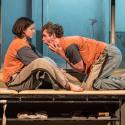
We open on a mother, Celia, hiding her cancer diagnosis from her tweenager son, Sam, who can sense there’s something wrong. We also see him ten years later, now a student, the remission no longer holding back that cruellest of diseases. This time, there’s no shielding Sam and the grief soon consumes him.
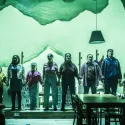
The stricken Celia did tell a story of the mythical island of Pangea to her confused and frightened young son, of the journey to get there, of its fairytale-like mysteries, a spiritual nirvana that offers salvation from the pain he is suffering. The young man now tries to reconstruct Pangea and the journey to it, partly as a quest and partly as the jigsaw of his life with its missing piece, partly as a safe space in his mind for his thoughts. If that sounds a bit convoluted, it’s because it is.
There are musicals founded on thinner premises than that, but all the issues that can arise with this most difficult of theatrical challenges, the truth that underpins that aforementioned joke, floods the stage and the laudable 90 minutes run time begins to feel a lot longer.
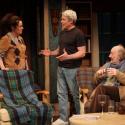
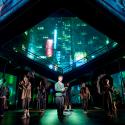
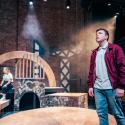
So many decisions make little sense. Alfie Blackwell is still a student and makes his professional debut as Sam – perhaps unsurprisingly, the task of carrying so much emotional baggage in the lead role proves too much at this stage of his career. He can emote with tears, smile at the craziness of the world in which he finds himself, but the crucial current that needs to flow towards the other characters and then on out into the audience, never sparks. 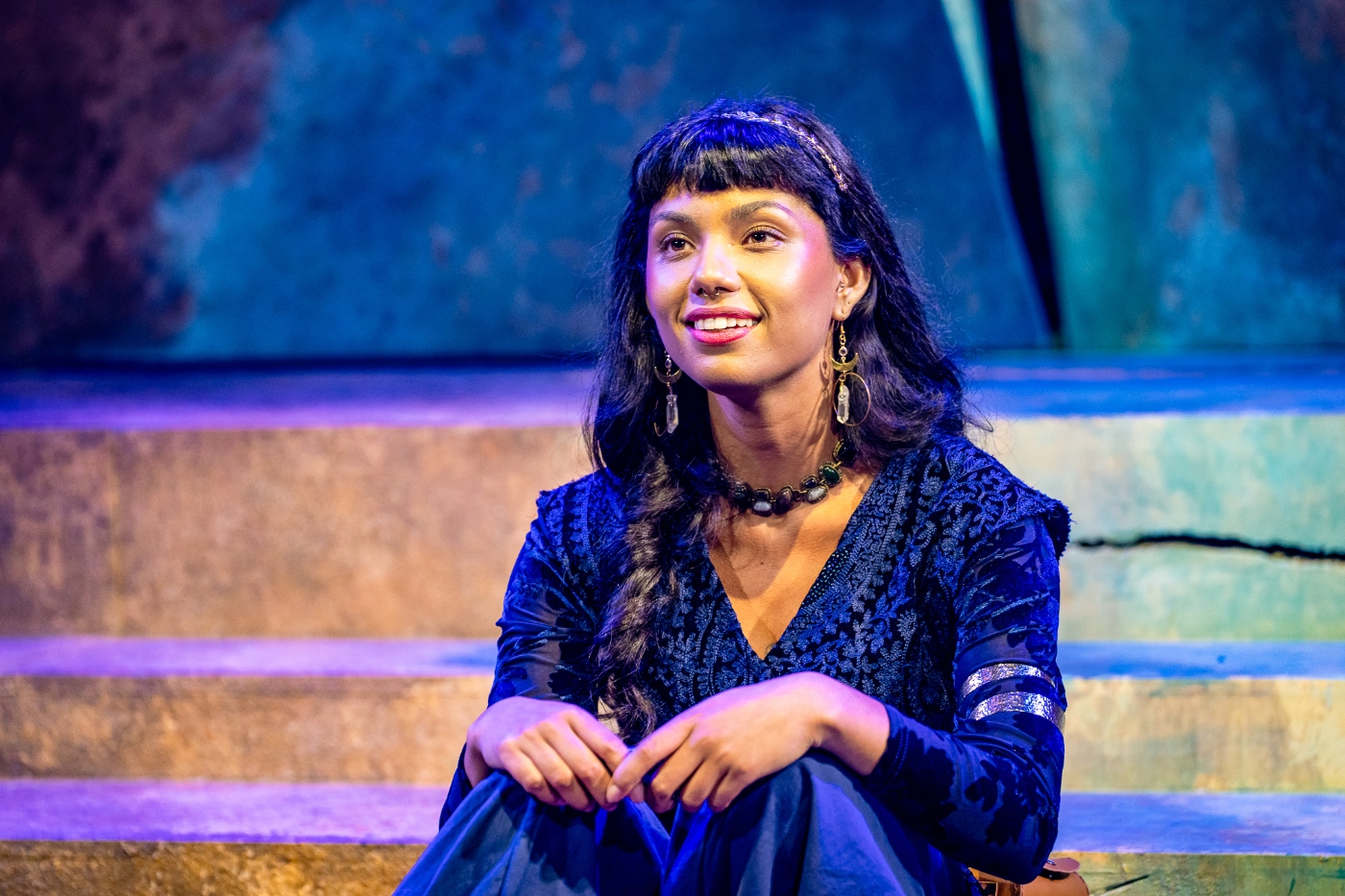 It’s not his fault, but his inexperience is thrown into sharp relief by Emily Tang (pictured above) as Sam’s girlfriend, Amy, and later doubling as the ferryman’s daughter, Maya. She’s much the best singer in the cast but gets very little stage time, mostly moving stuff round Carly Brownbridge’s fussy set in the blackouts. Both the decent Amy and sexy Maya are rejected, rather cruelly, by Sam, which diminishes both the production and our sympathy for the grieving boy.
Dan Burton plays two versions of a father – the stiff upper-lipped Arthur and the unreliable ferryman. The first is closed down by his own emotional trauma, the second lives in a kind of dream world, not as malevolent as Willie Wonka when he takes the kids on his boat, but just as charismatically untrustworthy. Sophia Ragavelas, after the slow opening scenes on the chemo ward, appears mostly as a ghostly presence upstage to offer advice and morale-boosting homilies (there are a lot of those). Her character is almost entirely defined by her illness.
Mark Curry fares better as "a, not the, prophet Elijah" – a much needed comic relief – and, though he is not the most accomplished singer, he does get the two best songs in his lament for the fact that his seeming immortality ensures that all the people he’s ever known are dead (“Everyone I Love”) and a patter song with Sam (“The Curriculum”). The other songs, in a folky / poppy style are somewhat tricky to distinguish, melodies, tone and, especially, emotional heft too homogeneous to drive the narrative forward and to illustrate the protagonist’s emotional journey. It doesn’t help that Storrow’s lyrics are pedestrian and descriptive, no matter how hard you search for a cunning rhyme or dazzling metaphor.
The crucial dramatic element of jeopardy is also absent, three coins allowing Sam to Get Out Of Jail Free, teleporting to his next staging post as and when required. Late in his journey, he needs to find a key at the bottom of a river, but it proves supereasy, barely an inconvenience, as 20 seconds of lighting effects later, he’s on dry land with the key in his hand. There’s time for a sermon about hope and a skin-crawling reading of a gravestone poem and we’re off up the stairs and breathing less stuffy air.
What stops the show being a complete washout is the same thing that sinks it. Director, Richard Israel, and Storrow pour so much of their heart and soul into something that means so much to them that they neglect the crucial fact that it also has to mean something to us. Like more than one production I’ve seen this year, the experience on the other side of the fourth wall is akin to watching someone go through a difficult, but ultimately successful, programme of psychotherapy.
There are people, especially (I suspect) younger than me, who have grown up with Adele’s songs on their playlists, to whom this subgenre of oversharing truthtelling appeals. Pangea, and its new King finally at ease, may be a destination for them, but, alas, not for me.