

There be dragons aplenty, angels, demons and ghastly creatures both fleshy and feathered in the Globe Theatre’s inaugural production of Doctor Faustus. Christopher Marlowe’s take on the familiar Faust legend, bold in its religious content, was a controversial hit of its day, but the play’s almost medieval apposition of high thinking and knockabout farce by no means guarantees it success in the contemporary theatre. If Matthew Dunster and his team of actors fail with any of their audience it won’t be for want of trying. Throwing themselves at the material with characteristic Globe energy, theirs is a Faustus of pageantry and spectacle.
The Globe musicians set the tone for the theatre’s every play, not just in their music but also their appearance. Sporting splendid bird headdresses, complete with protuberant beaks, and gaudily patterned jackets, they struck an exotic note borne out by the action, that is at its best in the visual set pieces.
The Seven Deadly Sins, vivid in red and black, emerge through at trapdoor at the crack of thuggish Beelzebub’s whip. Acrobatic Covetousness (the aptly named Michael Camp) wheels and darts around, while Jade Williams’s Sloth reclines on her cushions. The broad comedy of Gluttony (Jonathan Cullen), with his requisite fart gags, while entirely in keeping with the spirit of the play, does however pall somewhat. The Papal banquet, however, with its visual humour, comes off neatly thanks to Dunster’s swift pacing and the deft staging.
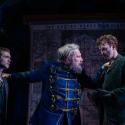
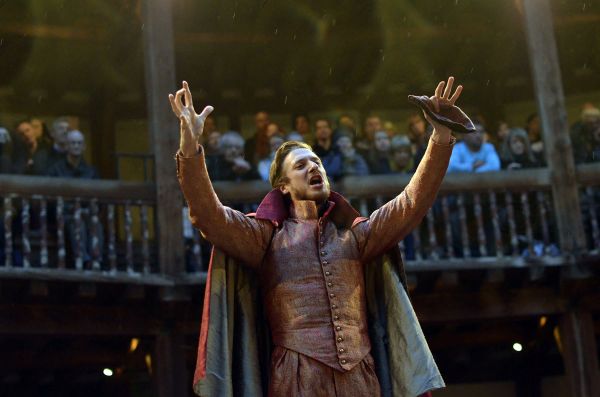 The props department have outdone themselves with the array of puppets that conjure Mephistopheles’s (Arthur Darvill, pictured right) dark spirits, even in the light of a sunny evening. The colourful innocence of Banio and Belcher (hand-puppets emerging from Robin’s trouser-seat) soon gives way to the magnificently skeletal hell-dragons on which Mephistopheles and Faustus ride, and the power of the final tableau – Lucifer himself, still in the white armour of heaven, wings spread wide to welcome the damned Faust – owes much to the splendour of his appearance.
Excelling in the comic encounters of Robin (Pearce Quigley) and Dick (Richard Clews), the production owes much to the whimsical West Country prattlings of Quigley. Skipping on as fey as any Shakespearean sprite, he focused the restless groundlings with a swift piss on a pillar, drawing the laughter that helped dilute some of the dense dialogue of the opening scenes. Although not so sparse as the seven-strong cast of the Young Vic’s 2002 production, there is a certain amount of doubling required of the actors, with Felix Scott proving particularly accomplished. Appearing primarily as Faustus’s narrator and manservant Wagner, he also enjoyed a deliciously lecherous cameo as Emperor Charles.
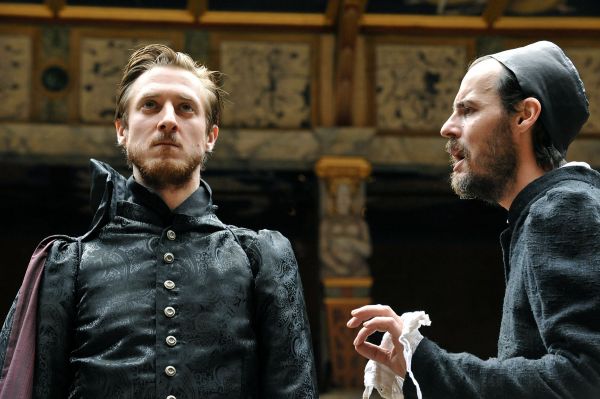 Yet try though the production may, among the pageantry and comedy there was something lacking – the psychological truth and complexity that refuses to be so smoothly unknotted. Dunster’s previous Globe outing with Shakespeare’s Troilus and Cressida made psychological sense of an arguably even more challenging play, so it is odd to find it lacking here. Perhaps it is the attempt to make Faustus, dense of reference and unfashionable of subject matter, fit into the family-friendly environs of the Globe that compromises the intensity of the central partnership of Mephistopheles and Faustus.
Smooth and urbane, Arthur Darvill’s devil (pictured above) never quite convinces us of his depths. An angel who fell along with Lucifer, confronted with the face of God and then exiled perpetually, his is not a straightforward evil. Yet here we see little of this tension, and his relaxed, chummy encounters with Paul Hilton’s Faustus allows us too easily to forget the conclusion to which their jolliest of japes must tend. Hilton likewise, though charismatic and eminently watchable, doesn’t really seem willing to commit to the contradictions of a scholar who understands that “the reward of sin is death”, yet pursues the path of sin regardless. The prologue to Faustus’s initial encounter with Mephistopheles is so brief that there is great pressure on the actor to set out his shop clearly; among the rustlings and fidgetings of the opening-night audience it just wasn’t possible.
A dynamic effort, this Doctor Faustus makes its own deal with the devil when it conjures an appealing, entertaining play from a recalcitrant text. If in the process it sacrifices some of its dark complexity, then perhaps that isn’t such a poor bargain given the context and the demands of Globe audiences.






Add comment