It was Lenin who realised early in the Russian Revolution that “of all the arts, film is for us the most important” and Hitler and Goebbels perceived the immense propaganda potential of the Olympics through the medium of film. The 1936 Olympic Games took place in Berlin a few months after Hitler’s armies occupied the Rhineland. Hitler spared no expense in making it the best organised and most efficiently equipped in the history of the Olympics.
After Triumph of the Will (1935), the documentary of the 1934 Nuremberg Rally, the director Leni Riefenstahl became established as Germany’s foremost “ideological film propagandist”. She was commissioned to film the Games “as a song of praise to the ideals of National Socialism”. The result was the four-hour documentary Olympia! (1938) in two parts.
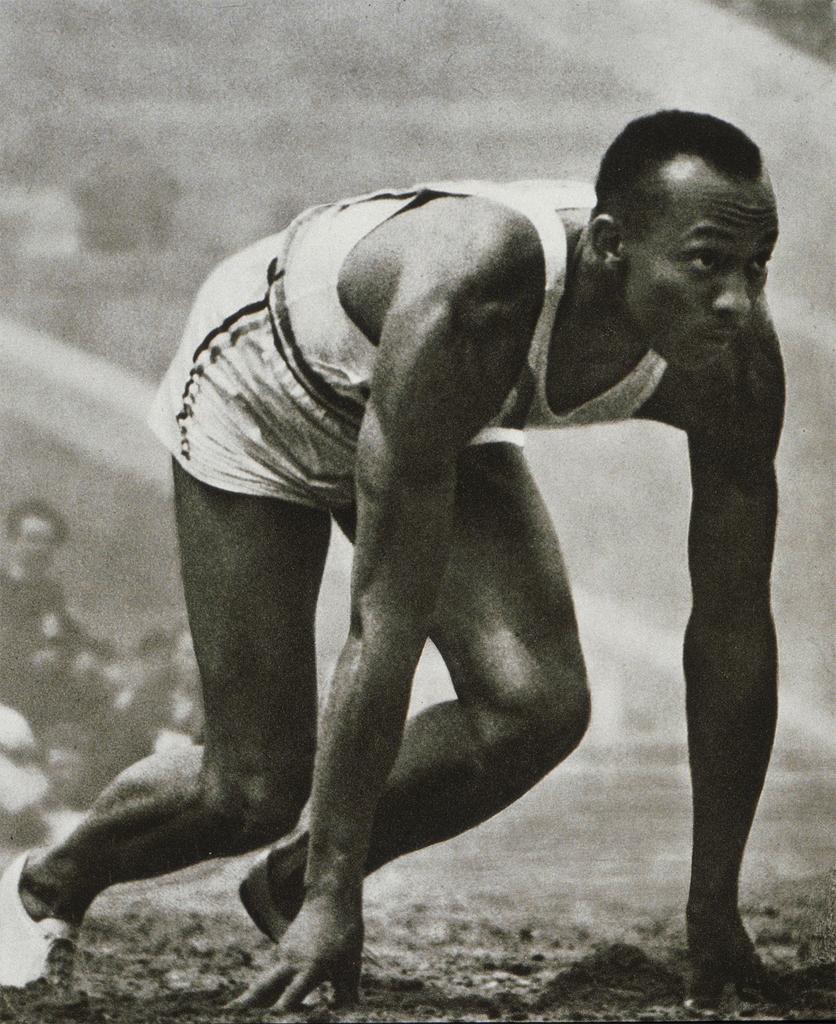 As there would be no retakes for the great moments, the filming was meticulously organised beforehand. Riefenstahl had over 30 cameramen, planes and airships at her disposal and spent two years in the cutting room. A grandiloquent prologue links the ideals of beauty in Greek antiquity with those of the Third Reich. In a “Summertime for Hitler” parade, the nations file past the Führer. Despite the insistence on Aryan splendour, Riefenstahl could not avoid showing the victories of Jesse Owens (pictured right), the “Tan Streak” from Ohio State. Legend has it that Hitler snubbed Owens for having shown up the Nazi philosophy of Aryan supremacy. When Owens returned home to the America of the Thirties he said, “I wasn’t invited to shake hands with Hitler. But I wasn’t invited to the White House to shake hands with the President either.”
A German girl drops a baton in the last lap of the relay and Hitler, turning to Goebbels, says something. Is he perhaps suggesting that her lack of concentration could be rectified in a concentration camp? Part Two opens in the pastoral setting of the Olympic Village where blond young men are swimming and taking a sauna together. They rejoice in their health and strength as future heroes of the coming war. The French title of the film was Les dieux du stade (The Gods of the Stadium). “I teach you superman. Man is something that shall be surpassed.” Thus spake Nietzsche and 50 years later his prophecy was fulfilled on screen. The ideals of the Olympic movement were transferred and corrupted into the ideals of the Nazi movement. It is easy to be seduced by the exceptional technique and beauty of many of the images of the film into ignoring the sinister significance of the swastikas on the arms of the officials or to forget the persecution of the Jews that was taking place outside the walls of the stadium.
The diving sequence in Olympia!