

It’s not every evening one is invited to take A Dish of Tea with Dr Johnson, and the 90 minutes spent in the company of England’s greatest wit and original lexicographer pass in a whirl of aphorisms and expostulations, with a fair smattering of historical grandees thrown in for good measure. That this production is a two-hander is no impediment to appearances from Joshua Reynolds, Flora MacDonald, the Prince Regent and Oliver Goldsmith (“He goes on without knowing how he is to get off”), not forgetting Johnson’s beloved cat Hodge. It’s the kind of densely researched, lightly delivered evening we’ve come to expect from Out of Joint, but whose latest West End home does it few favours.
Following a brief stint in the garret of Johnson’s own house in Gough Square and a successful run at Edinburgh’s Traverse Theatre, A Dish of Tea with Dr Johnson is currently to be found in London’s Arts Theatre. Lacking the obvious intimacy of the Traverse or the uniquely site-specific appeal of Gough Street, the show’s conversational tone is strained a little beyond comfort. With movement restricted to the odd gouty circumnavigation of the set’s single table, this is a play that thrives on the immediacy and interactive energy of its participants. We need to see the sweat that famously covers Johnson’s brow when he eats, to observe his blood vessels fill as he passionately denounces actor David Garrick.
Based largely on 18th-century literary groupie James Boswell’s The Life of Samuel Johnson and his Journal of a Tour to the Hebrides, the play has been ingeniously adapted by Out of Joint’s Max Stafford-Clark together with Ian Redford (who plays Johnson) and Russell Barr, the original Boswell. Barr’s illness has forced him to pull out of the show since Edinburgh however, and Luke Griffen has since stepped adroitly into Barr’s many roles (including on this occasion that of Hester Thrale, played on some other nights by Trudie Styler).
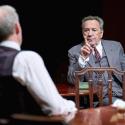
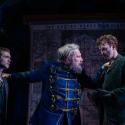
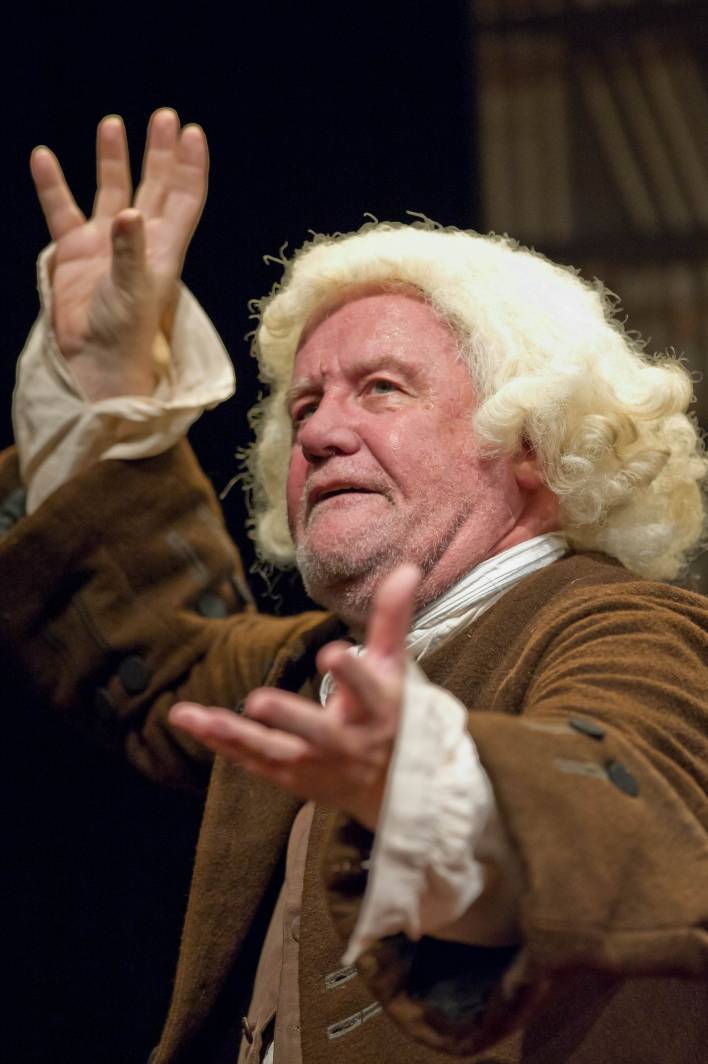 The play lives in the conversational sparring between Johnson and Boswell, the tempestuous affections of which relationship reveals the sum of each man. Redford’s Johnson (pictured right) is all burred Staffordshire vowels and bulk, his lived-in face lively with scrofula scars like a rumpled and stained sofa cushion. Shifting from affable wit – “Ah, so you’ve come. You are expected. I won’t enquire why you’ve no better business to be about” – to the tormented urgency of one whose bouts of melancholy and pain lead him to “depend on company”, his is a virtuoso performance whose authenticity is disconcertingly vivid.
Griffen shines as the smoothly deviant Boswell, casually recounting his encounters with whores on Westminster Bridge and his obsession with the corpses of hanged criminals. Impassive and gently amused, he offers the discreet orchestral accompaniment to Johnson’s cadenzas of wit. Less settled yet are his cameos. While the haughty Prince Regent, with his conversational tic “What-what?”, and smooth poseur Sir Joshua Reynolds hit their mark, the softly Scottish Lady Flora MacDonald, all downcast eyes and demurely clasped hands, still errs slightly to the camp, and Mrs Williams (Johnson’s ferocious blind housekeeper) lacks something of the peevishness the text leads us to expect.
“I am known as Dictionary Johnson, failed dramatist, successful essayist, biographer, critic, Latinist, epigrammist… a master conversationalist, clubman, shameless tea-drinker, and enemy of ‘cant’ in all its forms.” Johnson was a man of many parts, and to fit so many into so short and fluid a drama is a triumph of dramatic construction. The informal energy of Redford and Griffen carries a script laden with history, anecdote and social observation, filling out the pinched and gruff image we have of the great Doctor from his oft-quoted dictionary entries.
It was Johnson himself who famously lambasted a play as “worth seeing, but not worth going to see”. It’s an aphorism that certainly doesn’t apply here.





Add comment