

“I have nothing to say, and I am saying it. And that is poetry.” Originally delivered by John Cage at an artists’ club in New York in 1949, the composer’s Lecture On Nothing went on to become a core text within his 1961 collage-meditation of essays, Silence. Restoring it to spoken form (and thus reanimating the beautiful tensions of this un-speech, this voiced absence), Robert Wilson’s staging finds a whole new echo-chamber of resonances for a classic text muted by neglect in mainstream culture.
Wilson’s affinity for the American minimalism of this period is most famously explored in his quasi-operatic collaboration with Philip Glass, Einstein on the Beach, and it’s only a very small ritual stroll from this world of white-faced human automata and organic visual patterning to Cage’s verbal tone-poem of repetitions and self-reflexive abstraction. But while Einstein’s dominant mood is of disturbance and threat, Cage’s linguistic fantasy is altogether more playful, more benign.
The concept of nothingness is fragmented, fractured and reconfigured
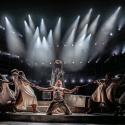
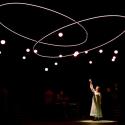
Delivered by Wilson himself, the text’s five sections construct an architecturally elaborate hall of mirrors, reflecting the lecture’s own processes back on itself and muddling thoughts on form and material with meticulously casual effect. The concept of nothingness (and the implied relationship between nothing, Nothing, and no-thing) is fragmented, fractured and reconfigured, subjected to an associative sequence of tests and assaults. Wilson’s set defers the absolute nullity of Cage’s silence one stage further with the clamour of its visuals - a floor strewn with scrunched-up newspapers crying their headlines, banners screaming theirs.
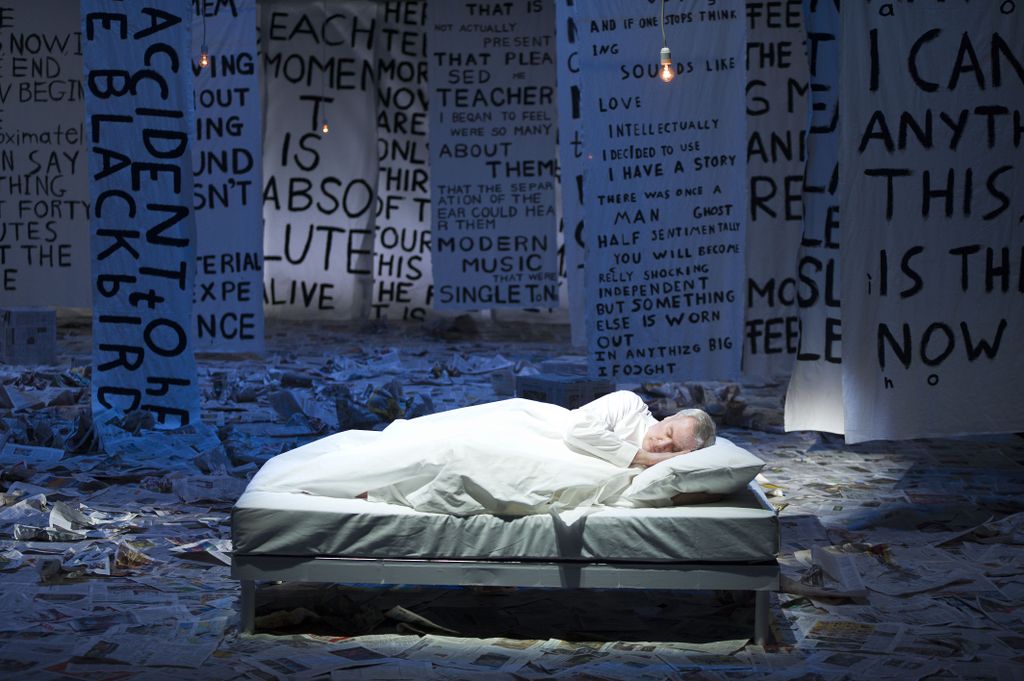 It could all be insufferably smug were it not for Cage’s own quiet wit and Wilson’s precisely pitched delivery. The repetitions of section four see verbal signs and signifiers part company, with words finding new freedom in their circling formations. Physicality (occasionally deployed for an easy laugh - welcome, on balance - in this potentially tense setup) brings tensions and reassurances to the text, though there’s no attempt to dramatise the work as such.
While the notion of an auditorium full of people leaving their homes and offices on a freezing Monday evening to contemplate nothing in the Barbican is antithetical to Cage’s fluid concept of art and culture, there’s an elegance to the irony that Wilson (pictured above) is eager to enjoy and exploit. There is poetry here of a more profound kind than the musical wisecrack of 4'33" and Cage’s writing more than justifies the weight and significance that Wilson’s performance ascribes to it.
In a neat gesture, Wilson’s own narration gives way at the core of the un-argument to silence, allowing Cage’s own voice to take over in recorded form. This staging of the Lecture On Nothing is a duet of gorgeous fluency between two natural partners, each instinctively in sympathy with the other. We the audience may have found ourselves “going nowhere”, but the journey has rarely been so scenic or filled with ideas.


Add comment