Unless Peter Jackson and his team decide to mine The Silmarillion for three more J.R.R. Tolkien adaptations, their films of The Lord of the Rings and The Hobbit will, by this time next year, comprise a complete hexalogy – or, at least, two consecutive triptychs. Setting aside for the moment the crass exploitation of the 317-page The Hobbit, which is being stretched thinner than Gollum's hair over eight hours, it would have been hoped that the entire gargantuan undertaking would be yielding a consistent vision that honours the author's conception of an alternative English myth.
This is not proving the case. Now that The Hobbit: The Desolation of Smaug brings audiences to the brink of the final chapter, Bilbo Baggins's journey is looking less like the spiritual antecedent (and the cause) of Frodo's more momentous odyssey than a blueprint for mindless gaming. On one hand, stylistic, tonal, and pictorial fissures have opened up in the series; on the other, the use of recurrent motifs is becoming stale.
A consequence of the blanket application of CGI is the sidelining of that old movie staple, acting
The logic that The Lord of the Rings was an adult tale that would also appeal to young people on the big screen paid off artistically as well as commercially. The logic that The Hobbit is a children's book best suited for the kind of kids' action-adventure cinema that would attract millions of adults hooked on 3D spectacles is also making a mint. As a serious evocation of Middle-earth, however, the second triptych is failing because it is being forced away from Tolkien's bardic sensibility by the calculated imposition of a PlayStation aesthetic.
The most blatant example of the video-game effect in last year's An Unexpected Journey was Bilbo (Martin Freeman) and the dwarves' perilous flight from the orcs on a series of suspended rope-and-board walkways in Moria. It is echoed twice in The Desolation of Smaug: first when Bilbo frees his companions from an elvish prison in the diseased forest of Mirkwood and they career downriver in barrels under orc attack; second when they are pursued by the dragon Smaug (voiced by Benedict Cumberbatch) in the labyrinths of Erebor, their ancestral home under the Lonely Mountain, which they seek to reclaim along with their coveted treasure. This inflated concluding sequence mars a movie that's otherwise more charged and gripping than its predecessor.
 Here and there, Jackson has drenched it in the sublime ominousness he brought to Frodo's quest. If Tolkien had lived to see The Lord of the Rings films, I can't imagine he wouldn't have appreciated the dread first appearances of the mounted Ringwraiths, their attack on Weathertop, the Fellowship's approach to the great pillars at Argonauth on the River Anduin, and the crossing of the Dead Marshes. Similarly, he might have admired the eerie scenes in The Desolation of Smaug that show Gandalf (Ian McKellen) and Radagast (Sylvester McCoy) recceing the Gothic fastness Dol Guldur, or the materialisation there of the Necromancer (the future Sauron) as a black mist briefing his reptilian Orc warlords.
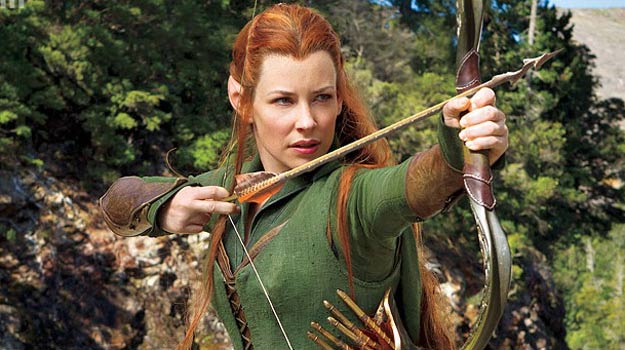
The reheating of ideas from The Lord of the Rings smacks occasionally of writers' weariness. The re-introduction of Legolas (Orlando Bloom), absent from The Hobbit book, and the introduction of the elf maiden Tauriel (the thoroughly modern Evangeline Lilly, pictured above), there to lure the Katniss crowd with some girl power, will annoy purists but they add humor. Asking Glóin (Peter Hambleton) about the identity of the ugly boy pictured on a miniature painting in his wallet, Legolas is told that it's the dwarf's son, Gimli – his pugnacious future comrade in arms. The growing love between the beardless dwarf Kili (Aidan Turner, pleasing) and Tauriel satisfies the same need for a rapprochement between their races, as the short-changed courtship of Eowyn and Faramir united two tribes of men in The Return of the King film. Physical healing plays its part in both romances, though Tauriel's joke about Kili's potentially small member is a Middle-earth first.
 The dynamic between the venal Master of Lake Town (Stephen Fry, pictured left) and his snide civil servant Alfrid (Ryan Gage), another newcomer, meanwhile recalls that of Saruman and Grima Wormtongue. Jackson's shifts in subjectivity make the disorienting of the dwarves when they enter Mirkwood one of the film's most disturbing sequences. It sets up their vulnerability to the spider attack which, though indispensable, seems rushed and lacks the menace of Shelob's stalking, stinging, and cocooning of Frodo in the Cirith Ungol pass.
A further consequence of the blanket application of CGI is the sidelining of that old movie staple, acting. Deprived of dialogue, Freeman and McKellen rely on rote ironic asides and mannered glances. Richard Armitage is unsubtle as Thorin, the blustering dwarf king-in-waiting, as is Lee Pace as Thranduil, the supercilious Elvenking. Luke Evans gives the film's most arresting performance as Bard, the Lake Town waterman, archer, and single father, who emerges as the beleaguered region's working-class hero.
If I were a 10-year-old who had never read The Hobbit or had it read to him, I might dismiss the above objections as joylessly pedantic. As a long-retired member of the Tolkien Society who bought into the dream in the mid-1970s, I resent seeing it desecrated by the opportunists who are cashing in on the multi-platforming of Bilbo's and Frodo's adventures. I don't doubt the integrity of Jackson, his co-writers Fran Walsh and Philippa Boyens, and their visual collaborators in trying to do their best by the books. But – for all the The Hobbit films' felicities, not least the graphic designers' gnarled, creaturely trees and those vertiginous edifices and vaults – there's something rotten in the digital Midde-earth.
Overleaf: watch the trailer to The Hobbit