

Just a few days earlier, the Scottish Chamber Orchestra had been doing a pretty convincing impression of a symphony orchestra in a powerful Vaughan Williams Fifth Symphony under John Storgårds. And here they were, in crisp, nimble Mozart and Beethoven, being a thoroughly convincing period band – well, with valveless horns, at least. They’re nothing if not versatile.
But the real joy of their conductorless concert – and joyful it truly was – was its laying bare of the mechanics of music making itself, and in just about every combination made possible by the absence of a conductor. For that, they were joined by two quite remarkable and, in their own ways, idiosyncratic soloists.
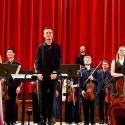
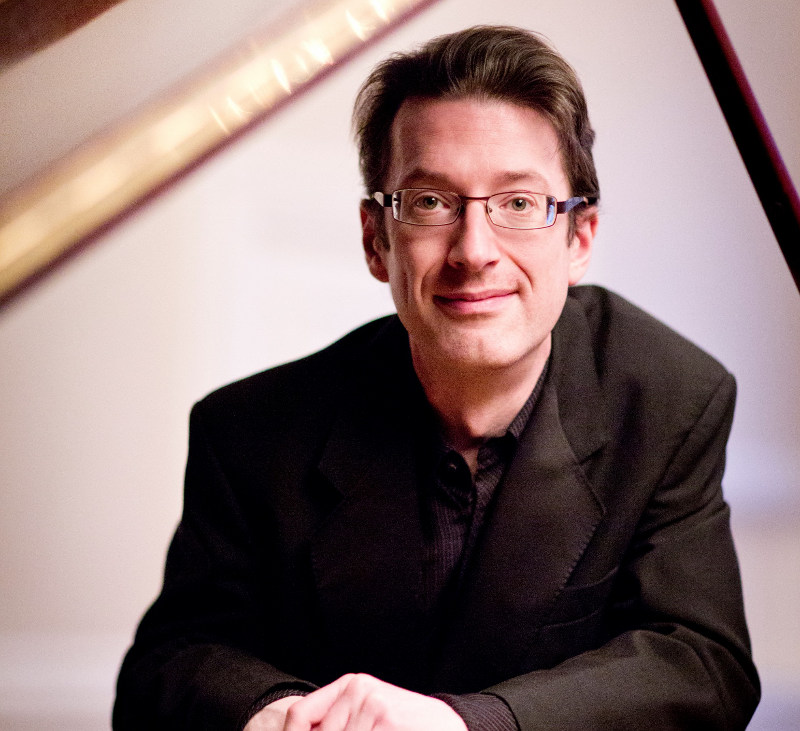 Violinist Alexander Janiczek is an associate artist with the SCO, and clearly has an easy rapport with the players, who responded with unerring conviction to his urgent direction of a seldom-played Symphony in G by CPE Bach, which Janiczek led from the concertmaster’s desk. Brisk, vivid and beautifully characterful, it was over in just a few minutes, but it left a strong impression nonetheless – full of verve, gusto, and anything but polite. If only the SCO players could have looked a little more like they were actually enjoying themselves.
Janiczek returned, this time standing in front of the band as soloist and director, in Mozart’s Second Violin Concerto, gently urging on the orchestral players and presenting the soloist’s role very much as first among equals, differentiating himself more by his bright, sometimes rather piercing tone than anything else. If the third movement rondo seemed to lack a bit of the spontaneity that had made the previous two movements so convincing, it was a thoughtful, compelling account nonetheless – followed by an equally charismatic reading of the Rondo in C, K373.
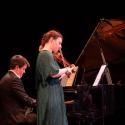
This was chamber music writ largeAfter the interval, another soloist joined the fun – pianist Llŷr Williams (pictured above right), directing Beethoven’s Fourth Piano Concerto from the keyboard, or strictly speaking leaping up and down from the piano stool to lean in towards the woodwind and strings with his concise gestures, before hastily sitting back down to regain his composure. It wasn’t always convincing – it produced a curiously restless second movement, for instance, where Williams’s haloed piano chorales always felt undermined by the knowledge that he was about to jump to his feet for another of the strings’ assertive outbursts. But it was fascinating to behold – especially in his natural partnership with Janiczek, who took over leading the band in some of the piano’s busier passages.
Balance was inevitably something of an issue: Williams’s concert Steinway often felt simply too weighty for the focused brilliance of the orchestral playing, even though he played with clarity and simplicity, rarely thundering, beautifully unshowy, with articulation so precise it bordered on the fussy. And despite a few moments where ensemble between soloist and orchestra went very slightly awry, the unanimity of intention was quite something to behold – a cliché to say so, but this was chamber music writ large. Not a concert of wild, provocative revelations, perhaps, but of assured, perceptive music making, and of many minds uniting with a single intent.





Add comment