

The BBC Proms is perhaps the only music festival in the world that would (or could) have programmed performances of Steve Reich in a Peckham car-park and Brahms by the Berlin Philharmonic within a few hours of each other. The audacity of it is glorious, the breadth exhilarating, and the fact that both sold out intensely heartening.
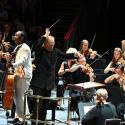
But, as ever with Sir Simon Rattle, it wasn’t quite as straightforward as that. The main substance of the Berlin Philharmonic’s second concert might have been Brahms and Dvořák, but the opener – a work the orchestra have already performed multiple times in Europe – was a UK premiere, one of many new pieces Rattle has commissioned and subsequently championed while in post.
It’s a work of scope packed into small span – as appealing a premiere as we’ve heard all season
An orchestral nocturne, Julian Anderson’s 10-minute Incantesimi (Incantations) is as delicate a play of line and shading as any of Whistler’s portraits of night. Unfolding in a single breath, the music (summoned, seemingly, by a coaxing melody from the cor anglais) conjures a series of ideas or characters that group and regroup in ever-evolving combinations. The strings hum soft and high in their register; flutes chatter and scurry; a woodblock raps out its presence. Fluid shapes and thick orchestral textures give this musical spell its power, sending shudders through brass and wind, and only quieting when instructed once again by the cor anglais. It’s a work of scope packed into small span – as appealing a premiere as we’ve heard all season.
But if the Anderson gave us the Berlin Philharmonic as spinners of an endless melodic tales, the Dvořák that followed was all about rhythm. These eight orchestra miniatures can so easily sound like a sequence of aphorisms – shiny, witty nuggets that dissolve almost immediately in the ear. With Rattle shaping the set, however, we got something much closer to a suite with a guiding emotional arc, finding pause and contemplation as well as helter-skelter thrills.
The plush beauty of sound summoned by this orchestra in full spate never fails to startle, and when this sonic richness is rubbed up against sharp-edged cross-rhythms the effect is giddily exciting. This was music-making both impulsive and crafted – art music with dirty boots. The cellos, placed at the centre of the orchestra flanked by split strings, crooned melodies refined to salon sophistication, while around them brass and percussion brought the sounds of the fair, the festival, the drinking house into the mix. Cymbals clashed with just the right degree of throwaway vulgarity, while the cheeky grace notes in No. 4 were passed around the orchestra like a good joke they’d just heard.

The instant gratification of the Dvořák offered quite a contrast to the mercurial performance of Brahms’s Second Symphony that followed. Catching and cradling the flashes of darkness (the twisted lullaby in the first movement, the two dissenting voices in the Adagio) among so much sunshine, Rattle gave us a symphony at war with itself, constantly torn between two paths, two instincts. The flexibility of tempo, constantly shifting albeit ever so slightly, discouraged resolution or complacency, reminding us that even the most glorious of summer afternoons cannot last.
It was here that the sheer quality of this ensemble came into its own, from the singing oboe melody in the Allegretto, floated over warm pizzicato cellos, or the generous line of the strings through the Adagio, to the sudden and remarkable pianissimo Rattle demanded from the orchestra in the final movement, quieter with each return of the theme until the horns were playing with barely a whisper of breath. To generate such control and then throw it all magnificently away in a sudden fortissimo climax is to force the entire hall to catch its breath. Rattle may have his naysayers, but last night won’t have given them any fodder.





Add comment