Coriolanus is post-tragic. It never horrifies like Macbeth or appals like King Lear, though its self-damaging protagonist is disconcerting enough. Shakespeare had written the signature dark dramas by 1606, including the most magnificent of the four (truly) Roman plays, Antony and Cleopatra. Along with Julius Caesar and Titus Andronicus, all are transferring from springtime premières in Stratford to the Barbican.
The Royal Shakespeare Company has chosen an apt moment to stage these chilly explorations of power and of who wields it over the people. How, the plays ask, do we want to be ruled? Whom do we want making, on our behalf, world-altering decisions? How do we ward off unwanted outside political control? By the end of Angus Jackson’s production, we are in no doubt that Coriolanus has let himself be ruled by temperament, and that his private failures have given both him and his potential subjects… no deal. Everyone’s loss: Rome remains riven by class and divided visions of the future; Coriolanus throws his life away.
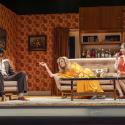
A short reminder of the not over-complicated plot: in the early fifth-century BC, Rome is under attack by the Volscians. The martial and patrician Coriolanus (Sope Dirisu), neither by aspiration nor experience a politician at all, sees them off and is pushed towards Consulship by his mother Volumnia (Haydn Gwynne, pictured below with Hannah Morrish as Virgilia). The Senate supports him, the two Tribunes (Jackie Morrison and Martina Laird) – heads of the citizenry – distrust him. Coriolanus sees no reason to deal with the plebeians and defects to the Volscians, taking sanctuary with his avowed former enemy number one, Aufidius (James Corrigan). It doesn’t end well. At least an hour has been lopped off what can be a gruelling four: Coriolanus is as long as Hamlet. This doesn’t mitigate an awkward fact that a large part of the play, in the middle, is taken up by much conversational to-ing and fro-ing over Coriolanus’s likely status in Rome, his prevarications and pride: bickering with the Tribunes and lording it over the populace, whom he manifestly despises. It’s a bit like sitting through a much longer version of that already distended scene between Malcolm and Macduff in Macbeth, a masterpiece of a play that its writer some two years later – around 1608 – was to some extent reprising.
Jackson has gone for a clean, uncluttered reading on the generous Barbican stage, with – mercifully – no smoke, spears or banners. The mob at the start, angry at potential starvation, numbers barely a dozen; from the off there’s a stated defiance of epic. The “market”, where the people engage with the Tribunes, is suggested by wooden balconies-on-wheels, Volumnia’s posh home by a glass cabinet containing a Venus de Milo-like torso. The entrance to the town, Corioli – giving our man his name and which he breaches so triumphantly – is a massive roll-down screen.
 No frills. Largely, it works. The setting is neutral-modern, with busy Roman officials dressed as carabinieri. When not stripped to the waist and dripping with blood, Dirisu as Coriolanus wears a fine, functional suit. Paul Jesson as Menenius, desperately trying to keep a peace between arrogant general and ungrateful plebs, is in black-tie. The Tribunes, Sicinius and Brutus, as women are slightly box-ticking – but Morrison in a suit and Laird in a skirt and high heels (which is, too, very slightly annoying), bring both glamour and matronly steeliness to roles that might otherwise be rather leaden. (Laird and Morrison are pictured above)
The real problem unfortunately is with Dirisu. There is absolutely nothing wrong with being very young – Dirisu is 26 – but there’s quite a lot wrong with un-nuanced acting. He is a commanding, handsome figure: a warrior, a runner, an athlete… But his monotonous, somehow untutored speaking of the lines is wearing. I kept thinking of Charles Dance, or Ralph Fiennes, or Tom Hiddleston. Against these quite fearsome embodiments, Dirisu comes across as a bit of a boy. He is offset superbly by Haydn Gwynne’s stylish Volumnia, moving and profoundly anguished when, supine, she begs her son not to rout Rome with his adopted Volscian friends.
Gwynne is really the star of the show, which is not otherwise troubled by anything especially bad. We remain in the grip of the story. It’s just that the sum of the production is surprisingly callow.