

Much of Rokia Traoré’s set on Saturday night comprised folk songs about Mali’s warrior kings, connecting with her country’s fabulously wealthy, proudly powerful past. They suit this diplomat’s daughter’s regal stature, which she has put at the service of a nation still enviably rich in musical resources, but battered by civil war, poverty and terrorist attack.
Traoré has also helped give this year’s Brighton Festival an Afrocentric perspective, ignoring the comfortingly familiar in favour of often black British or African artists. Her commitment as Guest Director extends to three headline gigs which refract Mali through diverse prisms. Following her opening night Afro-psychedelic head-melt, this return to the Brighton Dome is a more stately showcase for young Malian musicians, and her own subtle vocal art.
Only Mamah Diabaté, in his usual place on the lute-like ngoni, remains from the earlier night, in a five-piece completed by kora, bass, guitar and calabash and cajon. Traoré spends time in the four-part choir of backing singers, who she cedes centre-stage to early on, letting leonine blonde Dassoum Fané power through “Sodya”. As Traoré joins in long-dressed, loosely formal dancing, the music recalls mid-20th century ballroom rituals, seeming to fuse Malian and colonial styles with elegant ease.
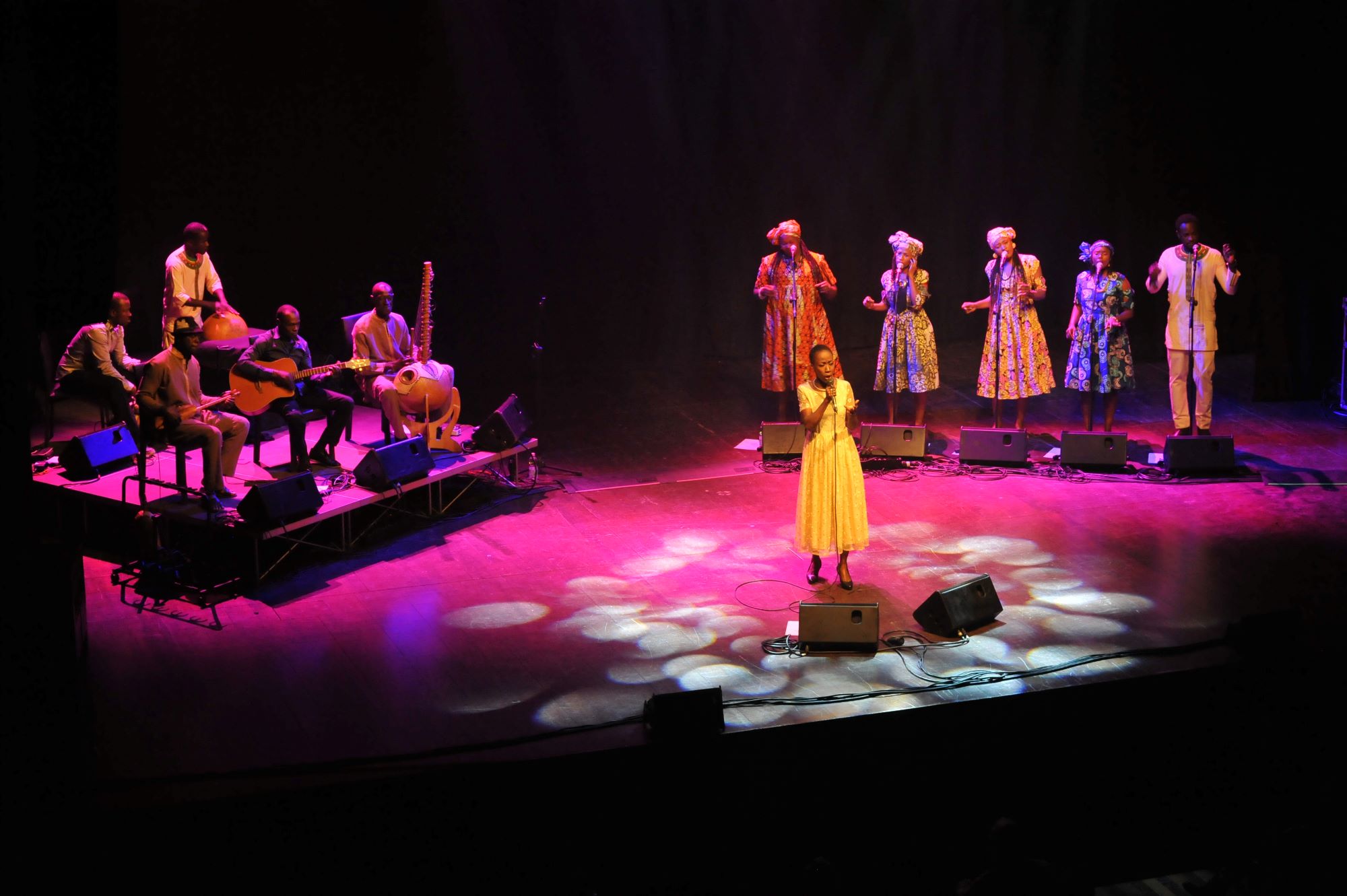 Traoré breaks off to explain that tonight is a fund-raiser for her Foundation Passerelle [gateway], which aims to build a modern base for Malian artists crippled by “informal” business structures and no spaces to work. “African art is for all around the world – except in Africa,” she sadly explains. Setting up this foundation with little personal wealth shows her commitment to the fragile, precious musical ecosystem beneath the potent touring Malians seen in Europe.
Traoré’s own dramatic, pop fluent-charisma made her an international star two decades ago. Her desire to symbiotically link Mali and the world, the traditional and modern, is natural for a singer raised between Brussels and Bamako. This hybrid sensibility and her particular vocal talent now inform Bob Marley’s “Zimbabwe”. She slowly picks over the words with a dragged-back drawl, making them strange. As Diabaté’s ngoni leads the spare, warm music, Traoré’s hands move in phantom finger-clicks: her whole body theatrically, precisely employed.
The band builds trancey, polyrhythmic cycles around Traoré and the chorus’s call-and-response. “Sounoukoun” sees the intricate pulse intensify as she demonstrates the art of queenly persuasion, murmuring, smiling intimately, overwhelming, insisting, pleading and demanding. Again, a small turn of the hand completes the effect.
Traoré’s formal control as a performer is in the service of rejuvenating traditional Malian music, and she rarely lets rip with star power. But “Damanzon” adds complex female force, even as she praises a legendary king. Leaning forward, she carries the song into the crowd, reaching new heights. Then she raids French pop from Mali’s disco-era charts for “Tassidoni”, a hit during her Seventies childhood.
The encore is all uplift. “Titati” began as a traditional song learned from the griot Backo Dagnon, but becomes an outpouring of pure, multi-lingual amour, an endless incantation: “Je t’aime, mon cheri, je t’aime...I love you, we love you... Any time, anywhere, at any cost...we must be in love!” Dassoum Fané whips her blonde hair in wild dervish circles, and the dancing at last spreads offstage. This 15-minute finale almost becomes the show, the previous precision subsumed in gently molten emotion. As with everything before it, Traoré’s transcendence is finely judged.








Add comment