Music plays a big part in the life of Dwight, an 11-year-old black lad growing up in early 80s Leeds. He doesn't fit in at school, bullied because he is "slow", and he doesn't fit in outside school, would-be friends losing patience with him.
But he does fit in at home, loved unequivocally by a protective mother, somewhat enviously by a bickering sister, and rather reluctantly by a preoccupied father. Like the records he plays on the gramophone, his life is about to spin – and he'll have to hold on to the warmth of family love in a cold world.
Zodwa Nyoni's new play for the Kiln Theatre packs issue after issue into its 140 minutes: so many that Nancy Medina's direction is occasionally overwhelmed by the need to make the next point. That pile-up may be the product of an understandable keenness to ensure these stories are heard on the London stage, but it's hard to keep track of the nuts and bolts of narrative development as another issue is raised. A whole season of Play for Today seems to have been packed into a single evening.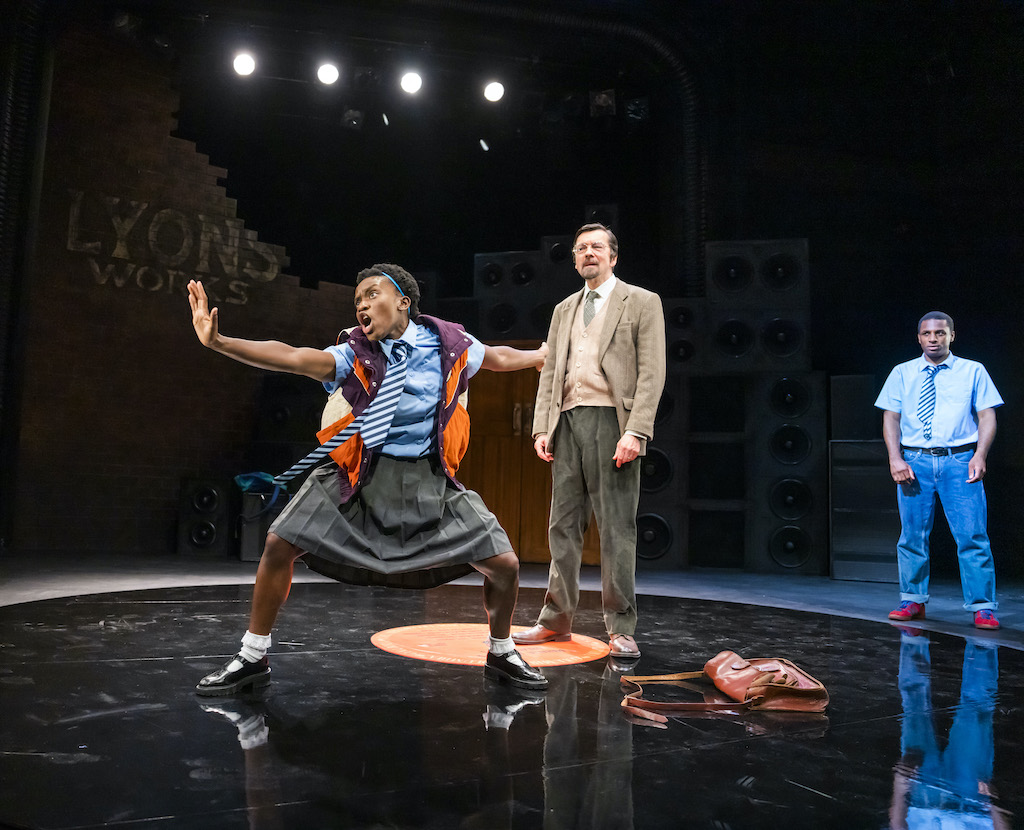 Lee Phillips gives Dwight a quiet dignity and terrifying vulnerability, stimming (to use the precise term) as his anxieties bite into his brain, full of love but unable to express it. These days, at least so one hopes, his autism would be recognised earlier and some support and empathy offered. Forty years ago, nobody had even heard the word outside medical circles.
Nadia Williams fills the stage with the outsize personality of Josephine, Dwight's fierce mother, a nurse who knows how bureaucracies can marginalise the powerless through rules and procedures: and she’s determined not to let that happen to her. She fights for what she believes in – her son – and she uses her Christian faith as a crutch. Her funeral forms the play's framing device, as her son and daughter look back toward their childhood challenges.
She needs faith because her husband has had his job taken away and, with it, his self-esteem. Andrew French channels a bit of Boys from the Blackstuff desperation as Leroy, the Jamaican eventually taking to the barricades in demonstration (the political is not the personal for him) before deciding to make a bigger change in his life.
Brianna Douglas (pictured above with Phillips and James Clyde) is a bundle of hyperactive energy as Dwight’s sister, Shirley, the kind of bright kid in whom teachers see potential but also worry lest wrong choices are made at key moments. Like Williams, Douglas brings plenty of humour to the role, and a steeliness, too, and it’s no surprise to find out that Shirley did achieve her ambition and that she can still, eventually, be cajoled into playing the childhood games that kept sister and brother together though the pain.
Hannah Morrish and James Clyde play representatives of the state (the white state as it overwhelmingly was then), intervening in black lives, regulating and managing public and private spaces. Morrish is the well-meaning white saviour-type social worker, Anna, and Clyde a teacher, policeman and prison officer possessed of varying levels of racism and condescension.
There’s just too much going on to let the drama breathe. Racism, Thatcherite economics, crises in social care, masculinity in a changing world, memory, mental health, betrayal, guilt, grief, black aspiration, redemption, religion and probably a few more matters all drive the characters, when one longs for the people themselves to take charge. The material (and the passion with which it is presented) might be better suited to a soap opera or TV series, in which nuance could be teased out of a plot that feels overly mechanical and overly keen to foreground the didactic over the dramatic.
But this reviewer is acutely aware of the fact that, though he also grew up in a northern city in the throes of the 80s recession, his experience was different to that of the black family we see here. He is also aware that amongst the many groups in attendance on opening night (cast and creatives, theatre employees and supporters, friends and family, local audience) perhaps the least diverse group of all is the press. We really have to do something about that so as to bring a broader range of personal experiences to bear on the critical reception of plays in the press as much as on their creation.