

Sir Adrian Boult: Complete Stereo Recordings 1956-1978 (Warner Classics)
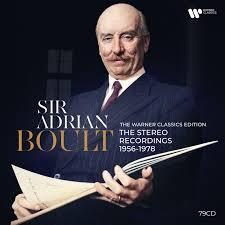
This hefty box set contains 79 discs, the earliest taped when conductor Sir Adrian Boult was 67, the final one when he was 85. Some conductors’ late recordings are too idiosyncratic for general listening but these are mostly excellent. Think Boult and it’s impossible not to think Elgar, Holst and Vaughan Williams, all composers which the conductor knew, but there’s a wealth of other repertoire here; Boult gave the first British performances of works as diverse as Berg’s Wozzeck, Mahler’s 9th Symphony and Bartók’s Concerto for Orchestra. You won’t find anything that radical here, the most ‘modern’ works being Vaughan Williams’ post-war symphonies and a disc of Britten. That these are stereo discs is important; Boult liked to have his first and second violins on opposing sides of the platform, making any antiphonal string writing much more vivid.
Most of the early LPs were recorded for the Pye label, Boult’s London Philharmonic Orchestra renamed the Philharmonic Promenade Orchestra for contractual reasons. The Britten disc is worth hearing – the knotty “Passacaglia” from Peter Grimes has plenty of menace, and we get sparky accounts of the Matinées Musicales and Soirées Musicales. Sadly, the fugue which closes The Young Person’s Guide to the Orchestra is fatally underpowered compared to Britten’s own Decca recording, though we get Boult’s narration as a mono extra.
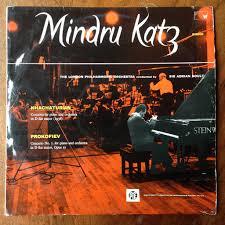
Other Pye treats include an enjoyable set of Schumann symphonies and a disc coupling Khachaturian’s Piano Concerto and Prokofiev’s Piano Concerto No. 1 with Romanian pianist Mindru Katz. I’ll forgive Boult using a flexatone instead of a musical saw in the Khachaturian slow movement, and the Prokofiev is fun. There’s a pioneering stereo version of Walton’s Symphony No. 1, more vividly recorded than the composer’s mono Philharmonia performance but not as punchy as Previn’s iconic RCA one with the London Symphony Orchestra. There’s a decent early stereo version of Elgar’s Symphony No. 2, a Boult favourite, though a zingy 1963 remake with the Scottish National Orchestra is more exciting.
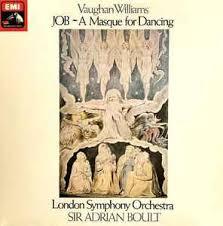
A move to EMI in the 1960s brought better engineering and production quality. Boult’s second cycle of Vaughan Williams symphonies is excellent, split between the London Philharmonic and New Philharmonia orchestras. No. 4 is weighty but powerful, No. 5 glows, and the tuned percussion in No. 8’s finale has plenty of colour and weight. Boult’s LSO version of Job still sounds marvellous, and there’s loads more. New to me were the Concerto Grosso and Partita for strings (both nicely done) and there’s a complete recording of the opera The Pilgrim’s Progress. We get masses of Elgar too, most of it superb. Ida Haendel’s 1970s version of the glorious Violin Concerto has more allure than Yehudi Menuhin’s 1965 account, and Paul Tortelier’s version of the Cello Concerto is a good alternative to Jacqueline du Pré’s. Boult’s final LPs of the two symphonies are sumptuously engineered, though I found myself returning to the smaller works more frequently. The two Wand of Youth suites are a delectable, as is Elgar’s orchestration of Bach’s Fantasia and Fugue in C minor.
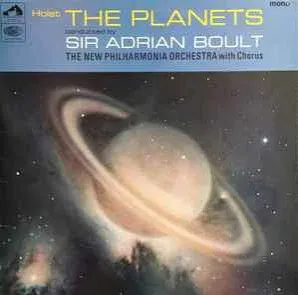
Boult gave the first performance of Holst’s The Planets and there are two accounts here. A 1978 one with the London Philharmonic was one of the last things he did, EMI’s analogue sound as vivid as any 21st century digital recording, but a 1966 New Philharmonia predecessor has a bit more punch. Holst’s Choral Symphony is a fascinating rarity, the other discs of English music including a collection of string works (Bliss’s Music for Strings sounding imposing) and Boult’s final LP, Parry’s Symphony No. 5 and Elegy for Brahms.
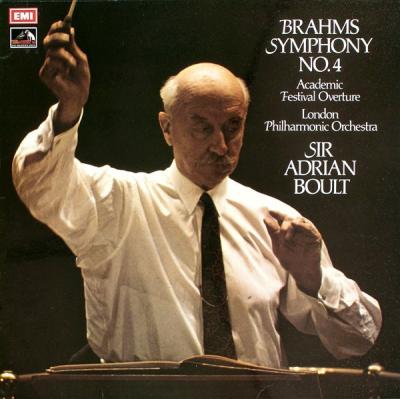
An early 1970s Brahms symphony cycle is erratic, with a cogent 4th and slack 2nd, though a disc of the two lovely Serenades is excellent. Hearing Bach’s Brandenburgs played by a large orchestra on modern instruments takes some getting used to, but Boult’s conducting is stylish and works on its own terms. André Previn turns up as piano soloist in a pair of Mozart concertos, and there’s a big-boned, affectionate account of Schubert’s 9th Symphony. Several discs of Wagner excerpts are impressive, with tender strings in the Lohengrin Act 1 prelude and an exciting Siegfried’s Rhine Journey. There’s the Jacqueline du Pré version of Strauss’s Don Quixote, assembled posthumously from a rehearsal take (and sounding excellent), plus a pair of Mozart symphonies. The hits overwhelmingly outweigh the misses; Boult makes heavy weather of Gershwin’s Cuban Overture, and the overture to Glinka’s Russlan and Lyudmila never catches fire. But it’s fun to hear him tackle works like Stravinsky’s Circus Polka, Ponchielli’s Dance of the Hours and Sousa’s Liberty Bell March; Boult was a consummate professional who invariably got decent results.
You’ll want this box set for the Vaughan Williams, Holst and Elgar, then; Boult’s interpretations of their music are about as authentic as they come. Tully Potter’s booklet essay is a decent read, and the remasterings sound consistently good. As a supplement, get hold of Boult’s luminous 1975 version of Moeran’s wonderful Symphony in G minor on the audiophile Lyrita label, to my mind the very best of his late recordings.
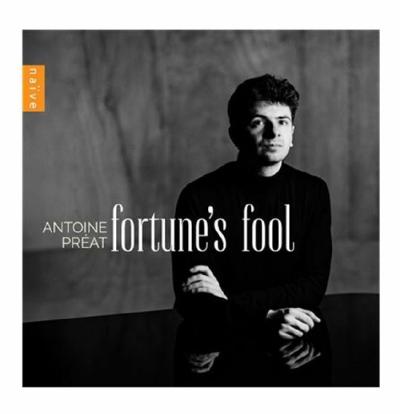
Fortune’s Fool – music by Haydn and Prokofiev Antoine Préat (piano) (Naïve)
Antoine Préat’s recital disc features piano music by Haydn and Prokofiev, the intention being to highlight their similarities, namely “their humour, big lyrical gestures, a certain dryness contrasted by very generous writing”. Haydn’s Hob. XVI/34 E minor sonata sounds disconcertingly modern in Préat’s hands, the first movement’s tendency to grind to a halt simultaneously amusing and frustrating, a dazzling exercise in musical throat-clearing. Which makes the lyrical central “Adagio” more of a relief than usual, every ornament perfectly shaped. Haydn’s rollicking finale is a riot here and a welcome reminder that music in minor keys isn’t necessarily dark or downbeat. It’s followed by Prokofiev’s five Sarcasms, acerbic and modernistic miniatures which echo the sonata’s stops and starts. They’re superbly performed here - sample the fourth movement, its glittering opening soon undercut by thunderous dissonant chords, or the fifth movement’s sinister, shuffling close.
Haydn’s Hob. XVI/32 B minor sonata is darker than the E minor. Listen out for an unexpectedly dour trio section in the second movement minuet, and a thrilling, propulsive finale with an uncompromisingly grim coda. Préat closes the disc with Prokofiev’s ten-part arrangement of numbers from Romeo and Juliet, played with an attention to detail and awareness of colour sharp enough to make you forget the orchestral original. There’s plenty of bravura but it’s the quiet moments which really tell, like the tender final bars of “Young Juliet” or the shimmering opening of “Romeo and Juliet Before Parting”. Exquisite stuff, and beautifully recorded too.
Schubert: Piano Sonata No.17, Schumann: Kinderszenen Arcadi Volodos (piano) (Sony)
Arcadi Volodos and the Sony label will shortly begin their fourth decade working together. Their release schedule has tended towards the frugal: this new album of Schubert and Schumann, recorded in concert at the Fondation Vuitton in Paris last June, a few months after Arcadi Volodos’s fifty-fourth birthday, is just the eleventh that the pianist has made for the label, having recorded the first, Variations, for release in 1997 when he was his mid-twenties, and only just emerging from studies in Moscow, Paris and Madrid.
The Russian-born and now-Madrid-based pianist has concentrated his playing on particular repertoire; “Kinderszenen” has been a staple in his recital programmes for many years. What Volodos does at his irresistible best is to be improbably poetic. He creates astonishing warmth and depth in the sound. Can the beginning of ‘Der Dichter spricht’ in the Schumann be played more beautifully than it is here? Could the dying chords right at the end of the vast and expansive ‘con moto’ movement of the Schubert sonata hint at tragedy more poignantly? In both cases, I very much doubt it.
The sheer beauty and heft of the playing are astonishing, but what takes a lot more getting used to is a kind of ‘rubato’ playing which veers into rhythmic disruption. Take the pair of pieces ‘Am Kamin’ and ‘Ritter vom Steckenpferd’, and Volodos’s gestural playing has a way of forgoing any feel-able basic pulse. A comparison with, say Radu Lupu shows the great Romanian inviting the listener onto much safer ground. Lupu takes the freedom to slow down massively, and brings greater poignancy from the fact that he has established a regular feeling of tempo, what it is and where it sits, allowing the listener to savour the pulling back more fully. Volodos is even more pointed with his disruption right from the start of the ‘Scherzo’ movement of the Schubert, where he inserts a delay and displaces the first beat of the written bar and consistently embeds that ‘tic’ into the melody.
With these idiosyncrasies, what we hear are “his” versions of both pieces, personal patterns that have developed over many years. And here’s the surprise: with his powerful physical gestures and facial expression, the way he performs – and the logic behind it – come across far more clearly when you can watch Volodos play, rather than just listening to him. Conveniently, if curiously, the actual live Paris performance on this disc is currently viewable on the “Maestro’s Corner” YouTube channel.
It’s paradoxical thing to suggest, and it might even sound crass: I have found this disc puzzling and idiosyncratic in the extreme. And yet it has whetted the appetite to hear and to see this unique pianist live. Sebastian Scotney
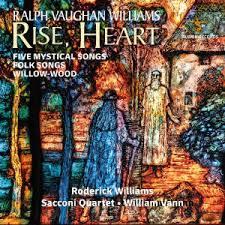
Ralph Vaughan Williams: Rise, Heart Roderick Williams (baritone), Sacconi Quartet, Levi Andreassen (double bass), William Vann (piano) (Albion)
Vaughan Williams songs? Yes please! Sung by Roderick Williams? Count me in! Obscure versions of familiar repertoire alongside new arrangements of less well-known stuff? This should be a treat. And it is! Williams’s singing is as enjoyable as it always is in this kind of repertoire, and I particularly enjoyed the string quintet and piano version of the Five Mystical Songs. These date from 1911, when Vaughan Williams had only recently released both the Sea Symphony and the Tallis Fantasia on the world, originally heard with chamber orchestra and choir, later just with piano, and later still in this present chamber version. If something of the grandeur is lost in the “Antiphon” (“Let all the world in every corner sing”) the chamber forces allow Williams to soar over the top in this last movement, and the opener “Easter”, but also to be more intimate in the middle movements. Having recently reviewed his Phantasy Quintet on the recent Piatti Quartet album, this is another small-scale Vaughan Williams to add to the favourites list.
There follow two early songs with piano, never previously recorded by a male singer. The songs, to texts by Christina Rossetti, are in the Edwardian parlour song vein in which Vaughan Williams first made his name. They are both lovely essays in this style and well worth hearing if you like that kind of thing, William Vann understated and restrained in the piano part. In 2020 Albion released all 81 of RVW’s folksong arrangements with piano, with Williams among the singers and Vann at the piano. Roderick Williams subsequently arranged eight of them for string quartet and baritone, the quartet part based closely on RVW’s piano parts. These aren’t as adventurous as Britten’s folksong arrangements, but neither are they entirely “straight”, and they transfer nicely to quartet. The Sacconis are rich and expansive in “She’s like the swallow”, sounding like more than four players, and circle restlessly in “Barbara Ellen”. “Oh who is that” channels The Lark Ascending in its violin arabesques decorating the vocal line, while “Harry the Tailor” is a vigorous end to the sequence. The album ends with the 14-minute cantata Willow-Wood, another early piece, previously recorded by Roderick Williams in its orchestral version, and here getting its first release in the original piano version. It’s one for the RVW completists, but not at the level of the other pieces here. “Complete flop” the composer wrote on the score after its premiere – which is harsh, but not a million miles from being right. Bernard Hughes
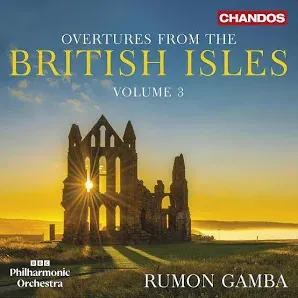
Overtures from the British Isles Volume 3 BBC Philharmonic Orchestra/Rumon Gamba (Chandos)
I’m a late arrival to this particular party, volumes 1 and 2 having passed me by, but listening to them is on my to-do list. The 11 works assembled here were composed between 1938 and 1949 and listening to many of them can be like stepping into a parallel dimension, a hermetically sealed world where musical trends and ideas from mainstream Europe held no sway at all. There are a few exceptions: Alan Rawsthorne’s bluff Street Corner has harmonic bite, and Frank Bridge’s Rebus, his last completed orchestral work, is a quirky gem. The one work by Britten, Bridge’s best-known pupil, is the overture to his 1941 operetta Paul Bunyan. This was ditched when Britten revised the full score in the mid-1970s, the surviving piano score orchestrated by Colin Matthews in 1977. Britten’s revision, an evocative prologue, is masterly, but this pithy five-minute piece contains a superb fugue and some punchy brass writing. It’s full of personality, as is Yorick by Geoffrey Bush, a brilliantly orchestrated tribute to the much-loved radio comedian Tommy Handley rather than a Shakespearian work. There’s genuine pathos in the slow central section, before an effervescent dash to the finish.
Alan Bush is more often remembered for his political views than for his music. Resolution (1944) began life as a brass band work, an imposing attempt “to suggest in musical terms the process by which a group of men and women lay the plan for some common enterprise”. Havergal Brian’s The Tinker’s Wedding opens promisingly but quickly runs out of steam; more impressive is Welsh composer Daniel Jones’s lilting Comedy Overture, music to prompt wry smiles rather than belly laughs. This album’s sleeve photo is misleading: Robin Orr’s evocative The Prospect of Whitby takes inspiration from the pub in Wapping rather than the North Yorkshire Coast. Also good is Richard Arnell’s The New Age, a work premiered at Carnegie Hall in 1939. Clifton Parker’s Overture to ‘The Glass Slipper’ is delightful and lasts just three minutes. The closer is Rossini on Ilka Moor by Eric Fenby, Delius’s former amanuensis and a talented composer in his own right. A pitch-perfect Rossini parody based on a famous Yorkshire tune, it was composed at lightning speed for a 1938 performance by the Scarborough Spa Orchestra. This is a terrific anthology, very well recorded and superbly annotated by Lewis Foreman, Rumon Gamba securing brilliant playing from the BBC Philharmonic.
Finding Light Meridian/Irene Messoloras (Signum)
Tomorrow is Today: Songs of love, beauty and the passing of time Papagena (SOMM)
Here’s a pair of choral releases, one by an established British group, the upper voice quintet Papagena, and the other by an interesting newcomer to the scene. Meridian is a young London-based choir, directed by the American conductor Irene Messoloras. Having released two EPs on Signum last year, now comes the full album, Finding Light. The choir is, on this recording, 19 strong, featuring a starry line-up of names of British choral (and solo) singers. The repertoire is 12 contemplative, sacred pieces on themes of mercy, love, and peace, ranging from the contemporary to the 16th century. The balance of the two is nicely realised right from the start, John Sheppard (1515-1558) leading directly to Vytautas Miškinis (b.1954), whose "Angelis suis deus" is poised and humble. Of other contemporary composers, we have some mournful Gorecki, the “Agnus Dei” from Karl Jenkins’ The Armed Man, the richly-scored, Anglican-tinged Lighten our darkness by Alexander L’Estrange, and the album ends with Morton Lauridsen’s timeless and statuesque Ubi Caritas. Of the older pieces, Sheppard’s Libera nos, salva nos has a weighty weightlessness, the sopranos floating and the basses grounding the harmony. I also enjoyed the Allelulia by Randall Thompson (whose name is mis-spelled on the back of the CD case), the choral equivalent of Barber’s Adagio for Strings, which has the biggest and warmest climax on the album. But perhaps my favourite track is Prayer by Hanna Havrylets, whose haunting solo by Grace Davidson is surrounded by a ghostly choral halo. Apart from a slightly one-note feel to the programming, this is a highly recommended album, with flawless and exquisite singing.

Papagena, led by alto Sarah Tennant-Flowers, also includes Elizabeth Drury, Imogen Ram-Prasad, Suzzie Vango and Shivani Rattan among the ranks; Tomorrow is Today is their fourth album, and their first since Hush in 2020. Stylistically, Papagena are specialists in not specialising, their repertoire embracing medieval, folk and contemporary music, often in personalised arrangements that make the best of their upper voice line-up. The 18 tracks here include nine pieces getting their first commercial recording, including group member Shivani Rattan’s joyous Indian song of celebration, Holi, and Janet Wheeler’s title piece, subtitled “Dawn Chorus”, scattered with birdsong and sung with a delicious wit and levity. The older music is sung stylishly and with a sculpted sound that is never forced, and subtly coloured. Monteverdi, Purcell and Leonora d’Este are all grist to their vocal mill, but the standouts come from further off the beaten track. The traditional Bulgarian Kaval sviri has bite and edge, the traditional Yoruban Canto e Eleggua is propelled by clapping and surprisingly bluesy harmony, and Sandy Denny’s Who Knows Where the Time Goes, arranged by Suzzie Vango, has a directness and simplicity that means it packs an emotional punch. This wonderfully varied disc is more than just a stylistic grab-bag, but has a real aesthetic identity and a winning self-assurance. Bernard Hughes





Add comment