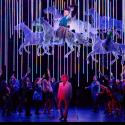
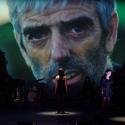
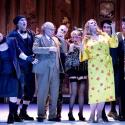
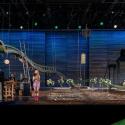
Just now, everything WNO does inevitably bears the mark of their Arts Council-imposed financial troubles, and this new Flying Dutchman directed by Jack Furness is no exception. It proceeds on a bare stage largely devoid even of props, the singers costumed in the most mundane modern street-wear, no sign of the sea or ships, nothing beyond a few mysterious period-clad Scandinavians far upstage and some neutral back projections on which the audience is invited - I suppose - to bring their imaginations to bear.
Of course there’s a justifying concept. “Stripping everything away,” says the designer Elin Steele, “lent itself to the metaphysical nature of the piece.” In this case the metaphysics involve a character not known to Wagner, the heroine Senta’s mother, whom for most of the vividly maritime (and vividly played) overture we are forced to watch in painful labour and eventually, in the coda, giving birth to a little girl in a red dress who inexplicably whizzes round and round the stage before being replaced by a bigger version of herself, whizzing faster.
At the end of the opera all is explained when Senta, instead of soaring up to heaven with the Dutchman, also whizzes, and is then carted off on her mother’s birthing bed. Meanwhile the poor Dutchman is left looking understandably puzzled on the empty stage, while the orchestra nevertheless intones the revised D major apotheosis in the usual way.
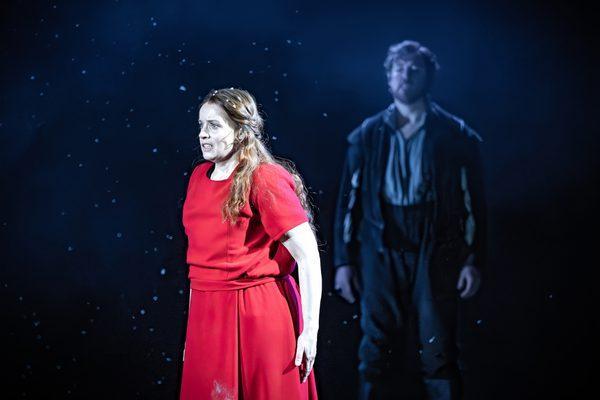
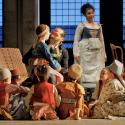
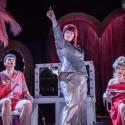
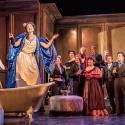
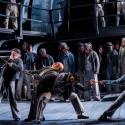
I’ve always been against clutter and a big advocate of operatic space. But space is for movement, whereas Furness’s directing, whizzing apart, is curiously static. The Dutchman (Simon Bailey) delivers his opening monologue pretty well motionless, and Senta spends a good deal of Act 2 on a chair centre-stage facing front with her spinning girlfriends in a semicircle behind her, like a well-behaved, if musically superior Sadler’s Wells chorus of old. The sailors in Act 3 sing lustily but are likewise more or less an inert mass with random individual ins and outs, like an ants nest. Sailing they never do. This may be metaphysics, or it may be simple under-production, but in either case it contradicts a score which, patchy though it is, is always exhilaratingly mobile and salty.
The conductor Tomáš Hanus generally responds well to this mobility, though at times he seems mildly infected with the onstage torpor and bothered by issues of ensemble. All the same this is musically a more than adequate first outing for the production. Bailey is a good, dark-toned Dutchman, most impressive in his confrontations with Senta (pictured above together), Rachel Nicholls’s beautifully sung and thought-out portrait of this strange girl haunted by the desire to marry the sea, while her actual betrothed is not even a sailor, but the hunter, Erik.
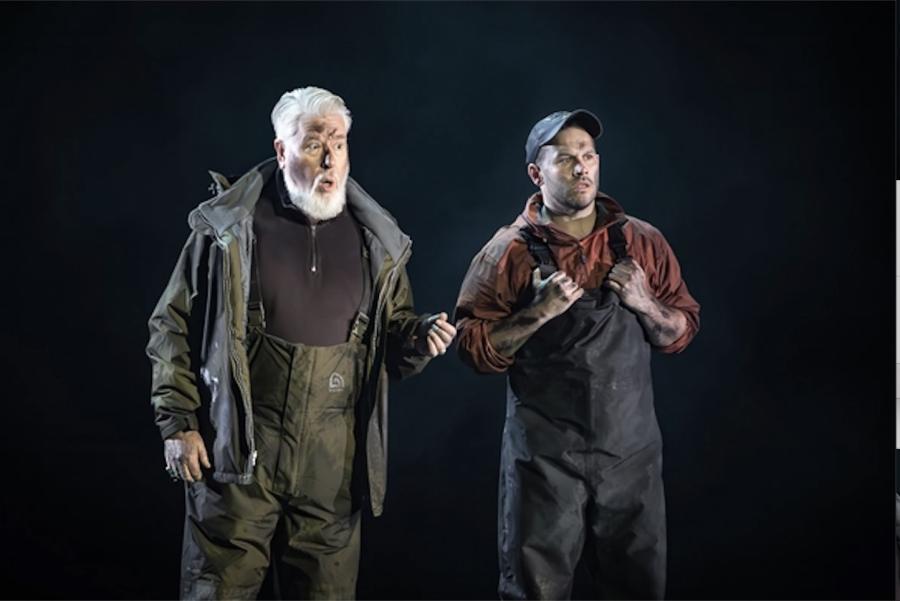
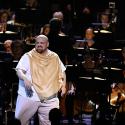
Leonardo Caimi is not helped in this thankless role by being suited and tied like a provincial estate agent, and is vocally a shade too Italian for a rough Norwegian trapper. James Creswell, on the other hand, is Daland to a tee, stolid and self-satisfied like his square-cut Act 2 aria, which charms and repels in about equal measure. Trystan Llŷr Griffiths (pictured above with James Creswell) sings the lovely Steersman’s song particularly well considering that he has no ship and no crows-nest to help give him that yearning feeling, and there is no Dutch ship for him not to see arriving.
I have to say that the performance as a whole dragged at times. I blame the production’s lack of specifics and, to be candid, its frequent ugliness and vulgarity: un-themed modern clothes, for instance, which at one point the chorus girls and Senta all remove, coram populo, for us to assess their underwear. The metaphysics may be wonderful but the aesthetics grate.