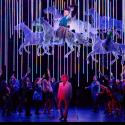
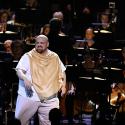
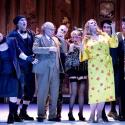
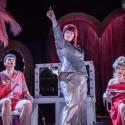
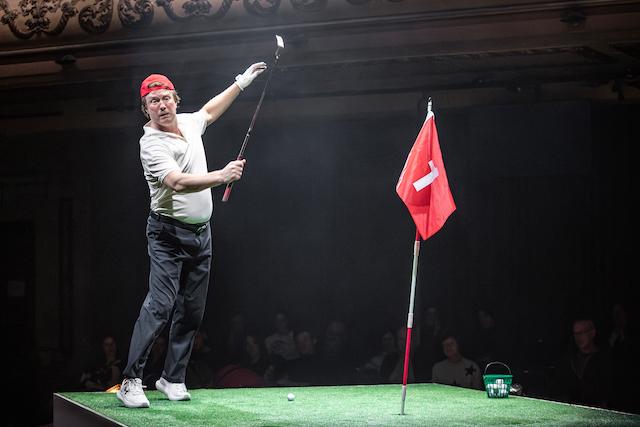
Tamerlano, tyrannical Emperor of the Tartars, is a burger-munching boor with a golf-habit, a bulbous belly and a crashing disdain for other people’s sensitivities. In Orpha Phelan’s dynamic, gleefully idiosyncratic production of Handel’s 1724 opera, Trump’s shadow looms large, as Tamerlano tries to force Bajazet, Emperor of the Turks, to haggle for his freedom by offering up his daughter, Asteria, for Tamerlano’s sexual delight.
The opera is one of many that Handel wrote as part of London’s craze for the Italian opera seria form – which featured multiple arias for its virtuoso singers – and began when he himself composed Rinaldo in 1711. When Tamerlano was first staged, it was set in the Ottoman Empire but in Phelan’s production we find it to be part of a Freudian experiment, in which Sigmund himself appears with a flipboard as he investigates different forms of tyranny over the centuries.
The anachronisms pile up – but if you worry about such things, maybe this is the wrong place for you entirely. Phelan’s witty take, the fourth in the series offered up by the London Handel Festival’s innovative Handel Opera Studio, instantly brings a freshness to the story that famously also inspired Christopher Marlowe’s Tamburlaine the Great. Countertenor James Laing’s antics may seem like easy comedy – at one point he performs the Trump YMCA dance, at another he petulantly pulls a violin from an orchestral player and cuts its strings. Yet we all know – at a visceral level – about the abuse and geopolitical catastrophe that accompanies such narcissistic clowning, and this plugs us straight into the intent of the original libretto.
Beyond Phelan’s diverting conceptual framing, the music itself is exquisitely realised under the directorship of Laurence Cummings, who after a brief absence from the London Handel Festival, returns in triumph with the Academy of Ancient Music. From the buoyant ceremony of the opening bars of the overture, which quickly evolves into a jagged, gossipy discourse between the strings and wind instruments, this is Handelian performance at its finest.
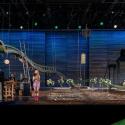
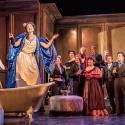
To reflect Phelan’s multi-layered vision, set designer Madeleine Boyd (whose wonderful design of My Fair Lady at Leeds Playhouse proved that she is also very good at traditional backdrops) heightens the sense of experiment by filling Shoreditch Town Hall with platforms at different levels. On stage itself, along with the orchestra, we have Trump’s study, while on a lower platform we have the imprisoned Emperor Bajazet. Close to that, another platform has Freud’s couch, while a larger platform with “grass” on it represents a more neutral arena where the characters occasionally come together. The overwhelming sense is of a series of territories over which Tamerlano is grasping for dominion. At the furthest reaches of the performing area we also have the Greek commander Andronico languishing in both moral and geographical isolation.
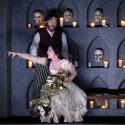
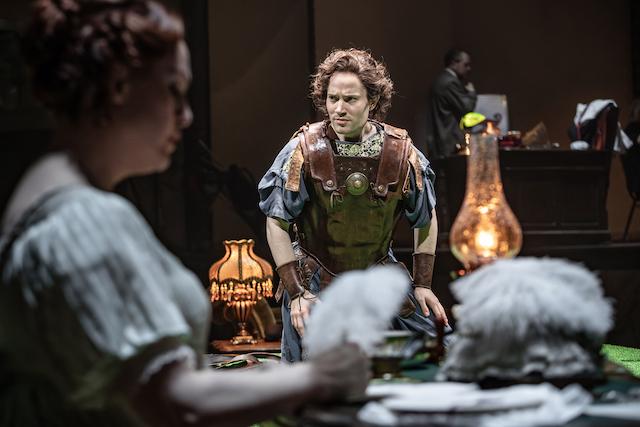
As the Emperor Bajazet, tenor Benjamin Hulett – one of the four characters dressed in ancient historical costume – gives a simultaneous masterclass in verbal clarity and nuanced, mellifluous singing. Morally, he is Tamerlano’s polar opposite, more willing to die than to sacrifice his or his daughter’s dignity. Countertenor James Ingbar (pictured above), making his London Handel Festival debut, delivers a similarly resonant performance, going from steely hostility to Tamerlano’s excesses to tones of heart-wrenching intimacy as he faces up to the consequences of his own love for Asteria, Bajazet’s daughter.
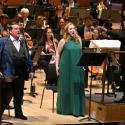
Playing Asteria, the woman over whom Emperors and commanders are wrestling, soprano Nardus Williams proves repeatedly through the evening why she is being hailed as one of our fastest-rising stars. Her voice, especially in the upper reaches, is like liquid gold, while her dramatic expression is as defined by fierce dignity as it is by anguished longing for Andronico. When she attempts to stab Tamerlano, it feels like a natural culmination of her refusal in any way to be belittled by a man who can only see her as a commodity. Handel was famously a composer who loved strong women, and Williams – who excelled on the Dunedin Consort’s Handel in Rome album – once more proves herself a shining interpreter of his music for the twenty first century.
In the role of Irene, the Princess of Trebizond betrothed to Tamerlano but cast aside while he vies for Asteria’s affections, mezzo soprano Kitty Whately introduces an enjoyably comedic tone of no-nonsense outrage. As Tamerlano’s friend, Leone – here transformed to Freud – bass Jonathan Brown brings an authoritative note of scrutiny to the action. Much as I loved the invention of it, I did slightly wonder whether the production would have lost that much if he hadn’t been Freud. That reservation aside, this is ultimately a glorious showcase of one of Handel’s great operatic masterpieces – though Trump could never hope to sing as beautifully as Laing, his reincarnation here proves a potent device to remind us how terrifyingly close the relationship can be between brutality and comedy.