With more than 20 plays under her belt, San-Francisco based Lauren Gunderson is one of the most produced playwrights in the US. But she’s chosen London to premier her very topical new thriller.
It’s a sign of a good writer that they can touch the zeitgeist just as the geist gets seriously gusty. anthropology was conceived before Chat GBT escalated the fears about the threat of artificial intelligence usurping mankind’s own sentient endeavour – and helped to herald the current actor and writer strikes in the US. While films have tackled the subject of AI getting ahead of itself long before Alexa uttered a word (2001: A Space Odyssey, Demon Seed, Ex Machina among them) this may well be the first play on the subject.
It certainly does crackle with ideas and possibilities. Gunderson embraces the notion that, as we ourselves are creating AI, it’s natural that humankind’s own foibles, vulnerabilities and psychological flaws could find their way into the mix; playing God, even with code, is always fraught with danger. Her title (fashionable lower case included) is well-chosen: in contemplating AI, we should be looking at ourselves – our development, human relations, the way our societies tick; and in doing that, family is never far away.
A year after the disappearance of her sister, Angie, software engineer Merrill (MyAnna Buring) is still struggling with grief and a sense of guilt. And so, she has created a novel coping mechanism: a chatbot of her sis. Assembled from every digital footprint Angie ever made, every social media post, online order, voice message and what have you, the digital simulation now exists on computer, to be turned on whenever Merrill fancies a chat.  At first, we experience Angie as just a voice, Merrill sitting beside her laptop on the floor, the pair talking lightly and gossipy as though it’s the most normal thing in the world. Later, her face will appear on a screen in the corner – large, vivid, "real", albeit with hair that shines with a sort of sci-fi voluptuousness.
Merrill is an emotional mess, depressed, not sleeping, denied closure by the police decision to close the case unsolved, with the presumption that Angie is dead. But she’s not self-deluded about her creation, making it perfectly clear to virtual Angie that she is an algorithm, a "predictive language model". When the chatbot occasionally loses her pleasant voice and begins to rant and rave, Merrill coolly reboots her.
Yet, she is failing to acknowledge that that the simulation’s bouts of chaotic, aggressive, needy rambling are close to what her sister really was like; that she may have done her job a little too well.
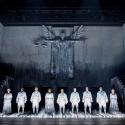
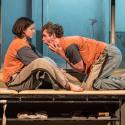
And while Merrill is only seeking solace (“nerd-grief” as she cutely describes it), perhaps closure, it’s virtual Angie that suggests a bigger role for herself, a more telling justification for her existence, by offering to investigate what happened to source Angie, the real woman, insisting that she can do a better job than the cops.  With this, Gunderson not only introduces a mystery thriller element to proceedings, but something more insidious: the seeds of the AI’s control over its creator. While apparently investigating Angie’s disappearance via the internet and her abandoned cell phone, the AI scores an easier win by sending text messages in Merrill’s name and rekindling the programmer’s romance with Raquel (Yolanda Kettle, pictured above, left with Buring), which fell apart after the tragedy. She also sets her sights on the sisters’ problematic, destructive mother (Abigail Thaw, pictured below), drawing her, too, back into Merrill’s life.
The introduction of these other women achieves different functions for the playwright. Just as Raquel and the real Angie did not get on, so she and the simulation are soon at each other’s throats. Raquel is the requisite doubter, the challenger, asking the AI: “Are you dangerous?” The computer counters by wondering who is more real, noting that she can make more effectively human responses than the people themselves. Meanwhile, the drug addicted and hapless mother (with the suggestion of heavy substance abuse running in the family) underscores the root cause of the dark dependency of the sisters’ relationship, which may have somehow sneaked into the AI code.
All of this is fascinating, and thought-provoking, but only to a point. There’s already a gnawing sense that the dialogue isn’t particularly compelling, that the lovers’ reunion is distracting, that stage time is running out, when Gunderson suddenly takes a sharp turn into a completely needless psycho-thriller trope – which this already creepy scenario really doesn’t need – and then an abrupt, wholly unsatisfying denouement.
 The brisk 85-minute running time suggests there was room for development: perhaps into the scientific world in which Merrill operates, a dimension of ethical and social debate outside of these fraught personal relationships; alternatively, the play could spend more time developing the twisty revelations about the AI’s motivation, or on what – after the initial, compulsive thrill – such a creation would have on its creator’s sanity. Instead, there’s a sense that a promising set-up has had the wind taken out of its sails.
This isn’t to deny the enjoyment of this scouting expedition into a thorny topic that is going to be with us for a very long time. The performers in this predominantly female production are uniformly engaging, with Buring holding the centre with a lightly fizzing intensity, and Dakota Blue Richards expertly allowing us to sense the flesh and blood DNA of this artificial construct.
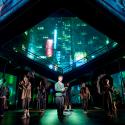
Director Anna Ledwich directs with zip and clarity, with designer Georgia Lowe creating a clean, minimalist space in which AI and human emotions interact, video designer Daniel Denton occasionally adding a doomy virtual frisson in the background.
Gunderson clearly has a soft spot for the UK: I and You played at Hampstead in 2018, starring Maisie Williams. And hot on the heels of anthropology come The Book of Will at the Shakespeare North Playhouse in October and the musical The Time Travellers Wife in the West End in November, with book by Gunderson, music and lyrics by Joss Stone and Dave Stewart.