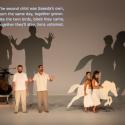
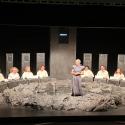
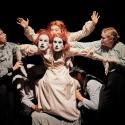
The author of such inimitably evocative melancholia as “If All The Cornflakes” and the many episodes of “Life In A Scotch Sitting Room”, Scottish poet and songwriter Ivor Cutler had a stellar cult following for many decades until his death in 2006. This wonderfully fluid ensemble show, making its English debut at the Brighton Festival, was devised by Scottish group Vanishing Point in association with The National Theatre of Scotland. It recreates episodes from Cutler’s life, and fragments of his music in a mesmerising, dynamic collage of bleak-tinged fun. Cutler, who always claimed that his life only began when he left his native Glasgow in his thirties, and never felt appreciated there, would have enjoyed the irony of this posthumous Scottish love.
It’s all held together by Sandy Grierson, who plays both himself, as well as Cutler, and his harmonium, a dourly comic wheezebox perfectly suited to the oeuvre. Grierson’s framing scenes, in which he discusses the role with Cutler’s partner Phyllis King, feel a little awkward to begin with, and the fact that Grierson drops in and out of role while Elicia Daly, as King, is always in role, causes a little double-take. But in fact some means of drawing us into Cutler’s life is necessary, since voice, persona and appearance are all essential features of his art. In a way, he’s a kind of miniature gesamtkunstwerk, in which butterfly-filled hats nestle alongside his distinctive fluting baritone, squeaking harmonium, gloomy puns and morose satire.
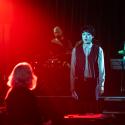
Grierson as Grierson is perhaps a little pious, but as Cutler, he’s superb: the voice is modulated to perfection, the mannerisms are beautiful to watch, and even the harmonium-playing is good. As King, Elicia Daly has a smaller canvas to decorate, but effectively conveys King’s mixture of control and sensitivity. The multiple roles, both musical and dramatic, of the remaining cast are dazzling: Ed Gaughan plays everyone from producer Ned Sherrin to a sadistic (and SNP-supporting) headmaster, and joins in the band between turns, while Nick Pynn, Magnus Mehta and James Fortune give an extraordinary display of multi-instrumental skill.
Cutler’s aesthetic – like Stevie Smith’s, a quiet bursting of the buttoned-upness of post-war British society – might not always translate effectively into the twenty-first century
It was the musical world that made Cutler's career: with support from Paul McCartney, John Peel and Andy Kershaw, all of whom are voiced with uncanny conviction by Ed Gaughan, he could hardly fail. Yet looking back on his work, it’s the words, more than the music, that really stand out, Cutler’s overwhelming skill a kind of emotional precision, creating pieces that are a tonal tightrope walk between the twee and the bleak. While his effect in performance is unique, there are several other writers with a similar ability to balance domestic humour and tragedy. There’s something of the poet Stevie Smith, another quiet post-war north Londoner, about his moods. She was described so deliciously by Philip Larkin as a combination of William Blake and Ogden Nash, and that fits Cutler too.
Cutler’s pieces don’t cover well, and without an actor as skilful as Grierson, other performances could quickly descend to the grotesque. So this show is unlikely to spark a major Cutler revival, since they’re deceptively difficult to carry off. And Cutler’s aesthetic – like Stevie Smith’s, a quiet bursting of the buttoned-upness of post-war British society – might not always translate effectively into the twenty-first century. But this is a deceptively skilful piece of theatre, and a vivid window into the life and work of a fascinating and unique figure.
- The Beautiful Cosmos of Ivor Cutler is at the Theatre Royal, Brighton, until 17 May