Food is the centrepiece of Gareth Farr’s chilling new play Biscuits for Breakfast. Meals are described so delicately that the rich steams of them cooking are almost scented. But though they are prepared, shared and savoured with fondness, crucially, they are never physically there.
Instead, budding lovers Paul and Joanne dine with food suggested but never shown. Paul, a trainee chef, woos the spiky Joanne with a perfectly made fish pie. Both work at the local hotel, with Paul dreaming of breaking away from the Cornish seaside for a future of bestselling cookbooks and lavish restaurants. He longs to impress his dead father, whose drunken voice we hear played over a tape recording, and to fulfil his childhood promise of achieving a "better” life. But when difficult times hit and the couple unexpectedly lose their jobs, his plans for the future are ripped violently and suddenly at their seams.
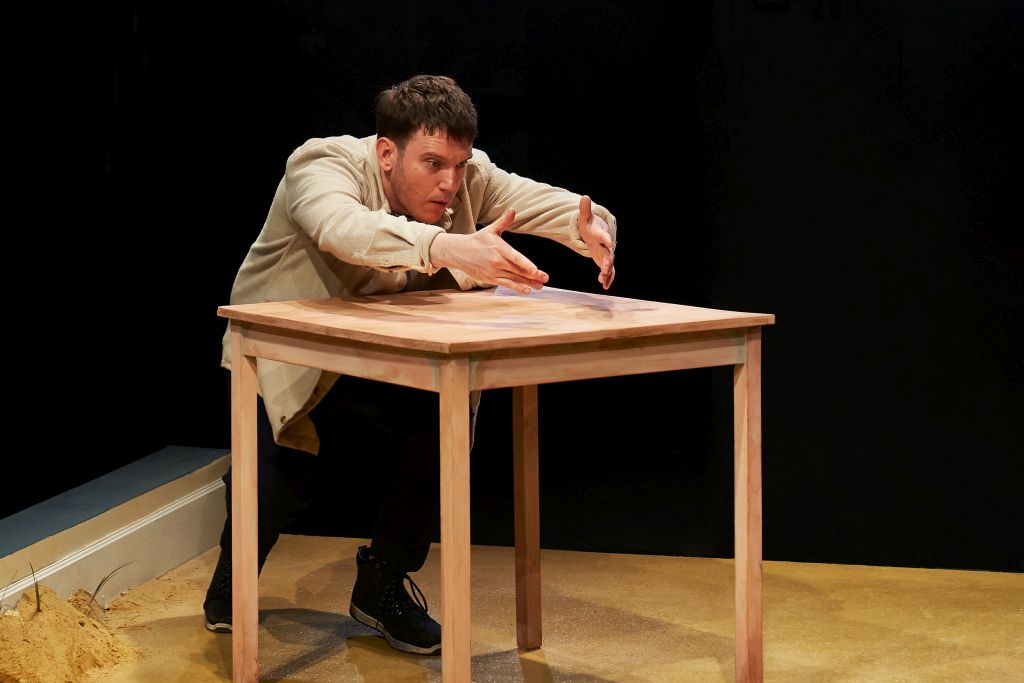 Running straight through and dealing with a progressively heavy subject matter, the writing asks for sturdy performances. Happily, the two young actors, Ben Castle-Gibb and Boadicea Ricketts, more than take to their roles. Initially uncomfortable in his own skin, Castle-Gibb's Paul (pictured above) shows how a love for food transforms the character into a magnetic visionary. As Joanne, Ricketts may seem brittle. But as their partnership spins into something more serious, her prickliness softens as befits someone who has been in care.
Hungry for life and for each other, Biscuits for Breakfast starts with all the tropes of romance: the two meet on a club dance floor, their conversation electric and channeling a deep and urgent desire. And like with all good love stories, the play sparkles with promise. Once it veers into darker, more desperate territory, and their hunger shifts into an acute ache, Farr’s script becomes glumly repetitive. With barely enough money for food, Paul and Joanne battle to put together scraps to eat. Paul is drained and immobilised, hoping for his luck to turn around, while Joanne steps up, resilient, and fights to make ends meet. Still, they inhale, taste and relish each bite they get, but what once was enjoyment turns to tragedy. The result is a bleak, hard-hitting picture of poverty in modern Britain that folds issues of race into the mix, as well - but even at 100 minutes, it all goes on too long.
Directed by Tessa Walker, the couple perform on a long, sand-decorated traverse stage marked out by a single table and chairs: Cecilia Carey is the designer. Often talking to each other from opposite ends of the catwalk, the pair can look a little misplaced. Between scenes, though, their fury breaks out, and they become almost dancelike as they storm towards the play’s next segment.
Farr’s writing has the roots of something timely and necessary. But laden with so many heavy-handed metaphors, it loses its way. As Paul drops further into a depression, he talks about being “trapped in a net” and feeling “unable to breathe”. While these might be apt descriptions of mental illness, here they feel contrived and awkward. A moving argument about Joanne accepting supplies from a food bank goes round in circles – though Ricketts deserves praise for her impassioned, mascara-streamed collapse. It is testament to the power of these actors that our attention, for the most part, is kept.
Their chemistry, coupled with a haunting lighting design by Matt Haskins, brings the play's Cornish milieu to life. With a chop and a few small edits, Biscuits for Breakfast could have the ingredients for something great. Right now, it’s just a little undernourished.