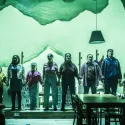
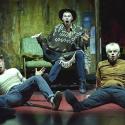
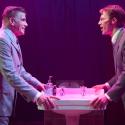
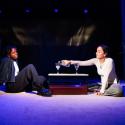
Alex Webb’s musical Café Society Swing, about a provocatively liberal Manhattan jazz club in the 1940s, made a much-anticipated return to the Leicester Square Theatre last night. With remarkable ingenuity and economy, Webb tells the story of the real Café Society, a radical and subversive multi-faceted entertainment venue, which on opening in December 1938 was the first non-segregated club in America. It soon courted further controversy with Billie Holiday’s debut rendition of “Strange Fruit”.
By cleverly reversing the chronology, Webb arranges the narrative so that the first half deals with the post-war hounding of owner Barney Josephson for supposed un-American activities. (His brother Leon was a member of the Communist Party, jailed for contempt of court.) The second half of the show then presents the club’s idealistic opening years, as it struggles to uphold its principles. Ultimately, it loses the battle for survival, but not before making important history in several ways, Holiday’s rendition of that superb but incendiary song perhaps the most enduring.
 As the title suggests, the music mainly originates from the peak of the swing era, when the rough edges of 1920s had been sanded to an incredible slickness, and rhythms had been honed to limb-twitching perfection. The band was superb, as you would expect with Denys Baptiste and Jason Yarde on saxes, and Freddie Gavita on trumpet. Gavita’s muted yowl alone raised the hackles, shivered the spine, and instantly set the 1940s scene.
For players of this quality, however, the score is quite straightforward: it’s the singers who have the challenge, and it’s not purely a musical one. Are they actors, replicating documented historical performances? Or are they jazz musicians, whose instinct is always to create something new? Three singers share the most exposed solo work: Ciyo Brown, also playing guitar, was charismatic, but sometimes lacked penetration; and Cherise Adams-Burnett sang with style and delicacy perfectly suited to her repertoire, which included the folk song “Lord Randall”, as well as standards. Vimala Rowe was sensational, managing convincing renditions not just of the standards, but also “Parlez Moi d’Amour”, in an authentic accent, and the closing number, “Strange Fruit”, delivered with eye-moistening poignancy.
In its current form, Café Society Swing makes a rather brilliant immersively theatrical cabaret show
As it stands, this show is in an interesting generic limbo. While the relative lack of clunky expositional scenes is both brave, in showing Webb’s confidence in the music to tell the story, and refreshing, because they are often the bane of the genre, it leaves a rather skeletal narrative framework (told expertly by the many roles of Gareth Snook) holding the songs together.
Looked at positively, this gives the piece an almost operatic feel, with emotion and plot densely conveyed by music alone; even the best musicals have quite substantial passages explaining who’s who and what’s what. In its current form, Café Society Swing makes a rather brilliant immersively theatrical cabaret show (though perhaps not one suited to dinner jazz venues: “Strange Fruit” is not a song to enhance your steak frites). For a sustained run in the theatre, another half an hour’s material would probably be helpful. (It’s barely two hours, with interval, in its current form.) Either way, the concept will scintillate and the music seduce.
- Café Society Swing opens in New York in November