It’s 1959. Trinidad is fighting for independence from British colonial rule, while the US is beginning to stake its own control over the island, whether through labour exploitation or crime. Some of the locals are finding themselves torn – between a desire to escape, or to have a piece of the action. And it’s driving them towards disaster.
Trinidadian British actress Martina Laird has turned to playwriting with a confident, evocative, and boldly authentic drama, set in the place of her birth, Port of Spain, and enriched by its patois. It follows its premier at the RSC’s The Other Place, in April, with a run at The Kiln, again directed by Justin Audibert. And it operates on a number of levels: as a noirish thriller, an intense family drama, and a hugely resonant reminder of the myriad ways in which colonialism can mess with a nation’s health.
The action takes place in one setting, the Alma, a gentlemen’s club in the port capital of the island. Designer Sadeysa Greenaway-Bailey’s design presents a sitting room with a kind of tatty grandeur, adapted only slightly to its task: a sofa and chairs, a record player, drinks lined up along one of the panelled walls. Light streams in through the shutters.
On the radio, there’s news of the latest speech by Eric Williams, who in 1962 will become the country’s first prime minister. But now a young woman, Ruby (Cat White) changes the station, settles on Put the Blame on Mame, Rita Heyworth’s signature turn from the film noir Gilda, and starts to dance along, Heyworth style.
White will spend the play in a series of stunning, figure-hugging costumes (also courtesy of Greenaway-Bailey) and the character’s deliberately seductive style reflects her relations with all of the men around her. When a policemen and friend Seldom (Shane David-Joseph, who offers the play’s comic relief) tries to casually con her, she snaps back: “It costs plenty to fuck me, plenty more to fuck me over”.
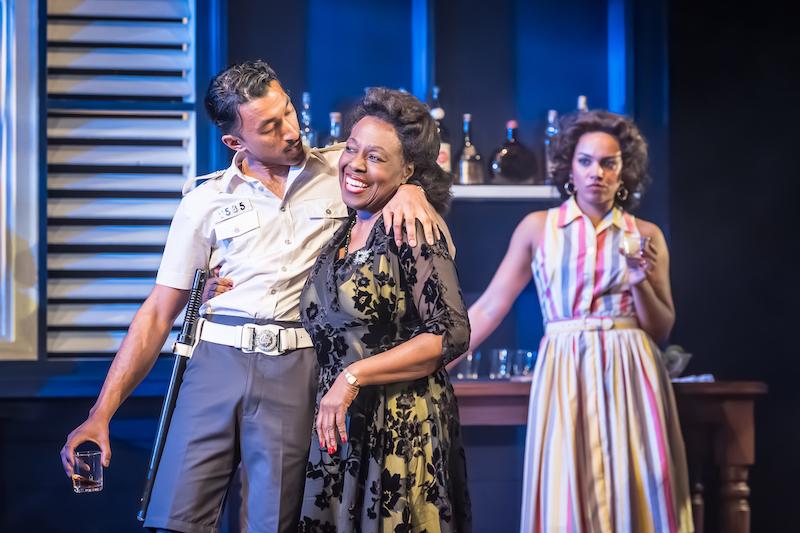
The Alma is run by Ruby’s mother Pearl (Ellen Thomas, pictured above with David-Joseph and White) for a patrician Englishman, Mansion (Roger Ringrose), a man who oozes genial venality, and uses his Caribbean income to fund his country piles back home. Both mother and daughter live in the house. Even though he dismisses the move for independence, Mansion has decided to return to England, while leaving Pearl to continue business as usual. Ruby is trying hard to wrest that control away from her ageing mother, but her plan is complicated by the arrival of Diamond (Martins Imhangbe), a brother she never knew she had. Pearl is none too happy to see him, but lets him stay anyway. And soon Diamond, with his overreaching ambition, is introducing Tom (Ziggy Heath), an American sailor with criminal connections and an eye on using the Alma for his nefarious purposes.
With all the characters manipulating and conniving, playing each other, and the steamy edge provided by the amorous attraction between Ruby and Diamond (despite being siblings), this certainly plays like a noir. But just as Ruby is fatale-adjacent, without much of an agenda beyond simple survival, the play itself uses noirish tics without going full-blown into the genre. Laird’s ambitions run deeper, underpinned by her interest in colonialism, gender power and dysfunctional family – all three interlocked in their effect on the damaged siblings.
Diamond, a strutting hothead, has been genuinely damaged by his abandonment by his mother, who in a tender speech will elaborate on the pressures that forced her to do it. At the same time, he’s bristling with anger at the years spend building roads for “the Yankies”, an affront that fuels a series of awful misjudgements.
Ruby hasn’t fared much better (their fathers aren’t even spoken of). But the greatest tragedy may be for Pearl, unfulfilled as a parent, who has spent a lifetime making money for a man who treats her as a slave, his “tropical nightingale”.
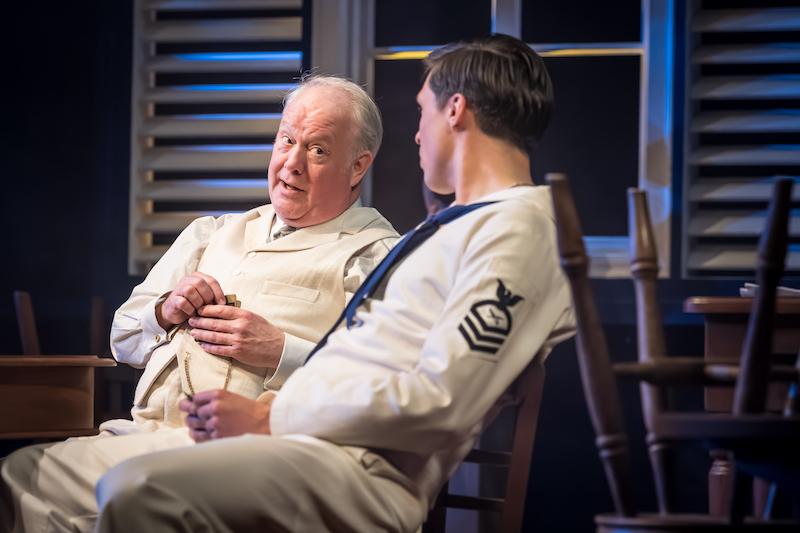
One of the play’s most incisive scenes involves a card game in which the Englishman and the American barter, ostensibly over the use of the house but really the future of Trinidad itself (pictured above, Ringrose and Heath). When Mansion patronisingly observes that the Brits play sport, the Americans play games, but on the islands “everything is like life or death” it’s not hard to imagine why.
Audibert directs an absorbing, uniformly well-acted production, with beautifully realised characters, language and music all firmly rooted in the setting; while the accents and idioms can be challenging at times, the determined authenticity pays ample dividends.
There could have been more. While there is a lot of bad rum delivered to the premises, this club never sees any customers, which strikes a false note; a few incidental characters would have offered a fuller sense of the island milieu, plus it just feels odd without them. The sexual relationship between the siblings is also undercooked. The fact that it’s barely commented upon suggests another societal issue here; leaving it unexplored contributes to the slightly messy denouement of an otherwise impressive debut.