Jack is an alcoholic. Stephanie is a whore. Joseph is stupid. Stevie is a broody neurotic. These identifiers are proudly proclaimed in the first minute of Matthew Perry’s debut play, but if you weren’t paying attention, fear not: they will be repeated, loudly and often. This is theatre as group therapy, and there is nothing left to the imagination.
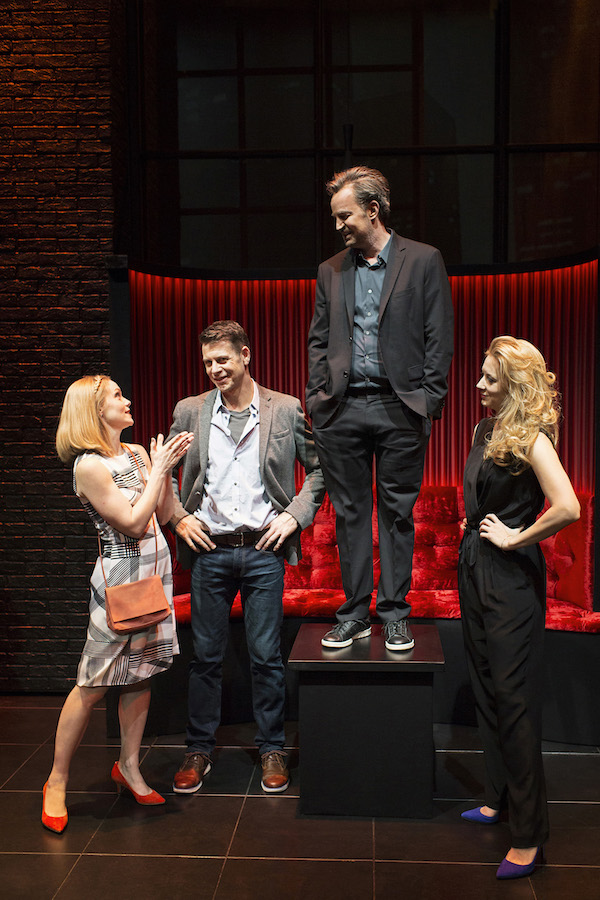
Though Perry (pictured below with the cast) has been wary of calling The End of Longing autobiographical, it’s not hard to read his character Jack as an avatar: the single, 40-year-old addict who masks self-doubt with sarcasm. But if this is a personal statement, shouldn’t it feel more, well, real? A couple of specific experiences aside – arriving at a bar two hours early so friends can’t see the extent of his drinking; accidentally broadcasting porn to the neighbours – this is a hazy, generalised account of the disease, more rehab role-play than fully realised drama.
 Short, glib scenes, overloaded with sitcom one-liners that cry out for a laugh track, lay inadequate foundation for the screeching turn into melodrama. “It’s breaking my heart!” cries Jack’s paramour Stephanie (Jennifer Mudge) in one particularly hackneyed exchange. “It’s drinking or me!” The action may take place in a soulless LA, but the dialogue, at times, is pure country song. Problems are bluntly diagnosed – prostitute Stephanie saddled with generic daddy issues, Jack needing booze to escape reality – and then awkwardly reworked into romcom. Love, it turns out, is a magic cure-all. And life is short. And problems can be willed away.
As lightweight comedy, the play has its moments. Christina Cole and Lloyd Owen work wonders with their odd couple: motor-mouthed, overanxious pharmaceutical rep Stevie and amiable dimwit Joseph, her human Xanax – although the latter’s supposed idiocy is undercut by his superfluity of Perry wisecracks. They provide decent physical comedy too, and build up enough good will to survive some of the creakier construction. Mudge delivers her myriad gags with a wry drawl that suggests Stephanie’s fragile veneer of sophistication, but she’s limited with a character built on conflicting male fantasy and hypocritical puritanism.
The most curious performance is Perry’s, which joins his writing in a tight race to the bottom. His delivery is stilted and unvarying, lacking the semblance of spontaneity injected by his castmates. Some jokes land in amiable fashion, but it’s an acting choice at odds with his supposed desire for darker, more reflective work. A moody cityscape backdrop to Anna Fleischle’s sleek, sliding set suggests a contemporary urban alienation not borne out in what is ultimately an old-fashioned, sentimental piece, dutifully marshalled by Lindsay Posner. Repeating the words “fuck” and “prostitute” as often as possible do not equal edgy drama.
Equally baffling is that Perry, who tried so hard to escape the shadow of his TV juggernaut, has essentially created a later-life version. It doesn’t take a devotee to recognise Chandler and Joey in the play’s Jack and, er, Joseph. That, at least, should satisfy Friends fans in the audience, but there’s little else to justify its vacuous presence in the West End.