By picking his way through Homer’s Iliad and Odyssey, and Virgil’s Aeneid - written 600 years later - Simon Armitage has it all, including the horse and Helen, each of whom in their way enable the hordes to breach Troy’s gates. What with that and the mingling of mortals and gods, not to mention the 100,000 troops that Agamemnon leads across the Aegean to rescue Helen, there’s a lot to attempt to pack into this theatre’s intimate space in three hours. Rather too much as it turns out.
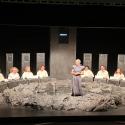
In order to accommodate the action, director Nick Bagnall has moved slightly away from the usual in-the-round format by having a large wooden ramp at one end to represent the city gates. At crucial moments, it opens up effectively to reveal a tunnel entrance to what looks like an underground car park. Hordes of spear-carrying warriors – well, 14 men and true – pour out at the height of battle.
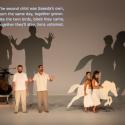
The Last Days of Troy is set in present-day Hisarlik, in north-west Turkey, the archaeological site considered to be the geographical location of ancient Troy. But since Bagnall uses minimal props and furniture, there is little sense of place. And, near the end, we have the horse. Not one out of Warhorse, all realistic, but a nursery toy on wheels, which is encircled by a large circular wooden casing descending from on high.
 We also have Helen, supposedly given a pivotal role here rather than her walk-on part in Homer. Playing the part is model-turned-actress Lily Cole, the face that has launched a thousand ads. She is decorative, statuesque and strangely passive, more peripheral than pivotal, often merely spectating from the balcony. We certainly don’t get any sense of her being, as the programme sells her, “Helen of Joy, Helen of Slaugher”. In truth, both the horse and Helen come as somewhat anti-climactic.
In the mingling of mortals and gods, Odysseus represents an amalgam of high-ranking nobles, whilst the gods of Olympus are represented by Zeus, Hera and Athene. The three of them squabble and banter and provide the comedy.
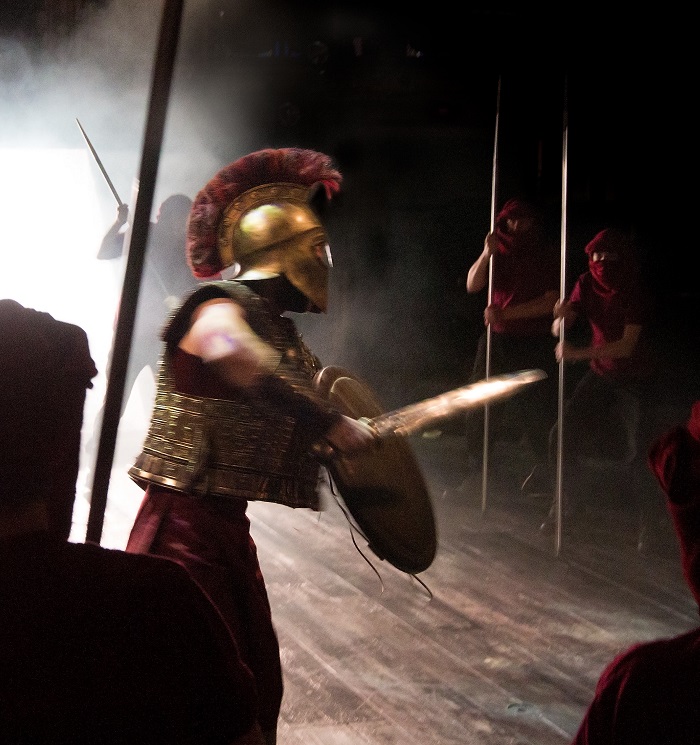
Zeus, splendidly portrayed by Richard Bremner, both comic and serious, really is pivotal. He opens proceedings looking like a white-haired vagrant purveying plaster models of himself from an old suitcase. And throughout the play he acts as both manipulator of events and as narrator. For instance, instead of seeing much in the way of hand-to-hand combat, we have to rely on his graphic description. Bagnall goes largely for a tell rather than show approach, except for the showdown sword-fight between Achilles, athletically and passionately played by Jake Fairbrother, and Hector, matchingly mobilised by Simon Harrison. There are strong performances all round in the 14-strong cast, with David Birrell bringing a sense of leadership, bombast and ruthlessness to the part of Agamemnon, and Tom Stuart shows Paris to be a sensitive Paris.
Armitage intersperses the scenes where mortals are concerned with warring, scheming to bring the conflict to a conclusion (unlike Homer’s Iliad) after 10 years, with the light relief of the gods. He digs into the lives and loves, the ambition and pride, the real relationships of the men and their women. The epic tale is told in a clear narrative and, as you would expect, the language, if not poetic is lucid, ranging from the grandiloquent to the everyday backchat, notably of Zeus and Hera (the excellent Gillian Bevan). Their exchange near the end, where they are again reduced to mortals trying to scrape a living by selling their little effigies, sums it up. They talk about when they first got together as young lovers. “And the rest is history,” says he. “Well, some call it mythology,” says she. And that is the key – it is impossible to say where history ends and mythology begins.
- The Last Days of Troy at Royal Exchange, Manchester until 7 June