We all remember that moment when we walked through the back of the wardrobe: the heaviness of the fur coats, that first crunch of the snow underfoot. It’s an extraordinary moment of childhood that has also become too normal because shared memory has made it so. What does it really mean to walk through a door and emerge in another world entirely? That’s inevitably one of the questions involved in staging The Lion, The Witch and the Wardrobe, and Sally Cookson’s production rises magnificently to the challenge.
Rae Smith’s thrilling design offers nothing as literal as a wooden cupboard: what we have instead are two vast wooden doors behind which lurks a sinister fur-clad army. In a production whose many references include the 1969 moon landing, the massive doors float through the atmosphere until they join. As Lucy, followed by her siblings, breaks through, each arrival in a new world is heralded by a cosmic fork of lightning.
CS Lewis purists need not fear: this production – which initially played triumphantly at Leeds Playhouse – very much draws its magic from the original. In a post-Philip-Pullman, and, let’s face it, post-middle-class age, any director needs to interrogate the class-bound Christian roots from which this timeless novel was allowed to grow.
What Cookson and the impressively titled "Writer-in-the-Room" Adam Peck have done is identify that the magic comes from a child’s ability to appreciate the infinite wonders of the universe. The tone is set on the evacuees’ train journey, in which the train is evoked by a model engine, behind which the Pevensie children’s old-fashioned Forties suitcases suddenly transform into carriages whose windows blaze with light.
Magic, in any story, needs to be underpinned with emotional heft, and here the sense that the Pevensies are deeply traumatised by their separation from their parents because of the war is a powerful grounding factor. Keziah Joseph’s Lucy deftly heads up the narrative, but the crisis of masculinity in both John Leader’s gawky disenfranchised Edmund and Femi Akinfolarin’s Peter – forced too young into the role of a parent – plays out a psychological drama all too familiar in broken families today.
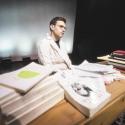
At a point when His Dark Materials is thrilling audiences weekly on the BBC, we are reminded that Bridge theatre co-director Nicholas Hytner was the first to dare to realise Philip Pullman’s vision of humans and their daemons. In Cookson's vision, when Aslan appears, we see the lion first in the form of a vast skilfully-articulated puppet: then Wil Johnson (who doubles up as the bespectacled Professor Kirke devoted to his cat, who in a hat-tip to parallel-world theory, is called Schrodinger) strides forward in his magnificent fur coat.
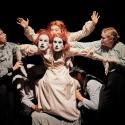
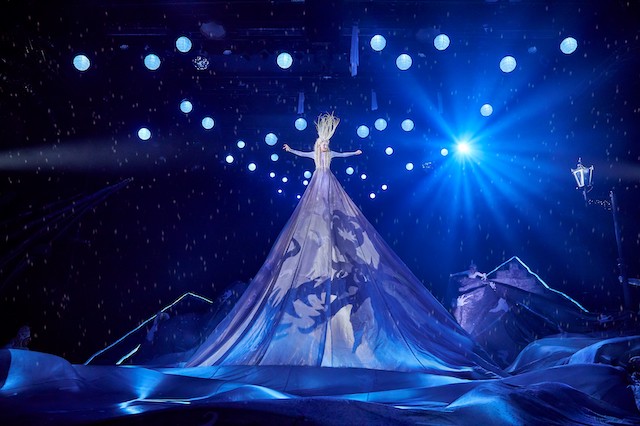 It’s all part of an electric interpretation, where Laura Elphinstone’s spectacular White Witch (above) – like the devil – has all the best tunes. She first appears on a structure that looks like an elegant illuminated line-drawing of a rocket: it could equally convey her across the snow or blast her through the stratosphere.
There are then, no lack of transcendent moments: but Christmas shows also need to revel in unashamed (yet definitely very woke) populism. We have in this spades (or is that snow shovels?), whether it’s in the form of bossily comedic evacuation officers, beavers who produce a “vegan hotpot” alongside the legendary marmalade roll, the White Witch’s baboon-like demons, or the folk Father-Christmas who performs a tap-dance as spring ushers its green revolution into this winter wonderland.
It’s a vibrant re-imagining which proves that, like any classic, this mid-20th century work of fiction lives on because it can embrace the shifting manifestations of historic and modern attempts to understand what underpins what life, at its most turbulent, can throw at us. In Cookson’s hands, Lewis’s narrative translates into a potent narrative of parallel worlds, in which childhood confusion is transformed into a spellbinding perception of infinite possibilities.
- The Lion, The Witch and the Wardrobe at the Bridge Theatre until 2 February
- Read more theatre reviews on theartsdesk