Jean Genet’s 1947 play has been quite a clothes-horse over the years, at times a glamorous confection dressed by designers, and regularly shape-shifting and gender-fluid. Cards on the table: I have disliked most productions of it for this odd vacuity, which allows it to become unmoored so radically from its source, the real-life case of a mistress and her daughter murdered by their two maids.
It pokes at you from the off with its sense of itself as an anti-play; it's more an arch ritual, there to provoke and mystify its audience, especially the average bourgeois. Its latest incarnation comes courtesy of Kip Williams, the Australian who created the video-crazy one-hander The Picture of Dorian Gray for Sarah Snook, seen in London in 2024.
For his “new version” of The Maids, Williams has branched out into modern telephony as his dramatic accomplice of choice. Each maid is armed with a smartphone, with which she films parts of the proceedings. Or she takes endless selfies, often having to fiddle with the phone’s settings to apply a filter that contorts her features into weird guises – a woman in full slap with a trout-pout, a grotesque old hag. The images from the phones are simultaneously projected onto the floor-to-ceiling panels at the rear of the stage, which double as mirrored wardrobes for their mistress’s vast collection of designer clobber. It's thrilling to watch at first, but eventually becomes an overbearing focal point.
Both Williams’s maids are played by women, and they work for a woman they call “Madame”; no character names are attached to the actors in the programme, but they refer to each other, as in the original, as Solange and Claire, increasingly interchangeably. Appropriately, Williams has larded the dialogue with references to emails and Ozempic, Kylie and “Anna”, the queen of fashion that all three claim to adore.
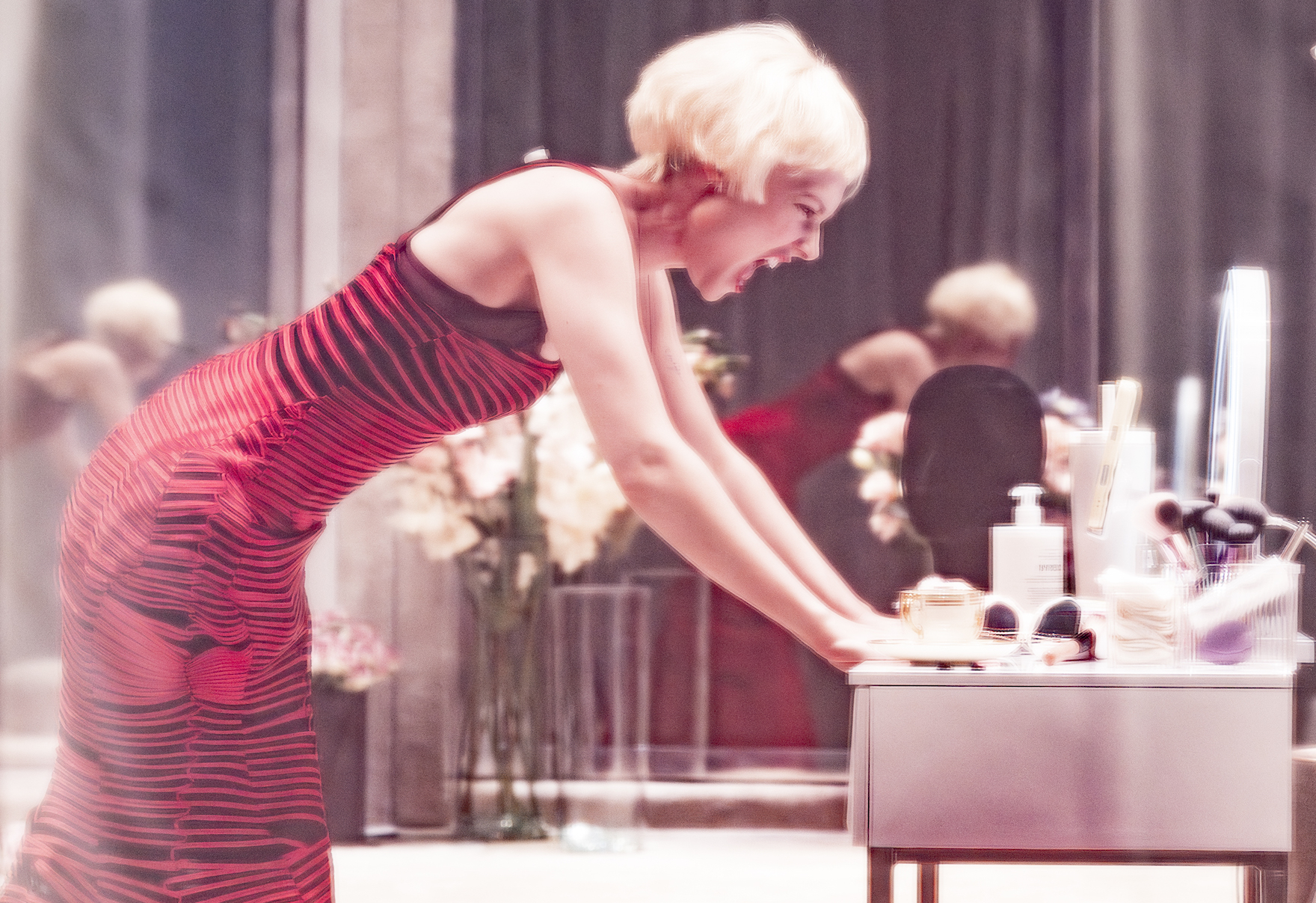 The women endlessly role-play as mistress and servant, in long screeds of abusive dialogue, with a “fucking” in every sentence. The drama opens with “Claire” (Lydia Wilson, pictured left) berating “Solange” (Phia Saban, pictured below) in the persona of Madame: a runaway train of angry insults and poor-me complaints – about the pink flowers that fill the room, the pink plastic gloves Solange is wearing, the arrest of Madame’s boyfriend for fraud, Solange's habit of spitting on everything as she cleans – delivered with traces of an Australian accent. When Madame (Yerin Ha) eventually arrives, she is indeed Australian, and every bit as vicious as Claire’s version of her suggests, unleashing a nonstop stream of invective steeped in bile.
The problem is that Wilson-as-Madame seems robotic, her helter-skelter pronouncements like the delivery of an actor reading from a teleprompter rather than the craft of a seasoned parodist, which her character apparently is. Perhaps she is supposed to be a lesser thespian than her sister, but her speechifying is tough to listen to, with no light and shade. Saban, on the other hand, is a natural comic talent, a buffoon with a robust intonation who can land every line and is especially funny when she does her impersonation of Madame’s doltish boyfriend. There’s a freshness about her, despite the madness of the context.
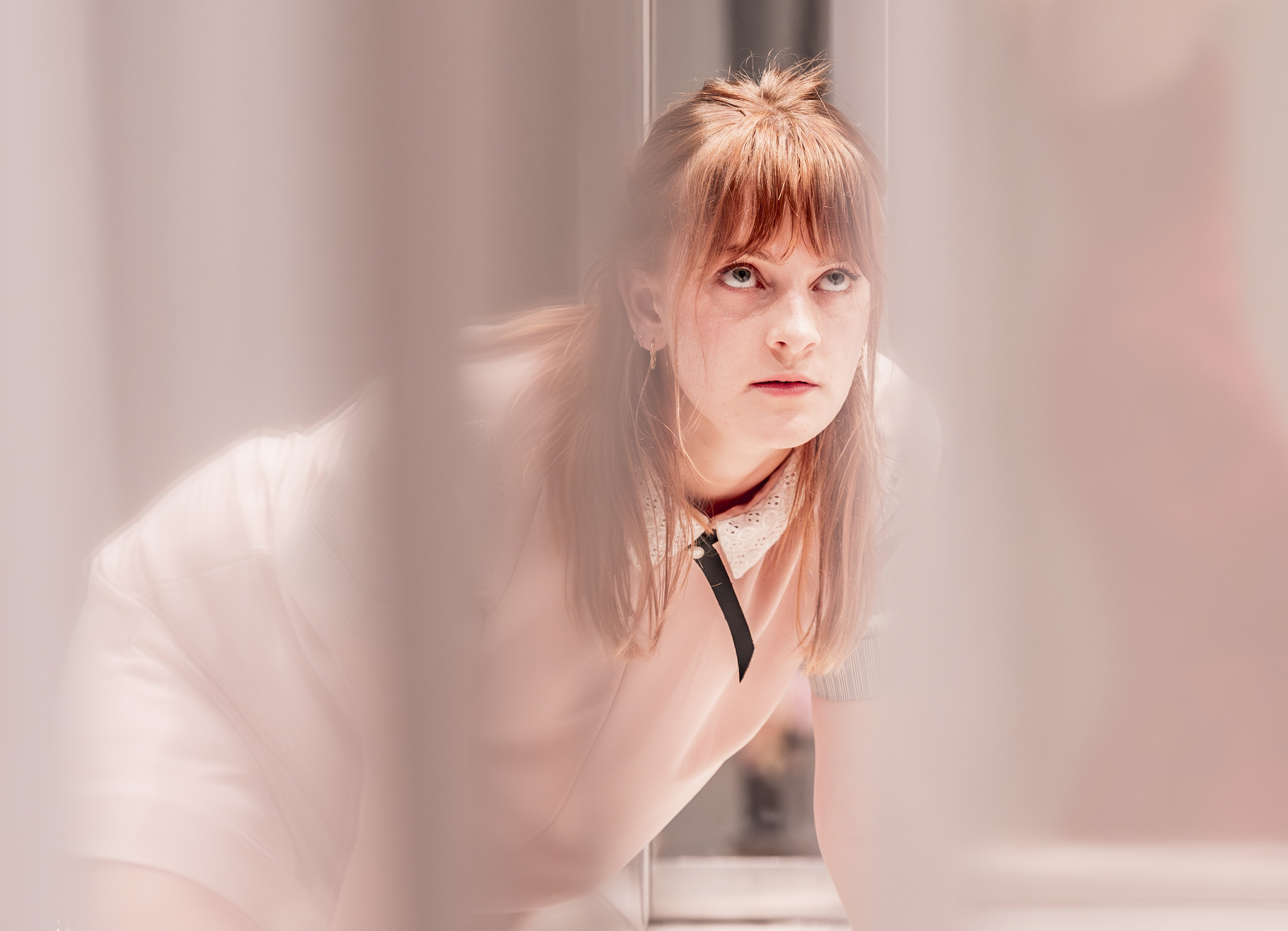 The world of the play here is one where social media rule. Madame is a Celebrity, her flat is surrounded by fans and 28.4 million people follow her online. She apparently has a chef, a personal trainer and other staff working away elsewhere in the building, though we never see them. Her clothes are at the OTT end of the designer spectrum, some specially created for her by [insert famous designer’s first name here]. But her maids too have an online presence, as all self-respecting young social media folk must, and they plan to include this audience in the murder of their hated mistress, long in the planning.
Is it Madame they hate, or the world she inhabits, which has bred this monster? The maids are conflicted: they lust for this world too. It’s “an incredible life, but it’s not ours”, as one of them describes it. Nothing is real there, it’s an “eternity of fake… an eternity of silicon”, as Saban calls it in her final, climactic diatribe. Genet’s emotional void has become a beauty tweakment.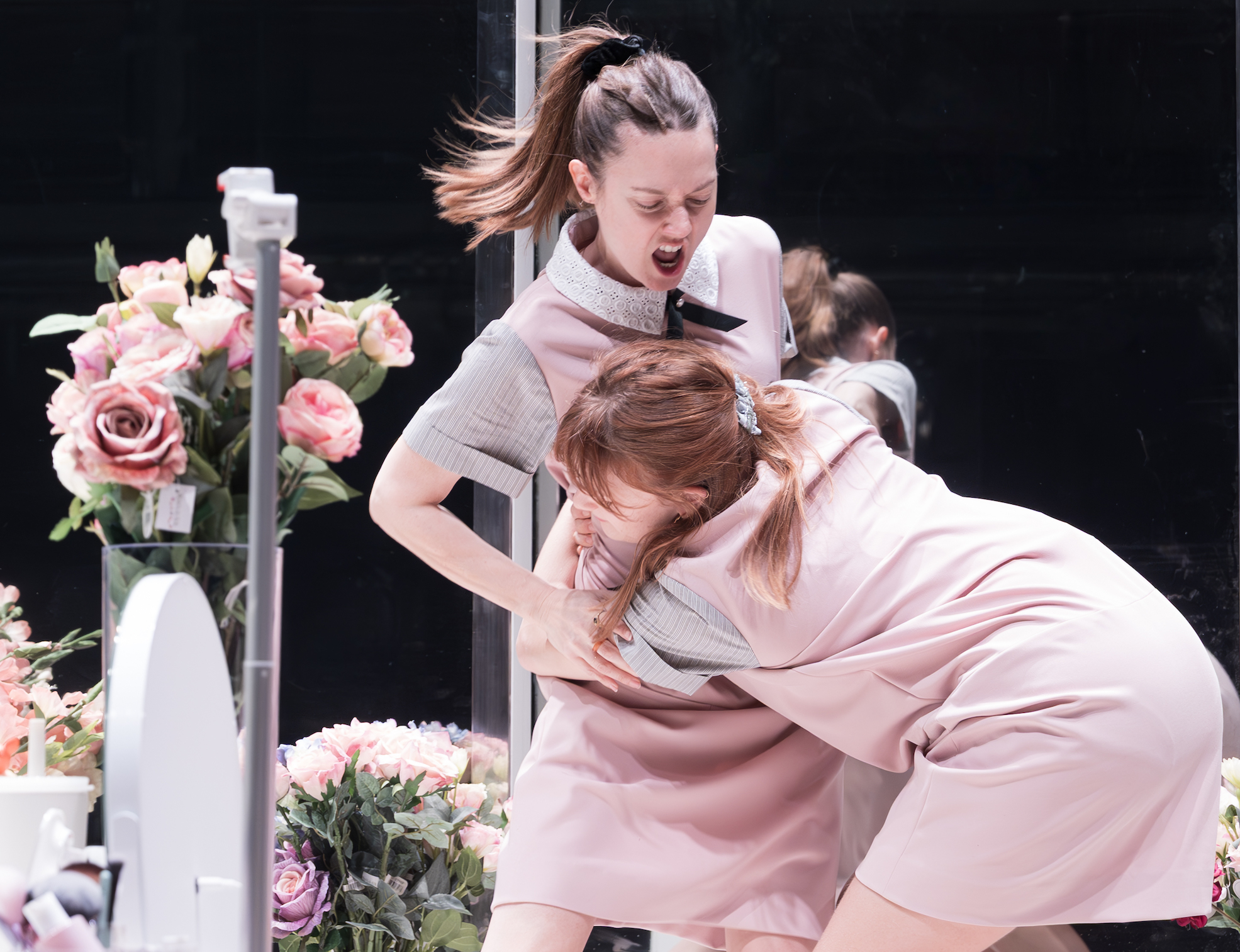 As the drama proceeded and Madame finally appeared, I became increasingly unsure – in a play where certainty is not a priority – what Williams wants from his revamp. Surely he Isn’t trying to turn Genet’s hothoused constructs into people we can understand? But yes, Madame is clearly a one-percenter to despise, screaming about her flowers, as she flings them around in a frenzy: “Nobody's doing pink hydrangeas any more!” Her kind of brand-mad, name-dropping celebrity has become an easy target, yet Williams goes for it. He seems to want to score points against the empty trivia of social media and its spurious notion of what constitutes success -- excess? But what the piece has to say about this empty distraction is oddly old hat.
With one foot in the real world like this, attempting social satire, it’s hard to “read” the fevered behaviour of the characters Williams has fleshed out. There are flickers of a homoerotic bond between the sisters, but nothing consistent; Madame is a creature they “love” as well as hate, but these terms drown alongside countless others in a slew of verbiage. This isn’t a gay Maids, a cross-dressed one, a politically incendiary one, where the underclass fights back. It’s more a sort of modern fever dream that you have to sit back and give in to.
Just letting it wash over you is exhausting, frankly. Hats off to the cast, whose stamina is incredible.