There has been a trend in productions of A Midsummer Night’s Dream in recent years to portray Athens as a sexually repressive regime in which Queen Hippolyta is resentfully shackled to Theseus after he has conquered her in battle. The Bridge Theatre’s – ultimately gloriously escapist – Dream, portrayed Theseus as a tyrant from The Handmaid’s Tale. Meanwhile, the beautifully austere Dream which played at The Sam Wanamaker Playhouse last Christmas, showed him as a psychotic misogynist.
This is a completely valid reading of the text – I personally have never recovered from the realisation that Hermia’s father, Egeus, is contemplating an honour killing if she refuses to marry Demetrius. Yet in Emily Lim’s open-hearted, riotously colourful production, there’s no such sense of oppression. Enyi Okoronkwo’s Theseus and Audrey Brisson’s heavily pregnant Hippolyta can’t keep their hands off each other, and it is Hippolyta who declares – flirtatiously – to Theseus that “I wooed thee with my sword”, rather than vice versa as in the original. It is also Hippolyta rather than Theseus who warns Hermia she might end up in a nunnery, but here her warning comes across more as the misguided complacency of a soon-to be-mother than as a genuine threat against Hermia’s freedom.
It’s a Dream that’s very much in the Globe’s tradition of crowd-pleasing entertainment, filled with music, laughter, and appropriately absurd audience participation. Michael Grady-Hall's Puck is a suitably irreverent agent of misrule. When he walks on stage, clad in pale green with white pom poms on his tights, his first act is to blow on a fountain topped by a cheerfully urinating cherub so that the water comes to an abrupt stop. After he retrieves the flower that Oberon calls “Love-In-Idleness”, he squeezes some of its juice into his own eye by mistake, which meant that on opening night he spent the rest of the evening besotted by an audience member called Steve.
The music – directed by Richard Henry with folk songs composed by Jim Fortune – is a particularly striking aspect of a production that emphasises both the joy and the healing potential of community. A band, made up of a tuba, percussion, accordion and two violins, accompanies songs ranging from Step It Out Mary, vividly performed by Sophie Cox’s Hermia and Romaya Weaver’s Helena at the start, to a gloriously comedic rendition from Titania and her minions of Harry Nilsson’s One Is The Loneliest Number. Frequently we as audience members are encouraged to join in. This works most magically when Puck divides the audience into four sections, teaching us to sing a chord in which the suspended harmonies provide the perfect sonic backdrop to moments of transformation and revelation.
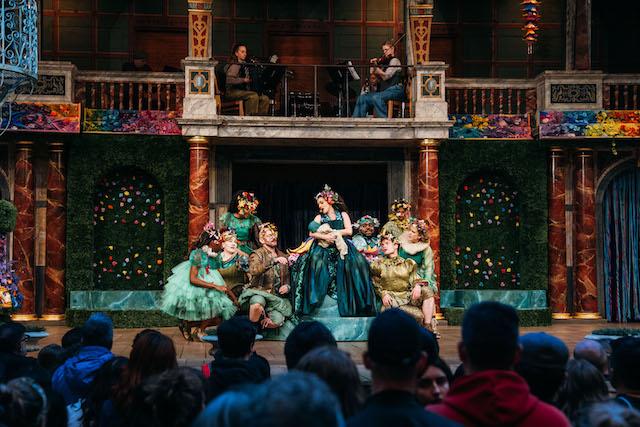
Amid all the music and merriment there is plenty of interesting attention to detail in the text, not least the moment when Titania frets about her dispute with Oberon. Suddenly her words – underscored by violin playing – seem to prefigure our anxiety about climate change. “Therefore the moon, the governess of floods,/Pale in her anger, washes all the air/That rheumatic diseases do abound:/And thorough this distemperature we see/The seasons alter.”
There’s nothing heavy-handed about this emphasis – the overriding message of the evening is that life is best when we resolve our differences and collaborate to celebrate the wonders of the world around us. It’s far from a panacea from the world’s problems, but it’s a highly enjoyable diversion. As with the best ensemble performances, there are many stars here – whether it’s Adrian Richards’ bombastic silver tinsel-clad Bottom, Mel Lowe’s slightly uptight funny-boned Lysander, Brisson playing Titania as a diva in emerald green, or Jamal Franklin as a cowardly lion. Lines are liberally borrowed from other plays too, ranging from King Lear to Julius Caesar, adding to the sense of exuberant irreverence.
Lim’s production won’t go down in theatre history as an outstanding Midsummer Night’s Dream, but it’s a warm and enjoyable reading that should definitely draw in the crowds. Stamp designs from conceptual artist Jeremy Deller heighten the sense of power to the people. On an unusually warm April evening – which seemed to fall in line with Titania’s predictions – it proved a delightful aperitif for the capital’s cornucopia of summer entertainment.