People sneer at musicals for endless reasons: they hate Broadway brashness, non-naturalistic lurches in and out of song, the sentimentality. One of the least acknowledged reasons, however, is because their plots – predictability plus songs – have zero tension. And you know what? Placed in the witness box, many a musical emerges guilty as accused. But the quietly astonishing Once is innocent of all those charges. Deftly exploding just about every myth about musicals, it’s simply riveting.
The tension maintained throughout John Tiffany’s bewitching production is all the more remarkable for two reasons. For starters, it’s a known quantity, an adaptation of the indie-film of the same name that cost less to make than the on-set catering budget of a Hollywood movie. Secondly, on the face of it, the offbeat story doesn’t sound gripping.
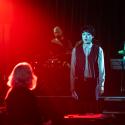
In this will-they-won’t-they Dublin tale, the disarmingly direct Zrinka Cvitešić is the unnamed Czech girl who accidentally witnesses musician-cum-Hoover-repairman Declan Bennett (pictured below) singing his heart out. A closet pianist working for little money in a music shop, she not only recognises his talent (as does the audience held in thrall by the shocking intensity of Bennett’s folk/rock voice), she realises that in the wake of serious heartbreak he’s dangerously at the end of his tether.
 Intolerant of his despair, she sets about reawakening his passion for music. But from this quasi-regulation screwball meet, nothing about either relationship or the show itself proceeds predictably. Tension is consistently built via the ceaselessly surprising handling of the material. Everything from Steven Hoggett’s subtly stylised movement to the pretension-puncturing wit is so constantly inventive that you‘re kept enthralled because you can almost never tell where a scene is going.
That much is clear from the opening number, inasmuch as there isn’t exactly an opening number. On Bob Crowley’s single curved set of a homely Dublin pub bedecked with glowing lamps and tarnished mirrors wrapping the stage, audiences are metaphorically and literally welcomed into the beguiling atmosphere with drinks available to anyone going on stage to savour the cast’s hootenanny in full swing as audiences arrive.
The deliberate blurring of the line between this and the show proper is indicative of the production’s dazzling fluidity. Much of that is down to the cast who are on stage throughout. As well as slipping drolly in and out of scenes, they play Martin Lowe’s frankly ravishing acoustic arrangements on everything from guitars, mandolins, ukeleles, violins, cello and accordion to, for heaven’s sake, a melodica. Having actors double as musicians is nothing new, but instead of merely slimming the budget while cluttering up the storytelling, here their musicianship is the story. Once is, in the widest sense, about the emotional power of making music, so having everyone sing and play gives the story and its staging compelling authenticity (the Once ensemble, pictured below).
 From Jez Unwin’s insanely repressed bank manager to Valda Aviks's take-no-prisoners mother, Enda Walsh’s cunning adaptation of the original screenplay banishes any vestigial tweeness via layers of comedy. In other words, Tiffany's production takes the material, but not itself, seriously. Furthermore, this injection of humour helps keep the stakes high through to the hugely affecting emotional climax. So much so, that the music can afford to take its time.
Keeping the production’s workings constantly on display though (as in War Horse) encourages audiences to use their imaginations. Alongside foot-stomping company numbers and “Falling Slowly,” the ballad which won the 2008 Oscar for Best Song, the highlight is “Gold”. Sung a capella by the entire company but barely rising above pianissimo, it’s a gloriously earned vision of hope. Beneath Lowe’s glowing harmonies, Hoggett’s performers stand stock still but then simply shift their weight, once, from one foot to the other. The tiniest of touches, it makes no literal sense but sends a surge of joy through the auditorium. It encapsulates the production’s restrained but exhilarating power.
Have I made myself clear? Go.