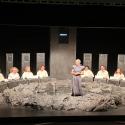
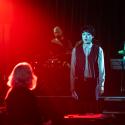
Ding dong, merrily on high! Christmas is almost upon us, and those girding themselves for a ghastly family get-together, complete with forced good cheer, paper hats and booze-fuelled bust-ups can see all their worst domestic nightmares enacted in Alan Ayckbourn’s bilious tragi-farce. Painfully funny and piercingly desolate, it’s a side-aching, heartbreaking depiction of loneliness, self-delusion and misery in middle-class suburbia. And Marianne Elliott’s excruciatingly fine production is as sour and dyspeptic as a Boxing Day hangover.
It’s the early Eighties, and at the home of Belinda and Neville Bunker (a couple who, in riveting performances by Catherine Tate and Neil Stuke, share an itchy, scratchy marriage that sticks them together and routinely tears them apart like Velcro), friends and relatives gather to share the festivities. Neville’s dipsomaniac sister Phyllis (Jenna Russell) is in the kitchen, woozily cutting herself on every available sharp surface and bleeding all over the Christmas Eve roast lamb dinner. Her ineffectual husband Bernard (a wonderful, poignant Mark Gatiss, hands thrust into his cardigan, his thin frame like a knotted pipe cleaner), is preparing for his annual puppet show, intended to entertain the children, but none too discreetly dreaded by all.
Neville and Phyllis’s bigoted Uncle Harvey (David Troughton), a former security guard who fancies himself something of an SAS commando, has a knife strapped to his shin and has bought toy guns for all the kids. And Eddie (Marc Wootton), Neville’s lifelong mate, has gone AWOL while Katherine Parkinson as his heavily pregnant wife Pattie is left tending to their fractious offspring in a deadened, despairing daze. Throw in Nicola Walker as Belinda’s desperately unhappy sister and Oliver Chris as the handsome young writer she brings along in the hope that tenderness might spark between them – an expectation that quickly founders when he and Belinda lay eyes on each other, and it’s lust at first sight – and the recipe is complete for a Yuletide feast of recriminations and disappointments that will be repeating on them all like acid reflux for years to come.
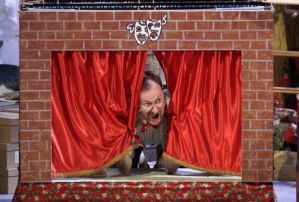 Rae Smith’s set, a three-storey cross-section of the Bunker domicile, is raw-edged; we can see the cardboard-like flimsiness of the walls, betraying the worrying fragility of the entire edifice and the marriages it contains. It’s no accident that Bernard’s puppet show is a retelling of the story of The Three Little Pigs; it wouldn’t take a huffing, puffing wolf to blow down this house of straw. The design also brilliantly facilitates the farce, allowing us to watch, horrified, as characters emerge from one room and descend the staircase to enter another, just in time to cop an eyeful of whatever unfortunate and inappropriate incident might be in the process of unfolding there.
And there are plenty of those: bungled sexual congress under the Christmas tree, ugly rows, stumbling, shambling drunkenness that lays bare whole wastelands of unhappy family life. Ayckbourn neatly yet savagely skewers the old canard that “Christmas is for the kiddies”; here, children are often mentioned but never actually seem, and when they are discussed it’s almost always in negative terms. Sweeping up sticky, scattered Dolly Mixture from her carpet, Tate’s Belinda wonders furiously, “Why they can’t put them in their ugly little mouths?” Parkinson’s Pattie, sliding wearily into a chair remarks, defeated and and deadpan, “The thing is, I don’t really want to have this baby, you know?” It’s certainly a hell of a set-up for the infant to be born into. These are relationships built on lies and habit; and in this context, even Uncle Harvey’s paranoid remarks about social apocalypse contain a grain of truth: “It’s all coming apart, you know. The whole fabric, ripping apart like tissue paper.”
But if all that sounds grim, it’s also killingly funny. The cast are terrific, their timing impeccable, and their moments of lucidity agonising. Gatiss’s self-loathing Bernard (pictured above) is especially good, matched by Russell as his slurring liability of a wife, got up in a pointy, tinsel-bedecked hat and a flouncey blue dress like an off-kilter Christmas fairy. And Stuke and Tate brilliantly capture the circuitous war of attrition between two people who have long since ceased to love one another but lack the courage and the energy to break free. It’s no sugarplum of a show, but this is as Christmassy as over-boiled Brussels sprouts: deliciously awful.