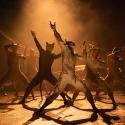
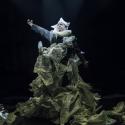
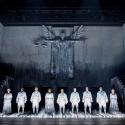
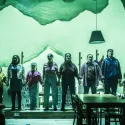
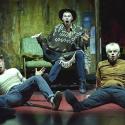
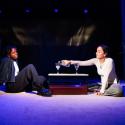
Time runs on different lines in Russian theatre to our own. The 83-year-old Galina Volchek co-founded Moscow's Sovremennik Theatre in 1956, and has been its artistic director for the past 45 years; Three Comrades has held its place in the Sovremennik repertoire since 1999. Search the British theatrical tradition for long-running shows and you may come up with one or two, like An Inspector Calls and The Mousetrap; but those have had regular cast changes. The Moscow public, it seems, likes to hold on to its stars. That made for some difficulties in age credibility last night, but there's no doubt that this is still a well-oiled machine that deserves to travel.
Our three comrades/Kamaraden/tovarischi are no communists – as they’re taken to be in a late scene here – but buddies bonded through suffering in the First World War and barely living as car mechanics in the Berlin of the late 1920s. Erich Maria “All Quiet on the Western Front” Remarque looked back in anger during his exile from Nazi Germany in the late 1930s; his novel became a successful Hollywood movie starring Margaret Sullavan and Robert Taylor. For essentially this is a love story between a frail girl and a penniless young man: think Murger’s Scenes de la vie de bohème a century on where the “students” are instead no-hopers with their futures taken away from them.
It’s easy to see why the novel was adapted for the stage by Volchek and Alexander Getman. There's not exactly an abundance of 1930s Russian drama looking back on the previous decade with honesty, and on this company residency in the Piccadilly Theatre the play should make a neat companion piece with the dashed hopes of Chekhov’s Three Sisters. There’s no attempt to shoehorn the book into a well-made play; countless short scenes are used to set up the mood and characters – established with admirable swiftness in the first ten minutes – with designer Pavel Parkhomenko’s appropriately shabby bits of set moved around as nimbly as if they were painted flats and Damir Ismagilov's lighting adding immensely to the atmosphere, a lesson in effective stagecraft. The sound collage, though its basis is dated-sounding synthesized music, assists the moodiness, too, until an ear-splitting ending which is the only obvious concession to new Russian vulgarity.
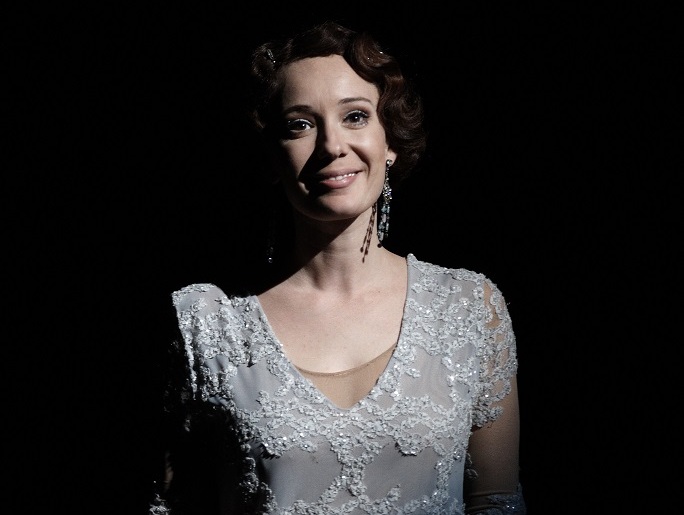
Ultimately, though, it’s all about the doomed romance between Remarque’s Rudolphe and Mimi, Robert Lohkamp and Pat Hollmann; no Chekhovian even distribution among the three supposedly main characters here. On the first night we were lucky to get one of Russia’s top actors, Chulpan Khamatova (pictured above), as the consumptive heroine, with her kittenish tones matched to a lithe physicality and charismatic beauty. Alexander Khovansky brings a not always appropriate vocal lugubriousness to her bottle-addicted, confused suitor. Still, they make a good pair, and when the pointedly cluttered set clears at the beginning of the second half to briefly replace the city with the seaside, the idyll is charming and Remarque’s mostly prosaic text hits a poetic streak.
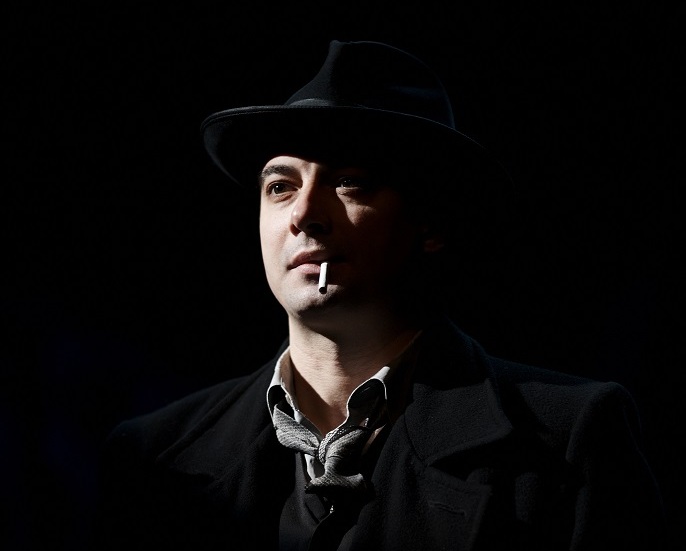
Khovansky (pictured above) is about a decade too old for the part now; so are his fellow comrades played by Sergey Girin and a disconcertingly hoarse-voiced Sergey Yushkevich. Age does matter here: the younger the actors, the more sympathy we feel for potential nipped in the bud. The ensemble, though, is undeniably impressive; a 37 strong cast moves around the stage as naturally and convincingly as the pieces of scenery. It’s a shame that the music-drenched sentimentality, bitter-sweet in a scene filled with Robert’s beloved prostitutes, finally explodes in a bathetic apotheosis. The smartphone-wielding Russians in the audience (my neighbours among them) seemed to love it. If you want the best fictionalised depiction of Berlin in 1928, stay at home with the 14 episodes of Fassbinder’s Berlin Alexanderplatz. But if you’re fascinated by how a fine Russian company handles the German picaresque, this is worth a shot. Hopefully the supertitles, a real handful moving at rapid speed, will hold out better than they did last night, but otherwise the production serves the Volchek ethos very well indeed.