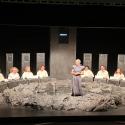
In one lifetime, the many loves that once dare not speak their names have become part of everyday chatter. But it would be shortsighted to believe that ancient prejudices are easy to overcome, or that change does not run the risk of creating familiar problems. In this new play, Wife, Samuel Adamson explores several decades of the trials and tribulations of forbidden love in a piece of epic theatre that is also exquisitely personal. At the same time, he has also penned a fan letter to the theatre, taking Ibsen's A Doll's House as a template against which to measure social progress.
The story starts in 1959: Suzannah has just come offstage after playing Nora in Ibsen's play and is taking her make-up off in her dressing room. Her one-time lover Daisy, who has been in the audience, visits her, with her new husband, Robert, in tow. Daisy loves the play, but her husband hates it: there's a passionate discussion about Ibsen's message of female independence, and then a more intimate dialogue between the two women. The issues include the question of how you think about marriage: is it a true meeting of minds, or a prison house with two jailers? Is theatre a safe place for sexual outlaws, or just an escape from reality?
These themes are then recapitulated in 1988, when Ivar — Daisy's son and a gay activist in the AIDS era — has a heated argument with Eric, his 20-year-old and therefore technically underage boyfriend. In 2019, it is the turn of Clare, Eric's daughter, to meet a much older Iver in an attempt to understand her now-dead father, a scene which also involves Clare's fiancé Finn and Iver's young lover Cas. By now, the old worries about closets have been replaced by new anxieties about metrosexuals, gender neutrality and transvestite art. All of which set the scene for a leap into 2042, when Clare's 22-year-old daughter Daisy finds herself, in a wonderful moment of harmony, backstage at another performance of A Doll's House.
Just as Nora's original slamming of the door on her marriage in 1879 caused cultural ripples all over Europe, so Adamson's thrillingly written play is full of echoes as each scene is a thematic recapitulation of the previous ones. Phrases, attitudes, sentiments and ideas repeat and fizz in a kind of gymnasium of the imagination which throws queer lives against theatre history in a brilliantly alive series of meditations on identity and life choices. In the first scene a tambourine is scribbled on, but we have to wait until the last one to know what has been written on it.
What keeps us going is Adamson's dazzling skill at presenting intense arguments between convincing individuals, with added layers of dramatic irony and hindsight. A key image is the idea that both hetero and gay marriage are prison cells, in which both partners are deprived of their freedom, either by social laws or by their own possessive instincts. If so, then the image of Nora's walkout retains its potency as a symbol of freedom, even if it solves few of life's mundane problems. Variations on this idea are played out also in the passages about theatre as a "prison with velvet curtains" (or is it an escape?), while the theme of medicine is suggestive of healing and redemption. In a text that bubbles with insights and illuminating declarations, there are name checks that remind us of the wider political picture: from Enoch Powell to Brexit.
As its name indicates, Wife is a drama that both examines the damage that such a role can do to women, and at the same time shows that this role can mutate and change over time. In our more gender-fluid era, different questions might arise, but the struggle to assert our own personal identities and hold onto a sense of our own liberty can still be pretty challenging. Even when they are no prohibitive laws to cope with, our own frailties and our own prejudices can spoil personal happiness. Using a mixture of humour and well-focused passion, Adamson explores all this in a piece that has a breathtaking range and an excitingly ambitious scope.
Indhu Rubasingham directs with focus and intensity, with Richard Kent's set and David Shrubsole's music creating all the ambiance necessary to tell this epic tale. A hardworking cast play several roles each, which brings alive the alarming sense that sexual transgression is almost genetic and helps set up some of the drama's thematic echoes. Karen Fishwick (Daisy and Clare) has a brightness and vulnerability that contrasts well with Sirine Saba's more worldly Suzannahs, while Joshua James's delightful young Ivar and grim Robert play well against Richard Cant's older Ivar. Calam Lynch is great as both Eric and Cas. The result is an evening both humorous and thought-provoking.