In his illustrious career, director Michael Waldman has profiled all manner of divas, from Elizabeth Taylor and Lord Byron to Karl Lagerfeld and Christian Louboutin. So why not Tony Blair?
His three-part series traces Blair’s story from his schooldays at Fettes College in Edinburgh to the present day, although perhaps not all points in between, with a string of contributors (alongside plenty of Blair himself) including Jack Straw, Clare Short, former Labour supporter Robert Harris, David Miliband, Harriet Harman, Jonathan Powell and more. Peter Mandelson delivers some typically slippery aperçus, accompanied by a caption explaining that he was interviewed before his US ambassadorship / Epstein catastrophe. Cherie Blair, seeming somewhat resigned and philosophical, offers some intriguing insights, not least that while her husband was “an amazing politician”, he wasn’t so great as a husband and human being.
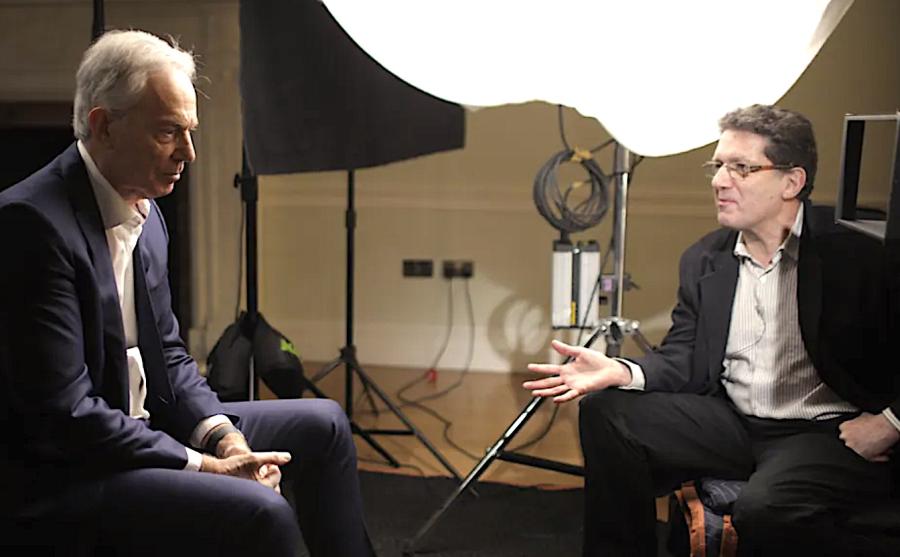
Blair was always a little bit too good to be true, the grinning, Bambi-faced charmer who, it seems, always knew he was destined for the top. Having dazzled the no-nonsense workers of Sedgefield, who might have harboured suspicions about an Oxford-educated barrister, he became their MP in 1983, and it apparently never occurred to him that he wouldn’t become leader of the Labour Party. Neil “we’re alright” Kinnock gave Blair a job in the treasury, where he struck up a close friendship with Gordon Brown. However, it seems Gordo made the fatal mistake of assuming that he was the senior partner and that the leadership would inevitably be his (pictured below, Blair with Michael Waldman).
It was eventually, of course, but by the time the saturnine Brown finally got himself into Number 10 after Blair’s resignation in 2007, Tony’s New Labour magic was proving as vaporous and elusive as an election manifesto. Waldman’s thesis is that it was Blair’s determination to invade Iraq in 2003, in search of Saddam Hussein’s chimerical “weapons of mass destruction”, that fatally punctured his prime ministerial career. Max Hastings pops up to observe that Blair was “morally compromised” by Iraq, but couldn’t see it.
Certainly, after getting Britain involved in wars in Kosovo and Afghanistan, it might have occurred to Blair that this was a campaign too far. The so-called “dodgy dossier” which supposedly proved that Saddam had the dreaded WMDs gets a mention, though his henchman Alastair Campbell accepts no blame, while Blair won’t admit the Iraq invasion was a mistake. According to his wife Cherie, Tony genuinely believed Saddam had the weapons, but Jeremy Corbyn says he thought Blair was caught in a “messianic trench”.
“Messianic” may be the operative word, and the theme of Blair’s religious belief is prominent here. It seems he was particularly influenced by an Australian priest, Peter Thomson, and we see a clip of him describing how “Tony Blair speaks in a prophetic way.” Blair first met Thomson while he was studying at Oxford, and even says that Thomson has been the single biggest influence in his life. It does indeed seem that Blair convinced himself that he was on a moral crusade to do “lasting good” for the world.
He found common ground with US President George “Dubya” Bush, himself a kind of evangelical Methodist. Blair and Bush formed a tight bond after Blair’s wholehearted backing for the US after the 9/11 terror attacks, pledging to stand side by side with the Americans as they supported Britain in World War Two. But, as the blundering Starmer keeps painfully discovering, sauce for the American goose may prove toxic to the British gander.
Still, Blair can point to a number of achievements which were certainly significant, though not always in a good way – devolution, the Human Rights Act, “open borders” immigration, independence for the Bank of England, the Good Friday agreement … and “Cool Britannia”. And there is surely some merit in his contention that “if we’d stuck with strong centre-ground government, we’d be in a much more powerful position today.”