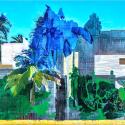
Salvador Dalí’s house at Portlligat on the Costa Brava is straight out of the pages of a lifestyle magazine, its sunbaked white walls dazzling in the sunshine, and light pouring in from every angle. It was a fisherman’s hut when Dalí moved there in 1930, extending it over 40 years like “a true biological structure” to make a home and a place to work for himself and his wife Gala, with every window letting in a view of the sea.
The house is one point of the Dalí Triangle: another is the Gala Dalí Castle at Púbol, not far from Girona (pictured below right). Dalí moved here after the death of his wife in 1982; in her lifetime it was her domain “where she could reign like an absolute sovereign” and in death it became her mausoleum. The final point in this Catalan tour is the Theatre-Museum at Figueres, home to the largest and most diverse collection of works by Dalí, and with its red walls and roof-topping giant eggs, a striking addition to the skyline since its inauguration in 1974.
 It was the house at Portlligat that I wanted to visit, and though a virtual walk was advertised it is actually the Theatre-Museum at Figueres that you can visit online, though a rudimentary 3D experience of both Portlligat and Púbol is available via the Salvador Dalí website. The surrealist artist was born at Figueres, and the theatre, destroyed during the Spanish Civil War, was a part of his childhood landscape, and the location of one of his earliest exhibitions. The rebuilding of the theatre began in 1960, in response to a request from the mayor, who asked Dalí to donate one of his artworks to the town. Characteristically, Dalí pledged a museum, saying: “Where, if not in my own town, should the most extravagant and solid of my work endure, where if not here?”
Crowned with a great glass cupola, the theatre itself forms the heart of the building, a massive, light-filled space dominated by the backdrop designed by Dalí for the the ballet Labyrinth, which premiered in New York in 1941.
Like many virtual tours, this one tends to lurch about drunkenly, and a heavy mouse-finger will leave you gazing disoriented at a ceiling, or nose to nose with a no exit sign. Randomly clicking on rooms unaided by an audio guide leaves you hopelessly underinformed, but you’ll occasionally stumble on something astonishing and often famous, like the painted ceiling in the Palace of the Wind, or the sofa in the Mae West room, modelled on the film star’s lips. Dalí wanted the museum to be a journey into his world, and the abiding feeling is of the pull of the real thing.
- Take the tour of the Dalí Theatre-Museum
- Salvador Dalí website
- Read more Visual Arts reviews on theartsdesk