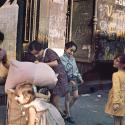
“I forgive you,” he said. “I forgive you… for the bombs.” Spoken by a young Muslim in measured tones that can’t hide his fear, these chilling words recall a random encounter with a stranger.
Written and directed by Imran Perretta and based on his own experiences of growing up in London, the destructors provides harrowing insights into what it’s like to be seen by society as a potential threat, a terrorist in the making. Not long after 9/11, the attack on the Twin Towers has created an atmosphere of suspicion and distrust, which registers on the stranger’s face in an “obscene gaze, full of terror and disease”. The narrator’s response is to “breathe deep; but as I inhale, his toxicity seeps through the gaps in my teeth. I must bear the weight of responsibility for the actions of others. His forgiveness is an unspeakable trauma that touches the deepest part of me... We know what we are accused of, but never what we have done.”
Perretta, who is of Bangladeshi descent, describes the film as a coming-of-age story, an account of how his approaching maturity was matched by an awareness that “my body was perceived as a weapon… The more I grew, the more I became aware of people’s fear of me. I would hear people locking their car doors as I walked by or clutching their purses as they passed me in the street, as if all they were seeing of me was this potential for deviance and destruction.”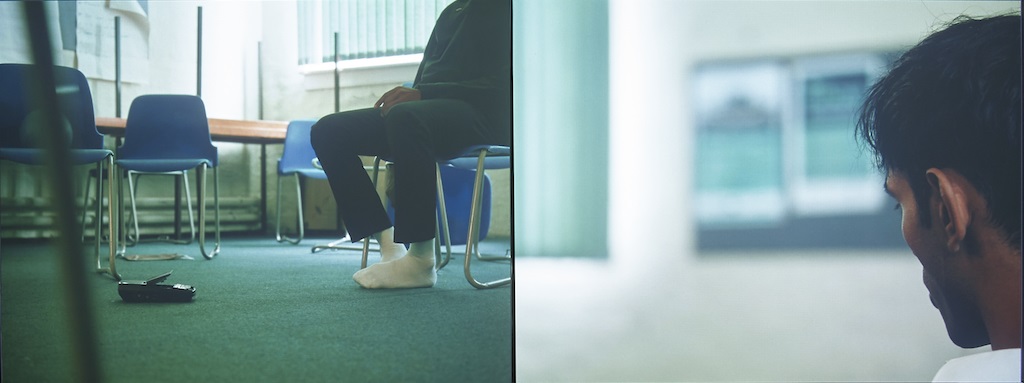 Another young man recalls the time spent caring for his mother during the final stages of her illness, after the NHS had withdrawn its support. “It seems that a brown life can cost too much,” he remarks, “and yet seem so very cheap. When I think of this time, I think of the ulcerous rage.” Fortunately, his mother’s love acted as a healing balm. “The feeling of being loved deep in my marrow,” he says, was enough to counter the “everyday cruelty of a loveless world of endless hostility”.
The film was shot in a Victorian school in Tower Hamlets, now used as a community centre. Serious underfunding has seen the slow decay of the building and a gradual decline in the services offered there and, as local authority support for the community dwindles, the feeling increases of being “underprotected and overexposed”.
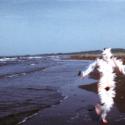
Perretta conveys this sense of vulnerability in several ways. Odd camera angles provide only partial views of each speaker. Faces are cropped so identities are obscured and the narrators seem very close yet strangely distant. The credits are projected onto surfaces that undulate as though blowing in the wind, to create an unnerving sense of a world in flux that offers no stable support. Even bricks and mortar have become permeable; black smoke pours into the community centre through the air vents and, seeping under the doors, water floods the corridor. This is a world under siege.
the destructors could easily have become a rant that made viewers as angry and upset as the protagonists; but Perretta’s calm and measured direction achieves the opposite effect. A glimpse into what it feels like to be a target of other people’s anxieties and fears, the film arouses enormous empathy and helps to counter the paranoia engendered by events like Sunday's knife attack in Streatham.
This perfectly pitched little gem should be shown in schools, colleges, shopping centres, churches and community halls all over Britain.