Khadija Saye was 24 when she died in the Grenfell Tower fire of 2017, the same year that her series of photographic self-portraits showed in the Diaspora Pavilion at the Venice Biennale: she was the youngest artist in a roster of well-established figures such as Joy Gregory and Isaac Julien.
Claiming prescience in art is tricky and probably ill-advised, but still it is true that in the aftermath of Grenfell, In This Space We Breathe directly addressed the outrage of that disaster, in which the right to live and breathe freely at home had been so flagrantly violated. Since then, the murder of George Floyd, and Covid 19 have forced us to confront the inequalities and prejudice suffocating BAME communities, and these events bring new resonance to Saye’s work, currently installed across the façade of 236 Westbourne Grove.
Though only six went to the Biennale, the complete series of nine photographs was produced specifically for the Diaspora Pavilion, a continuation of Saye’s exploration of her mixed faith, Gambian-British background. In each image, the artist is engaged in an aspect of traditional Gambian spiritual practice, the exact nature and significance of which is incomprehensible to anyone outside that tradition.
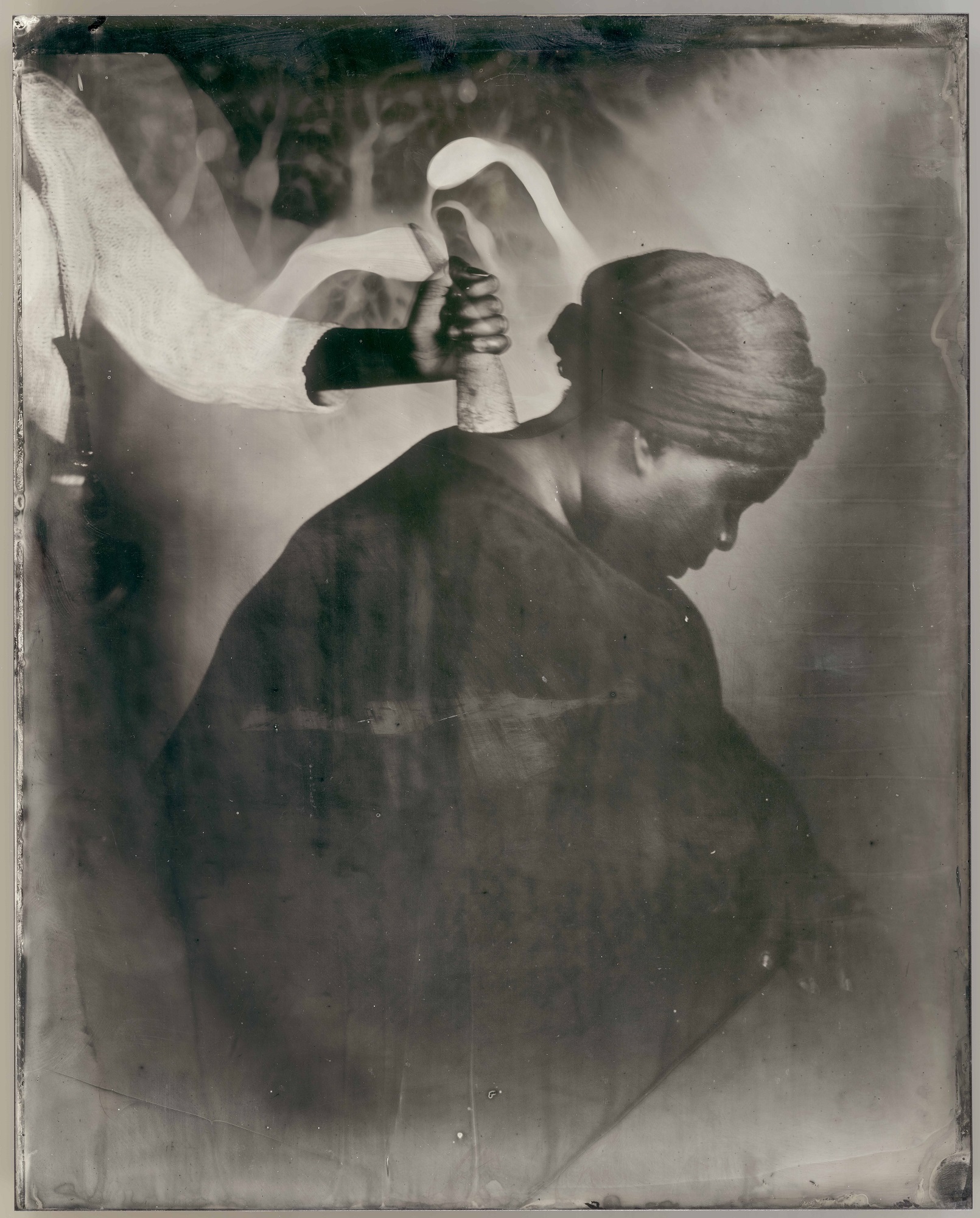 Her chosen medium, the archaic process of wet collodion tintype is an inspired one, its characteristically ethereal, indistinct rendering emphasising the gulf of understanding that will for most viewers make these deeply meaningful rituals entirely meaningless (pictured right: Nak Bejjen, 2017). Redolent of 19th century imperialism, the distinctive aesthetic qualities of tintype place Saye’s self-portraits in a history of the depiction of black people, contributing to a narrative in which "primitive", "exotic" traditions and rituals have been used to justify their subjugation.
Saye’s self-portraits move easily between the historical and universal to the personal, and the mood of each picture changes as she experiments with her cast of props. Sometimes, her eyes closed or averted, she seems to occupy some other persona or mental space; in Limoŋ (main picture), her face is obscured by what looks like a cluster of dark lemons, save for her right eye twinkling next to them, surely conspiratorially.
The challenge to decode props recalls much older traditions of portraiture, and the soft rendering of skin and fabric allows easy parallels with painting. In Toor-Toor, Saye’s direct gaze and decorative headdress recalls Rembrandt’s self-portraits, in which hats enable him to occupy a particular persona.
In This Space We Breathe launches Breath Is Invisible, a new public art project in Notting Hill set up by patron and businesswoman Eiesha Bharti Pasricha, and curated by Sigrid Kirk, to address the issues of social inequality and injustice laid bare by recent events. Later on this summer, Martyn Ware, Zachary Eastwood-Bloom and Joy Gregory will present new commissions created in partnership with the local community.
- Khadija Saye: In This Space We Breathe at 236 Westbourne Grove until 7 August
- breathisinvisible.com
- More visual arts reviews on theartsdesk