The note of longing scored into this exhibition’s title is well-judged: as things are now, it is the sight of the elderly in the company of friends, watching the world go by from a doorstep or park bench, that provokes a pang of nostalgia, far more than the surface details of the mid-20th century, when these pictures were taken.
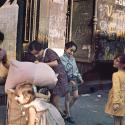
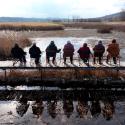
Produced in response to the virus, this selection of 20 photographs by Shirley Baker (1932-2014), focuses on her depictions of the elderly, who blossom under her gently satirical gaze. The online exhibition includes examples of Baker’s colour work as well as her preferred black and white, all of which date from 1960-1985 and were taken around Salford and Manchester.
In different times, the exhibition’s focus on our aged population might seem to risk its audience, but the show, co-curated by Baker’s daughter Nan Levy, reveals Baker at her best, the equal of famous contemporaries like Bill Brandt, and a forerunner of Martin Parr’s bittersweet social forensics.
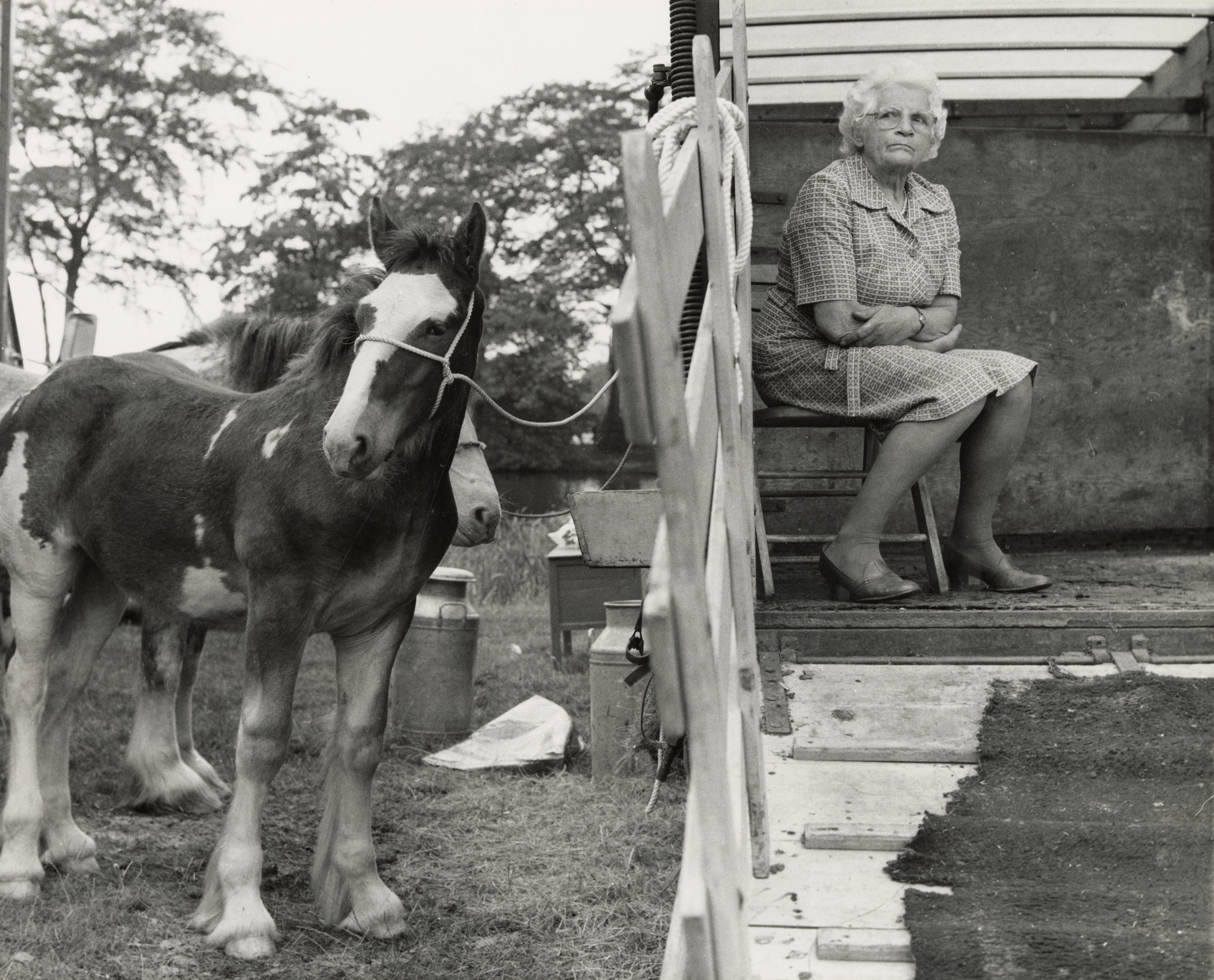 A Woman on a Bench, c.1965 (main picture), holds two dogs on leads, the three of them all looking distractedly away from each other, each wearing uncannily similar facial expressions. A picture taken at some event at Poynton, Cheshire, 1968 (pictured above), shows a horse tethered to a horsebox, inside which his owner sits on a stool. Both wear puzzled expressions, as if startled by something out of shot, and they mirror each other in a way made all the more absurd by their somewhat reversed roles.
Though so often funny, Baker shows us time and again that this tendency to look like others, whether animal or not, is an expression of our humanity, a way for us to connect and empathise with others. In a picture from 1970, two women silently and entirely separately appraise a display of knick-knacks or similar, apparently united in thought and gesture, if not in words. On occasion, Baker’s eye is straightforwardly wicked, and though there are echoes between one set of legs and another, the real point of Untitled Woman and Horse, 1968, is the juxtaposition of a blameless old lady and a horse’s back end.
Signage is also recruited by Baker, adding humour, and an elegant neatness to a view of an open-top car in Chester, parked by what must be the River Dee, its occupant reading a newspaper in oblivious defiance of the signs instructing otherwise.
Baker was a reluctant amateur, unable to join the staff of the Guardian which she said “ran a ‘closed shop’ …, open only to men.” Though we are still largely unfamiliar with her work, Baker is best known for her pictures of northern slums, for which this timely and carefully conceived exhibition offers a valuable corrective.