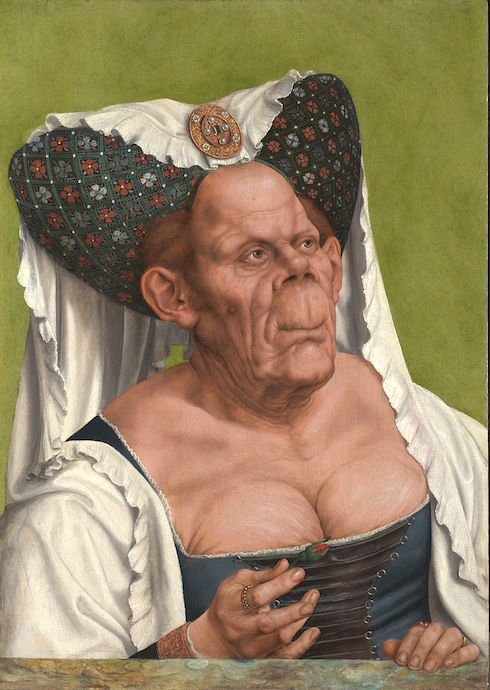
Despite the fact that it’s a cruel depiction of an aging woman, I have always loved Quinten Massys’ The Ugly Duchess (pictured below, left). The Flemish artist invites us to laugh at an old dear who, in the hope of attracting a suitor, has tucked her hair into a horned headdress and decked herself in a décolleté gown that exposes her wrinkled cleavage.
Even in 1513, her ridiculous outfit would have been outmoded. In her hand she holds a rosebud, suggestive of amorous intent; the implication is that this misguided soul has donned her youthful finery in an attempt to regain her lost allure and capture the attention of an admirer.
Ironically, the paint surface across her bosom is covered with a fine mesh of tiny cracks. In a poignant reminder that nothing escapes the ravages of time, the pigment that describes her withered skin has also dried out over the centuries.
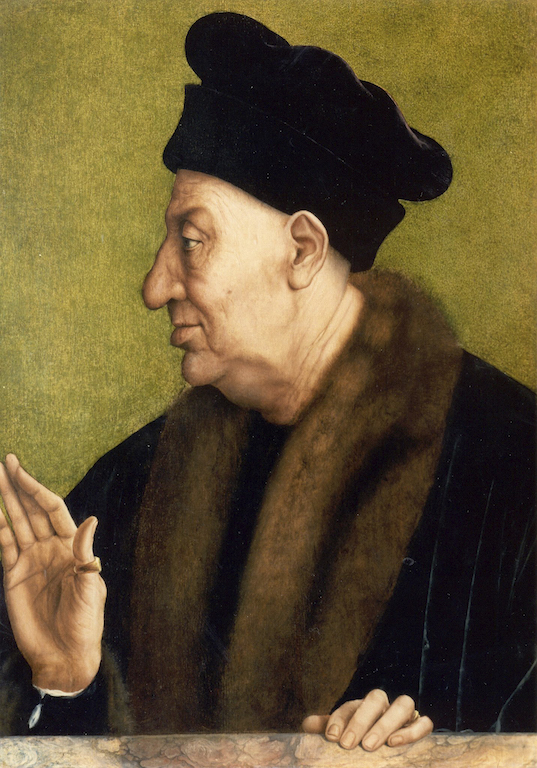
 The National Gallery has reunited the painting with its companion piece, a picture of an elderly man also dressed in outdated attire (pictured below, right). His portrayal is far more sympathetic than hers; he wears a floppy velvet hat whose curves echo his big nose and knobbly jowls, but the joke is understated. Massys resists the temptation to play him for laughs as he does the old woman. Casting a jaded eye towards his would-be seductress, the man holds up his hand, as if to say “Thank you, but no thank you.”
By comparison with the Duchess, he is unremarkable – elderly and dull. So what is it that makes her so endlessly fascinating? Her extraordinary features are all awry; her big ears, snub nose, unusually long upper lip, heavy jaw and turkey neck verge on deformity, yet her brown eyes seem filled with hope and longing. When compared with the woman in Jan Gossaert’s portrait of An Elderly Couple 1520 (main picture), also on show, it becomes clear just how far she deviates from the norm and how brazen her character must have seemed at the time.
The woman in Gossaert’s painting stands behind and to the left of her husband, in the subordinate position reserved for wives. Plainly dressed, she gazes modestly downwards. With his resolute expression and clenched fists, her husband seems poised for action, while everything about her suggests passivity and resignation. Her expectations seem low and, consequently, her face lacks vitality. By contrast, Massys puts his woman in the man’s place and, with her raised eyes and active pose, gives her the initiative; instead of standing placidly by, she instigates a social encounter.
 This could be a factor in why, despite her prominent breasts, I’ve always thought she resembled a man in drag. And according to the display, there may be some truth in my assumption. Massys based his Duchess on the copy of a drawing, which is now lost, by Leonardo da Vinci of an old woman with similarly bizarre features and clothing. But another source of inspiration was probably the "Sausage Woman", a character to be seen cavorting through the streets of Europe during carnival surrounded by Morris dancers. Suggestively waving a pig’s trotter and carrying a string of sausages impaled on a barbecue stick, this matron would have been played by a man in drag and wearing a horned headdress indicative of lascivious ambitions.
One source of the painting’s enduring fascination, then, is the ambiguity of a main character whose meaning may be more complex than at first supposed. What makes the picture so poignant for me, though, is the old woman’s optimism. She has yet to discover just how misguided are her attempts at seduction, since she hasn’t grasped the fact (as true now as it was then) that most old men want partners half their age and often succeed in getting them. Because of a discrepancy she hasn’t understood, she is a laughing stock. Plus ça change.
- The Ugly Duchess: Beauty and Satire in the Renaissance at the National Gallery until 11 June
- More visual arts reviews on theartsdesk