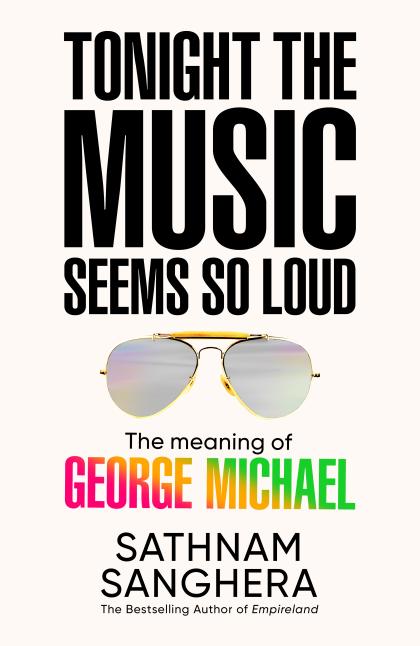
Sathnam Sanghera’s previous books have included a memoir about growing up Sikh in Wolverhampton, and two acclaimed (and very good) accounts of colonialism – so it wasn’t entirely obvious that his next should be a meditation on the life and work of popstar George Michael. But Sanghera, a fan since childhood, sets out to investigate Michael through a number of lenses (including those of “Queer Icon” and “Celebrity”) and to interrogate his own complicated relationship to the star. Not a biography, it instead often feels like an (over)extended magazine feature (Sanghera writes for The Times), but has some insights on, for example, the immigrant experience which the author is well-placed to uncover.
As Sanghera explains, in the 1980s George Michael was not an uncomplicated star for a Sikh youngster to revere. And I can identify with this. At a similar time in history I was a big Prince fan, at a school when, safe to say, none of the other boys were. And like Michael, Prince wasn’t always an easy person to be a fan of. I still remember walking into Woolworth’s to buy the cassette of Prince’s Lovesexy, replete with a fully nude Prince (legs artfully folded) on the cover. Sanghera’s similarly equivocal love of Michael is touchingly explored and is the strongest aspect of the book.
But it takes a long time to get going. An introduction dealing with the cultural phenomenon of Whamageddon is laboured, as is the first chapter. In this, Sanghera sits reverently on the modern version of the north London bus route on which Michael wrote “Careless Whisper” in his head (not even the same route, let alone the same bus), and visits the car dealership which was once a restaurant where he first DJed. Later he goes to the Indian restaurant that used to be Michael’s father’s Greek, and to the Swiss skiing resort where the video to “Last Christmas” was filmed. These episodes provide little revelation or entertainment.
But the book does warm up. The chapter on being a child of immigrants – something common to Michael, his Wham! bandmate Andrew Ridgeley and Sanghera himself – is interesting, as is the chapter about Michael’s control freakery in the studio, one consequence of which is a pretty slim catalogue for a long musical career. In the nuanced chapter on Michael as a gay icon Sanghera is good at weighing up that Michael, once out, was seen as a hero of the gay community, but did stay a long time in the closet (and even at one stage used his “straightness” against Freddie Mercury’s “gayness” in order to secure a tour to China).
When it comes to musical analysis there is really not much on offer: Sanghera is out of his depth and admits as much. But even when he ropes in his friend Jane, boasting a music degree from Cambridge, all she offers is “the magic of his voice takes it to another level”. Likewise the lyrical analysis is superficial: even for this most confessional of songwriters, I don’t think you can just casually pluck lines from songs to explain Michael’s thinking, or the events of his life. It just feels a bit shallow.
Sanghera’s readiness to consider both sides of every aspect of Michael is the strength of the book. Tonight the Music Seems So Loud is not hagiography, although born of fandom. Michael was generous (and often capricious) in donating to charity and supporting friends and family but also very hard-nosed in business dealings, even with Ridgeley. His celebration of his gayness embraced being unashamed about his cruising while in a relationship – but would we celebrate a straight popstar who boasted of casual sexual encounters? Michael does come over well on the whole – his readiness to take the joke on himself is endearing, including appearances on Catherine Tate and Ricky Gervais’s and Stephen Merchant’s sitcom Extras – but there is a real sadness in his ultimate descent into drug dependency and early death.
And for all that he is clearly an important person in the history of 80s celebrity, in particular as a key case study of the appalling way homosexuality was treated in the media of that decade, I fear that Sanghera overclaims for Michael as a musician. Yes his handful of best songs live on through MOR radio and nostalgia streaming, yes he had the ability to write a hit and had an incredible soul voice, but ultimately I am not persuaded his output has him in the first rank of pop musicians. The book sent me to Michael’s post-Wham! output, and, I’m afraid, it’s just a bit thin – polished, but lacking the chutzpah and joyfulness of the early hits. That is not to belittle Sanghera’s fandom, or the devotion that has gone in to this book, which is clearly deeply researched and a passion-project earned by the success of previous books. It’s just that, for all this book is going to be enjoyed by George Michael fans, he wrote his best song at 17 and his biggest impact was done by 23, and he knew it. And that was his tragedy.
- Tonight the Music Seems So Loud by Sathnam Sanghera (Pan MacMillan, £22)
- More book reviews on theartsdesk