Two centuries ago, New York City was a tangled collection of streets on the narrowing southern end of Manhattan island. Expansion pointed only one way, and in 1807 a three-person team proposed it be organised on a grid. They sketched ranks of rectangular city blocks reaching eight miles north, up to 155th street. And with a few alterations of detail – Central Park did not appear on their map – present-day New York displays exactly that rectilinear array.
That satisfying shift from idea to reality makes the New York Commissioners’ plan “the most courageous act of prediction in Western Civilization”, according to the architect Rem Koolhaas. It wasn’t quite that, as Bruno Carvalho points out, in The Invention of the Future: A History of Cities in the Modern World. The plan left nearly everything apart from the grid of streets open, which is probably one reason for its success. It accommodated the advent of whole avenues of skyscrapers, for example, which the builders of 1807 had no possible means to construct. But it reinforces two takeaways from this interesting if occasionally slightly frustrating book. Planning in and for cities has very long-term consequences, so is unusually engaged with the future. And whatever plan is implemented is gradually modified, in large and small ways as technology, politics, and urban lives evolve.
New York’s successful effort at a planned future comes roughly half-way through the period Carvalho treats. He offers entwined histories of ideas about the future, and cities, beginning in Lisbon in 1755. The earthquake that destroyed nearly all the city that year prompted a plan for rebuilding, also with a grid, that serves as a starting point for his commentary on visions of urban futures.
Cities, then and now, are where future-oriented thinking tends to happen. People move to the city to make a new future for themselves, a megatrend that shows no sign of slowing. More than half of the planet’s population are urbanites, and the proportion of city-dwellers looks likely to rise to 70 per cent by mid-century.
The concentration of people creates problems that bring a wish for urban planning. Rapid urban development instils a feeling, largely absent from earlier human history, that things could be wildly different within a lifetime. And densely populated cities make class differences starkly apparent, so future-oriented political movements may take on a revolutionary cast.
The author is a Harvard professor who as a child lived for a while in Brasilia. An entirely new city was an architectural showcase for the nation, but the “rational” layout was soon overtaken by an influx of newcomers living in satellite settlements that were entirely unplanned. Brasilia is dealt with in a few paragraphs in the book, but that formative story of unintended consequences is typical of many of the other histories gathered here.
Carvalho relates them in chapters that cover four or five decades apiece, each weaving together a selection of ideas about the future at the time and glimpses of urban development in one main city, with others brought in for comparison. The mix, along with some choice illustrations, is mostly effective. The material on cities helps illuminate the generally more familiar extracts from futures literature. And his familiarity with South America enriches his narrative – the chapter on 1870-1910 focuses on Rio de Janeiro and that on the 1900s to 1940s on Buenos Aires.
The exposition can be quite dense, a habit amplified by the author’s occasional tendency to head off in several directions at once. The overall narrative that sometimes struggles to become visible amid the detail charts a rise in confidence that cities could be effectively planned, peaking at the beginning of the 20th century.
Like other articles of faith in progress, this confidence faltered after both world wars. Since the mid-20th century it has taken further knocks, often from the effects of allowing cars to dominate city transport planning. In the US especially, they tipped the balance away from vertical development toward horizontal spread: vast tracts of suburban sprawl connected by the newly built interstate highway system (a project boosted by a famous General Motors-sponsored exhibit, Norman Bel Geddes “Futurama”, at the 1939 New York World’s Fair).
More positively, Carvalho brings out how people adapt to cities, but also reclaim their features, old and new, for their own purposes, whatever planners might intend. His comment on Rio applies also to New York, Paris, London or Lagos: “city life produces indeterminate spaces that cannot be computed, previewed or predicted. They remain to be filled in.” This is also part of the appeal for the millions who still head to cities in pursuit of a better future.
The book ends without offering any major conclusions about ways of building more viable urban futures. There is a strong impression the author would like improved mass transit, and fewer cars everywhere (who wouldn’t), but also a sense that he is aware he has taken on a subject that is hard to do justice to in a single book. Any serious consideration of where urban futures are headed now, for instance, would need to say a good deal more about China, home to more megacities than anywhere else.
But perhaps a more comprehensive treatment would not yield greater insight. It is easy to agree with the recommendation to consider past futures when we try and think about how to maintain liveable, sustainable cities in the later 21st century, as we must. But easy, too, to conclude there are few general pointers to success. When Carvalho briefly toys with a global stocktaking in his epilogue, he reports finding “many contradictions, fractured patterns, and simultaneous storylines.” That feels like the most intellectually honest position to hold. The world is complex, and getting more so. So are cities. We can look to the past for pointers on what might work, but every city planning effort must also be open to creating futures that haven’t been thought of yet, and enacted in the knowledge that it won’t turn out quite as intended when the plan meets urban reality.
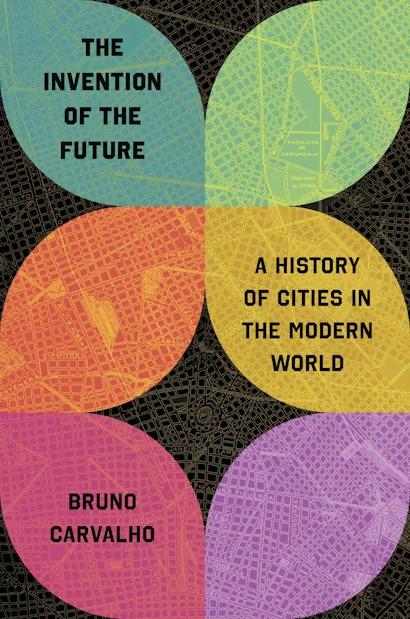
- The Invention of the Future: A History of Cities in the Modern World by Bruno Carvalho (Princeton University Press, £30.00)
- More book reviews on theartsdesk