11am concerts do take some getting used to. The BBC Proms season has no fewer than seven of them this year, three on Saturdays and four on Sundays. And yet, strangely, for this programme, mainly consisting of works for concert band, it did genuinely seem like the right time of day.
This is open-hearted, maybe even community-minded music, and when it is played with the panache, joy and precision that the London Symphony Orchestra’s wind, brass and percussion brought to it, the feeling of morning freshness is undeniable.
That was particularly the case with the opener, Vaughan Williams’s English Folk Song Suite, written for Kneller Hall in 1923, which I can remember rehearsing and playing, revelling endlessly in its earworms, as a teenager. Everything from the LSO was wonderfully crisp and precise, especially some sizzlingly light interventions from the side drum. The candour and poise of James Fountain’s playing of the first cornet part was a particular joy throughout. The Suite is an exquisitely crafted piece, particularly the almost nonchalantly clever interweaving of four folk melodies in the third movement, “March: Folk Songs from Somerset”. 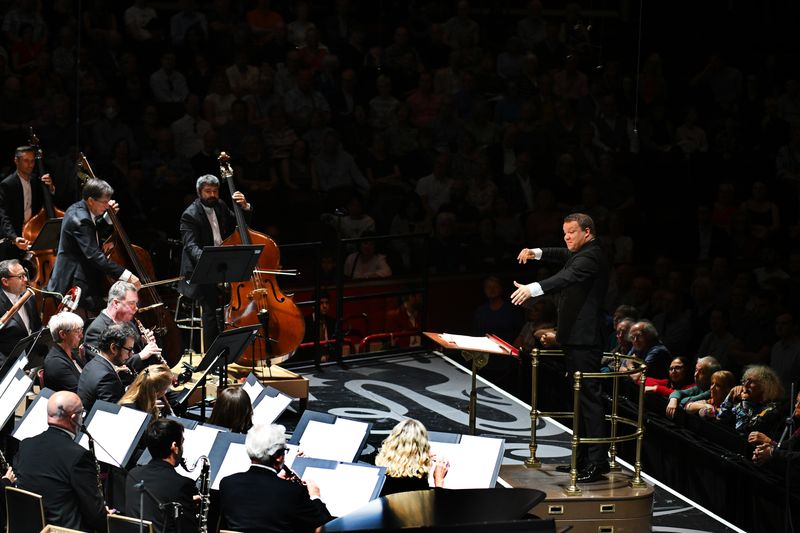 Equally deftly achieved was a less well-known piece, the first set of English Dances which Malcolm Arnold wrote for orchestra in 1950 and were later arranged for wind band by Maurice Johnstone. I know that angry letter-writers don’t normally need any encouragement, but if one of them were to berate Sam Jackson for the fact that an entire Proms season will only have included nine minutes of music by Malcolm Arnold...and what a travesty that is… he or she will definitely have a point. But what a great nine minutes it was: the ease of the first movement, the joy of the second, the inclusion of no fewer than seven clarinets of different dimensions, some wonderful dovetailing of melody between the lower saxes and the french horns in the "mesto" movement. More please...
The last half an hour of the concert was given over to Percy Grainger, works for wind band from various stages of his adventurous life. This music is sometimes carefree, sometimes just busy, briefly irresistible in Country Gardens, melodically inventive in Lincolnshire Posy, but possibly outstayed its welcome.
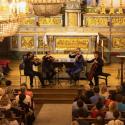
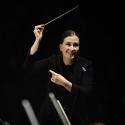
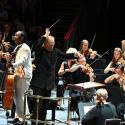
This concert was to have been conducted by Sir Simon Rattle, but he had to withdraw at a few days’ notice for "routine surgery’". His replacement was Ryan Bancroft (pictured above with the players), who seemed very much at home in the repertoire. Bancroft is a brass player, and in his time as a conducting student in Glasgow, he played the trumpet professionally with the BBC Scottish Symphony Orchestra. His relationship with the LSO has definitely got off to a good start, but there was nevertheless one piece which left me wondering whether Simon Rattle might have brought more of his pizzazz or charisma to it, and that was Tippett’s Paraphrase on Music from "The Mask of Time" (1992). Might the trumpets have blazed more brightly? Might the ending have been more fervent? It's impossible to tell. 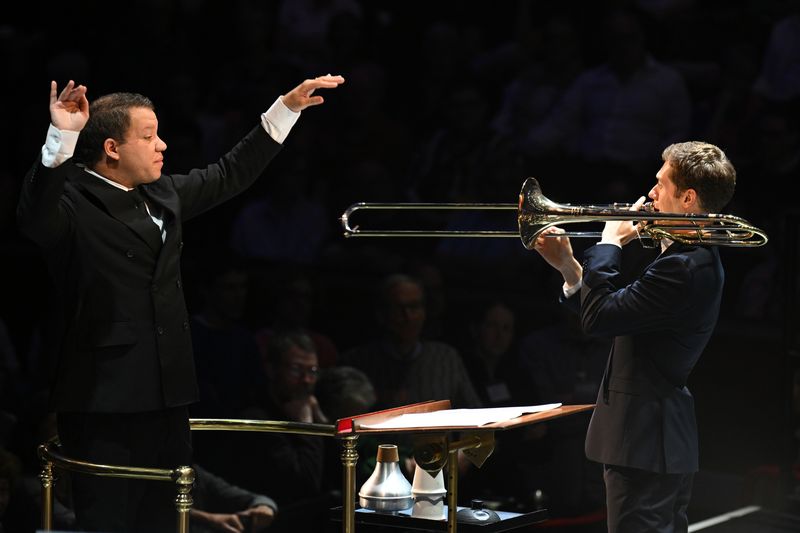 The programme had one curious outlier, the trombone concerto Eine kleine Posaunenmusik (1980) from the American “third stream” composer Gunther Schuller (1925-2015), in which the unifying constant is a repeated reference to a specific tone row. The fact that the orchestral forces are so unusual (including harp and harpsichord) is probably one factor behind the fact that performances are rare, even allowing for the global shortage of trombone concertos. The orchestral writing of the more energetic movements has the spirit of Webern in its sparseness, with vanishingly brief interventions and chirrups from all over the orchestra, and a high-lying and virtuosic solo part.
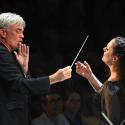
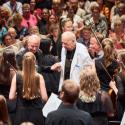
Peter Moore (pictured above with Bancroft) has a gentleness on the instrument which allowed him to make a strong case for the piece. The slow movement, “Chorale”, is extraordinary, with the clarinet section seeming to make an explicit reference the Berg Violin Concerto, and the tantric woodwind writing demands superhuman feats of breath control. Moore also played an encore, “Etudes” for trombone by David Uber; solo trombone is a glorious sound in the Royal Albert Hall.
All sections received deserved and warm applause at the end, especially the percussion. If this concert turns out to signal the start of an annual 11am Proms concert band strand… it can, in all seriousness, only be a good thing.