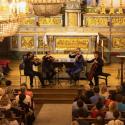
“Let his words resound on high,” sings the choir in the final chorus of The Creation. In King’s College Chapel in Cambridge, it is hard not to want to look up, to admire the splendour of the largest fan vaulting anywhere in Europe. King’s truly is hard to beat as a setting in which to hear Haydn’s oratorio.
And whatever else is going on in the world, there would seem to be a good fit here: the 500-year-old building speaks of dignity, importance, grandeur. And Haydn’s work, on one level at least, lives and breathes the unquestioning affirmation of faith in a God who is “exalted” and “almighty”.
Friday night’s performance of The Creation, sung in English with the text as (sometimes curiously) adapted by Paul McCreesh, was one of the flagship events of this year’s Cambridge Music Festival. The Festival team could probably have sold out this concert at least a couple times more, but it was designed as a one-off, a special celebration which would neither be repeated nor recorded.
The choir of New College had been brought over from Oxford, in order to double the choral forces to more than sixty voices. A chamber orchestra-scale Philharmonia had been specially shipped in from London. And it also happened to be one of the first public events of the reign the new, resplendently begowned Provost of King’s College, former Financial Times journalist Gillian Tett.
As is inevitable with the best-laid plans, real life intervenes. We were made aware in the introductory remarks by the Dean of King's College, Revd. Stephen Cherry, that the Swedish soprano Miah Persson, by far the starriest of the trio of vocal soloists as billed in the programme, was unable to perform and would be replaced by Sally Matthews. And since Cherry happened to be making those prefatory remarks against a loud backdrop of fireworks, they also prompted a jocular reflection from him as to whether – particularly in a city as deeply steeped in its science as Cambridge – the fireworks were there to cast doubt on the Biblical creation story, and to force us think about ‘Big Bang’... either instead or as well.
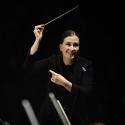
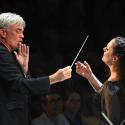
Could it be argued that there is some sort of poetic aptness about a performance of The Creation being be a one-off like this? Not really, because there is another question lurking: how deeply into the work can such a performance really go? In conductor Daniel Hyde’s hands, and presumably with severely limited rehearsal time, it was perhaps inevitable that an element of what Philippe Herreweghe has called The Creation’s “contagious joy and optimism” would go missing. It is probably unreasonable to go on about the type of performance this wasn’t, but I also looked in vain for some of the mischief and fun that a conductor like, say, Nicholas McGegan would have brought to it.
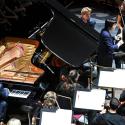
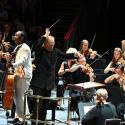
 That said, the ability of London orchestral players to thrive without needing Continental European rehearsal and preparation time is, as ever, a miracle, and the players of the Philharmonia were really getting into the spirit of the occasion. Violinist Jonathan Stone, as leader, was a very strong presence, energising and galvanising the strings. All of the contributions of Sam Coles (pictured above by Guy Wigmore/ Philharmonia) and his golden flute were absolutely spectacular, and I enjoyed some fine moments from the basses, notably some edgily provocative staccato walking in the “Great whales” section. And bass trombone players, given the opportunity to play the famous No. 26 (which they will have practised interminably as an orchestral excerpt), need no encouragement to nail a deep, rude growl to the walls of a resonant building.
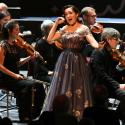
The vocal trio were impressive and affecting. Sally Matthews gave Haydn’s florid, liquid lines real shape and clarity, and her duets with tenor Robert Murray were among the highlights of the show. Murray, meanwhile, was truly relishing and shaping every word of the text with both thought and flair. And I loved the ease with which the sound of James Platt’s sonorous bass was in full harness right from the start of the work, and also the way in which (I think) he chose the devilish option to drop to a final low D on the words in “sinuous trace the worm.”
The combined choirs of King's College and New College Oxford made a strong, balanced and lively sound, but what was surprising was a serious lack of clarity of diction and enunciation. Was there simply not time to work on that, or have things now come full circle from the days of college choral directors such as Bernard Rose who used to forbid any compromise on the clarity of the text?
This was a unique occasion, but, for Haydn’s genius to shine as brightly as it should, The Creation probably needs less seriousness and deference – and more rehearsal time – than this performance was able to give it.
- The Cambridge Music Festival’s celebration of John Tavener 10 years after his death with Daniel Hyde directing the BBC Singers to be broadcast on BBC Radio 3
- More classical music reviews on theartsdesk