Did you wonder what all those creative musicians and artists did when they couldn’t perform in public last winter? Some of them started making films. Putting film of yourself online was, after all, a way of communicating with an audience, and had the bonus of being a potential promotional shop window for your work once people were allowed back in venues again. Manchester Collective, true to their pioneering and resourceful nature, went one step further. They made films, in collaboration with others, whose viewing could happen in a venue as a kind of event in itself.
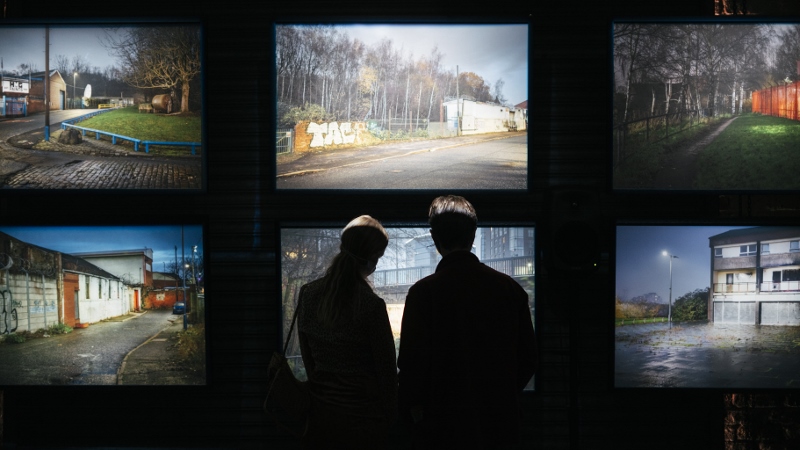
It’s actually a combination of a photography exhibition and a film show, with visitors taken in small groups into The White Hotel, a former MOT garage now occasional night club in that part of Salford that feels like downtown Kampala and nestles in the shadow of Strangeways Jail, to view it (pictured below). The dance is part of the film; the music is previously recorded work by Manchester Collective, the ensemble.
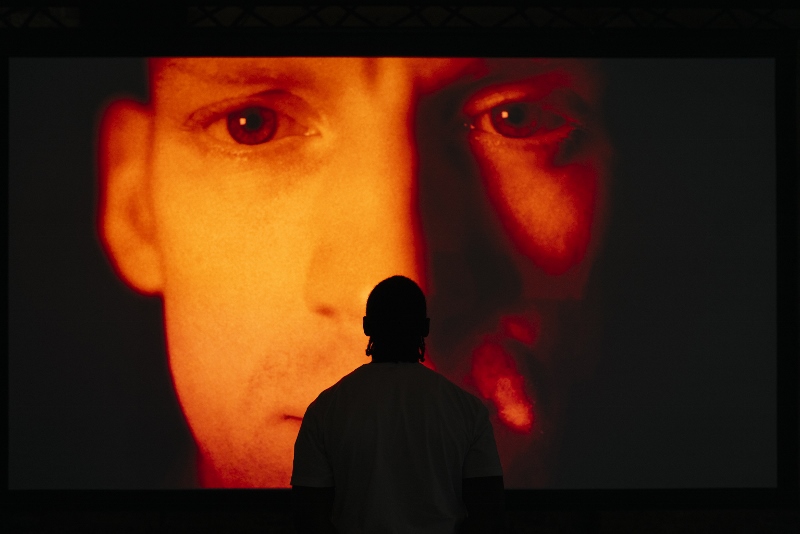
 Collective artistic director and normally leader-violinist Rakhi Singh becomes a silent actress, in scenes made in the dark times of last winter, alongside Sebastian Gainsborough (also known as Vessel) and Ashiya Eastwood, with solo movement artist Blackhaine (pictured below).
The subject-matter? Mancunians might say it’s about finding out where the bodies are buried. There are reputedly 40,000 of them in Angel Meadow, a former slum and cemetery close to the valley of the River Irk in central Manchester. Denizens of Chetham’s School of Music know about the Irk: it flows right under their building (which has watertight barriers in its lowest entrances in case the river floods, as it’s expected to every now and again) just before it joins the River Irwell in the confluence which sited the earliest human habitations of Manchester. Victoria Station sits astride it, and railway lines and viaducts dominate the valley.
 Today this is one of the latest parts of inner Manchester to sprout into high-rise living blocks: the brick and masonry relics of centuries of industrial and social history are still visible beneath. It’s the place Simon Buckley has pictured in eerily beautiful still photographs, using the twilight luminescence of natural and urban light, and it’s the setting for the film he devised and directed.
He writes: "If ever I was going to sense Hades in my city, surely it would be here …" – a reminiscence of Friedrich Engels’ phrase "hell on earth", as experienced on his walks through the area as he developed the ideas that became The Condition of the Working Class in England.
The 30-minute film sees three present-day walkers exploring it at night, and encountering the scary figure of Blackhaine. Is he a ghost from the past? Perhaps. His appearances and their progress are posited against the slow movement from Bartók’s Divertimento, Wojciech Kilar’s Orawa and The Centre is Everywhere by Edmund Finnis, a piece that Manchester Collective commissioned, premiered and featured on their debut CD of the same name: all recorded by the Collective, whose members get their credits at the end.
You make your own narrative. There’s other recorded music as background – and they play us out with that old favourite of urban soundscapes, Ewan McColl’s Dirty Old Town. If there’s a message in the tale, it’s maybe that in Manchester everything changes: Angel Meadow was once a slum and now it’s a grassy open space; Strangeways was once a park and now it’s a prison; The White Hotel was once a garage and now it’s a venue.