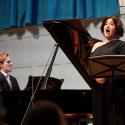
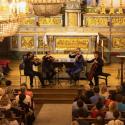
Will she? Won't she? Ooh? Ah? No to the Mazurka? Yes to the Barcarolle? We were an audience on tenterhooks last night as flu-ridden Ingrid Fliter coughed and spluttered her way through her Chopin recital at the Wigmore Hall, chopping and changing her programme every five minutes as her fever came and went. The amassed audience willed her on enthusiastically. London was falling in love with Fliter.
The staggering first half, full of weighty, melancholic Chopin works, begged one question: where was all her power coming from? Here was this pretty, petite Argentinian unleashing torrents of energy, an extraordinary tonal thickness, a richness that never compromised on clarity, that few male colleagues could achieve with six-plus-feet of muscle behind them.
It was quite paradoxical how her touch seemed both freighted with gravity and full of air, limpid and flush with sound. She conjured up the vocal jungles of a polyphonous choir then thinned herself out to a tracery whisper. Often the two ran into each other. Rapid change, the action of the exponential curve, the whip of a scorpion’s tail, lay at the heart of her music-making. As did weight. I’ve seen few pianists able to measure their touch as well as Fliter, and thus make a simple two-note final interval a textural climax, as in the Nocturne in B major, Op 9 No 3.
Of course all of this would be for naught if she wasn’t a very fine storyteller too. Sometimes things unfolded very naturally, as in the Barcarolle in F sharp major, whose shifts in speed provoked a feeling of flying over contoured land; sometimes they proceeded according to a dramatic internal monologue. Both ways it was compelling stuff, so compelling in fact that one completely forgot her musical solecisms, her excessive rubato, for example (something Chopin deplored), which could have driven one mad.
Somehow, Fliter makes things work that shouldn’t. Her slight lack of flight in the final run of the Barcarolle made sense when imagined with such heft behind it. Even when she was wrong, she was usually right. And her ease with the bright jig in the middle of the Mazurka in C sharp minor, Op 50 No 3, boded well for the second half of waltzes.
In fact, it was a bit of a disappointment. Perhaps that fever was finally getting to her. Perhaps she just wasn’t in the mood. Certainly, the party spirit that I had hope for didn’t come. This was a vision of the waltz through the eyes of a depressed teenager. On the one hand there was something quite nicely bolshie and Carmen-like about the rendition; on the other, this, at times, descended into po-facedness.
It was deliberate, of course. She could quite easily have played these as light meringues – as she did in the melodic repeats, offering up delectable doll-like replicas of the hammer-and-tonged originals – but she had chosen not to. To me this was a mistake. These waltzes are insubstantial only if and when you attempt to make them "substantial" in some grand, Beethovenian way. Do this and you flatten their real substance, which is mainly sugary and delightful. Work with, delight and exploit that sugariness and the works will reveal great substance. The considerable, as Jonathan Miller once put it, is to be found in the negligible.
Still, what she was attempting to do was coming through. Her execution, delivery and commitment could not be faulted. Nor could her winning smile, which, when it came out at the end, was like an encore in itself; she chose to provide us with a rendition Chopin's Trois Ecossaises, Op 72 No 3, as well. Her next concert is not to be missed.
- ingrid Fliter's Complete Chopin Waltzes CD
is out now on EMI
- The Wigmore Hall season continues tonight with Kit and the Widow