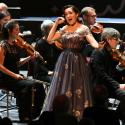
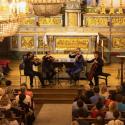
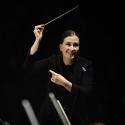
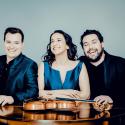
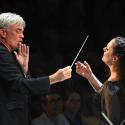
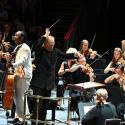
Of all the inventive and enterprising things Manchester Collective do, it’s most often been the playing of a string ensemble led from first desk by Rakhi Singh that’s been the most fundamentally rewarding.
Last night’s concert was further confirmation of that. The formula for other outfits to introduce new music has often been three (or four) standards, with one novelty sandwiched in, on the spoonful-of-sugar principle. The Collective do it differently: they give you three or four novelties, with one standard inserted for recognizability. And in this case the standard (Tchaikovsky’s Serenade for Strings, and in fact two parts only of its four) was interleaved with the new music in their characteristic, slightly mischievous, now-familiar way.
First off came Grażyna Bacewicz’s Concerto for String Orchestra, from 1940. It should be a classic by now, but isn’t, and Rakhi Singh’s welcoming verbal introduction expressed a hope that “we can make it part of the string canon today”. They certainly could hardly have done more to that end, with an assured, energetic opening, illuminating its soaring melodic lines, a haunting presentation of its profound slow movement, and a dance-like romp through its buzzing finale.
The second part of the programme was, if anything, even more powerful. It was offered as “a kind of long-form thing”, beginning with Tchaikovsky’s first movement, then the first of two parts of Caroline Shaw’s The Evergreen (arranged for string orchestra), then Tchaikovsky’s Élégie movement, segueing into the second piece of Shaw’s music, and finally capped by Wojciech Kilar’s almost incredibly rhythmic Orawa. It worked brilliantly – not just because of the richness of the long-bowed playing, exhilaration, élan and exaltation of the orchestra’s opening Tchaikovsky, but because of their instant adaptation to the contrasting sound world of Shaw’s music, with its sustained textures of chordal harmonics (reflected, as they were, at the close of the delicate but passionate Tchaikovsky that followed) and evanescent string-crossing figures. The second Shaw movement builds through slow harmonic change to its own big finish, but that was as nothing compared to the impact of the Kilar work (from 1986). Whatever its programmatic background, the growth of its textures and singing cello solo (Christian Elliott) were endearing. Wave upon wave of rhythmic excitement leading to a pounding conclusion were played with superlative skill and extraordinary impact.
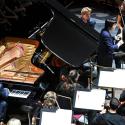
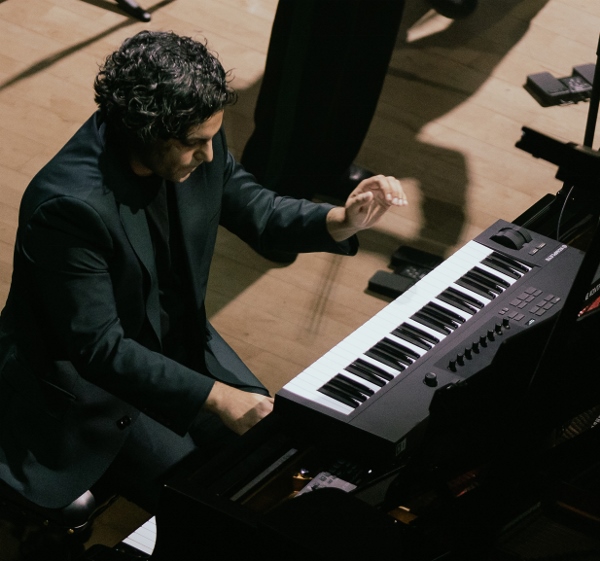 Before all that there was a world premiere: Schiller’s Piano, by Laurence Osborn, a concerto in which the soloist, Zubin Kanga, had a second, electronic keyboard (for sampled sounds) atop his piano [see picture], and the composer supervised the electronic effects from the sound desk at the rear of the stalls seats, while Aaron Holloway-Nahum conducted the acoustic musicians. There is a detailed allusive story behind the title, as Osborn tells us he was moved by the story of how inmates of the Buchenwald concentration camp were made by the Nazis to construct a counterfeit of an historical piano that once belonged to the great poet-dramatist Friedrich Schiller, so that the real one could be hidden away. Only it wasn’t a piano at all, just an empty shell to be put on display instead.
The piece has seven sections, the inner five titled after materials that go into piano-making – wood, brass, felt, wire – and using sampled sounds based on working with those elements. There is also much electronic “ambience” comprised of field recordings. I have to say it helps to have the section titles to identify the materials used in the sampled sounds: scraping, whining, scrubbing and something almost like tap-dancing were the impressions of them purely as aural effects. The rustles, rumbles and birdsong from the field recordings seemed far more prominent, and, since the piano is given much to do also, the complications of the resulting mixes and blendings were considerable. The best impressions (for me) came when the purely musical elements of the composition shone most clearly, through string instruments alone or single-note lines, and as the pianist becomes singer in the quiet and utterly moving contribution of the 1938-written Das Buchenwaldlied, which enters in the next-to-last section. The concert’s title, “Fever Dreams” was an apt reflection of this.
- Repeated at the Southbank Centre, London, 12 October
- More classical reviews on theartsdesk