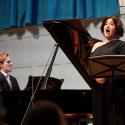
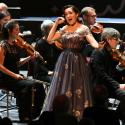
To the great Weill interpreters she summoned at the start of her First person for theartsdesk, from Cathy Berberian to Tom Waits, can now be added mezzo-soprano Katie Bray's contribution. The hour's worth of songs from the German, French and American eras she presented in the perfect Fidelio Cafe setting, the wintry night outside and cosiness within evoking Berlin or Vienna haunts, didn't include everything that's on her new CD, but it all made perfect sense, and saved the most emotional until last.
Bray is a superb communicator, and a generous sharer with her co-artists. The programme fulfils the promise of Weill's Utopia, Youkali, that unattainable place which is the idealistic opposite of Brecht's Mahagonny (where the motto, so pertinent still in 2026, is "here you may have anything, so long as you can pay for it").
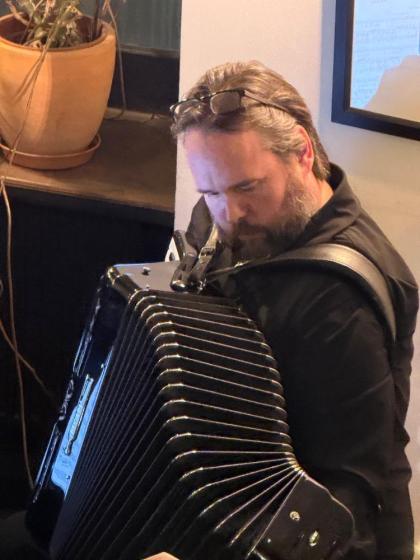
Our chanteuse descended the stairs in a wordless, exotic melisma before launching into the "Barbarasong"; there were also meditations on "Youkali" from pianist William Vann, accordionist Murray Grainger, who can really make his instrument sing, and double-bassist Marianne Schofield, each one of whom could sustain a programme on their own. The finale, a rich presentation of the whole song, drew on Bray's impressive range and came straight from the heart, wringing a few tears from the audience - no mean feat for a modest tango.
The only snag about the live presentation was that more folk in the room needed to understand the text - very important in the case of the "Barbarasong" from the Brecht/Weill Threepenny Opera, though Bray's soft singing in the third verse (where the singer says "yes" to a rough, penniless type) was mesmerising. Another German number would not have gone amiss; I can't wait to hear my very favourite, "Surabaya Johnny", on the CD. Bray did give charismatic context to other numbers, with the first emotional climax coming in "J'attends un navire", one of Weill's songs for Jacques Deval's Marie Galante.
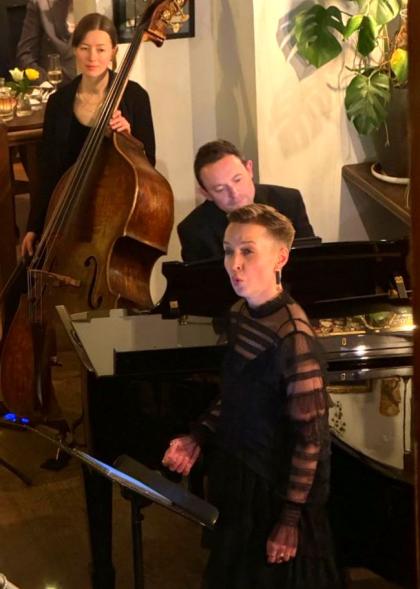
There were two American-era songs unknown to me: the comic and diction-perfect "Apple Jack" and "This Time Next Year" from the unfinished Huckleberry Finn (yes, indeed, lyrics by Maxwell Anderson, but the last is especially poignant given that it was one of the last songs Weill wrote before his untimely death in 1950). As moving, in fact, as the very well-known "September Song", in a magical arrangement played exquisitely by Vann. So much heartache, so much to tell us about the turmoil of a country in ferment and the pain of exile. Bray understands that so well; may we see her soon in the Brecht/Weill "sung ballet" The Seven Deadly Sins.