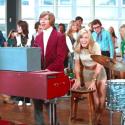
James McAvoy’s directing debut has a plot that’s so implausible, it would probably be laughed out of pitch meetings. But the story is essentially true, as recounted in the 2013 documentary The Great Hip Hop Hoax. “Based on a true lie”, the opening credits announce.
This mad storyline’s two protagonists really were ridiculed when they took time out of their call centre jobs and boarded a bus from Arbroath to London for a record label’s open auditions, only to be dismissed as “rapping Proclaimers”. Their authenticity and nationality derided, they decided to prank the “Scottishist” music industry by posing as a rap duo from Emmet, California. What their experience says about the music industry is the motor of the film.
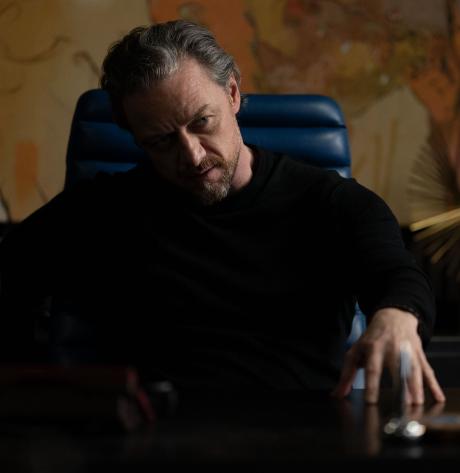
And it moves along nicely as it goes briskly through the familiar arc: the duo’s fumbling first attempts at getting a record deal, breaking through when a scout spots them, impressing the saturnine record label boss Anthony Reed (McAvoy himself, pictured left) and storming it at their first London gig. The downward spiral is a well travelled route too: the increasing offstage hedonism leading to errors in judgment and worse, until they split up, one returning to his pregnant girlfriend, the other deciding to slog it out in London. (He’s still there, whereas his mate in Dundee married his girlfriend and has three children.)
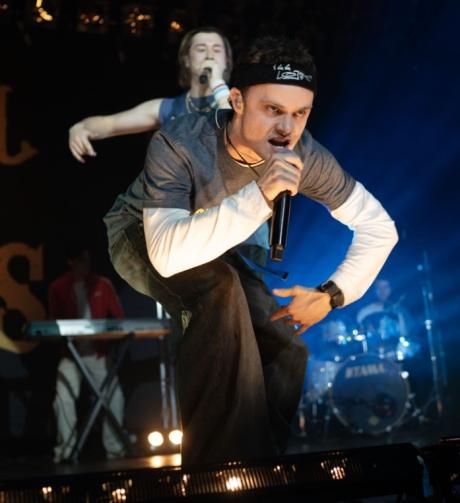
The madcap plot is held together by Seamus McLean Ross as Gavin Bain (pictured below, front, with Sam Bottomley) and Sam Bottomley as Billy Boyd (the rappers’ real names). Gavin is the Liam Gallagher of the duo, mercurial and wayward; he doubts his obvious talent and starts fuelling himself with whisky and recreational drugs. Billy is the more grounded, quick-witted and smart, though even he strays with one of the hangers-on that he and Gavin, now reborn as “Silibil N’ Brains”, inevitably attract.
For dramatic purposes, the script has to reduce the pair’s odyssey through the music industry to a form of shorthand that compresses its workings a bit too far beyond belief. After a near-miss with a posey “suit” played by James Corden, sitting in front of a trough of M&Ms (ho-ho), the two land a record deal in one brief meeting with a sceptical Reed. Then, seemingly just days later, an appearance on MTV and a gig at the venerable Glasgow venue Barrowland, supporting the Detroit rap outfit D12, miraculously appear. Only at the movies. Yet the basics of this story are true: having lived as punky “Californians” 24 hours a day, honing their accents and devising a back story, the two managed to sustain their phoney IDs for three years. They were dropped by Sony Music UK only when it started shedding personnel and pruning its talent roster; the film’s version is necessarily more climactic.
There is a nice streak of acid humour in the script (credited to Bain, Boyd and Elaine Gracie), especially its approach to “Scottishist” attitudes. Billy notches up sales by adopting a smooth English accent, but neither man is keen to cross the border to “where the English are”. They try to sell their act to London-based labels over the phone (from a phone box: they don’t have a landline, let alone a mobile phone) but invariably get through to a bored receptionist. When Billy tries to cheer up a despondent Gavin, he tells him “It’s not the end of the world”, but, for Gavin, being back in Arbroath is just that. McAvoy adds a reminder of what’s possible for enterprising Scots with a giant Trainspotting mural on a wall near the duo’s homes, of Ewan MacGregor emerging from his toilet; the next time we see it, somebody has daubed “It’s shite being Scottish” next to it, and eventually we see it all being painted over by men from the council.
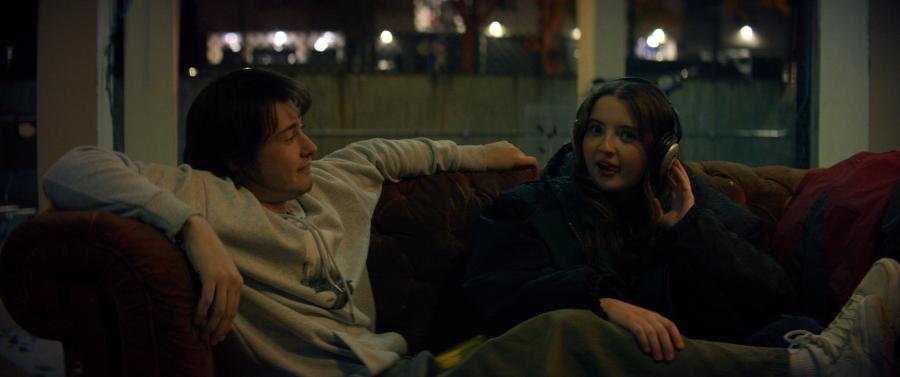
At the heart of the film are two dynamic performances, Ross a jittery livewire, Bottomley the wisecracking captain of this ramshackle ship. The rat-a-tat rapport between them is entertaining, as is their stage act, a gutsy rap that sounds somewhat like Eminem (a prime force in early D12, with whom the real Silibil N’Brains reportedly toured). Their Puckish energy is offset by the tart commonsense of Billy’s girlfriend Mary (Lucy Halliday, pictured above, right, with Sam Bottomley).
Mary is also a 3D counterweight to the cookie-cutter recording industry types, who typically talk in platitudes and splash stupid amounts of money around. The sole sympathetic character down south is Tessa (Rebekah Murrell), the scout who becomes the men’s champion. She knows in her industry it’s a case of “Black music, white management” and has squared this circle by the end of the film.
McAvoy has landed on a great subject here, though it has emerged as more of a feelgood film than perhaps the material suggested. He has evolved into our most exciting stage actor; with luck his next directing project will be an even more challenging one.