

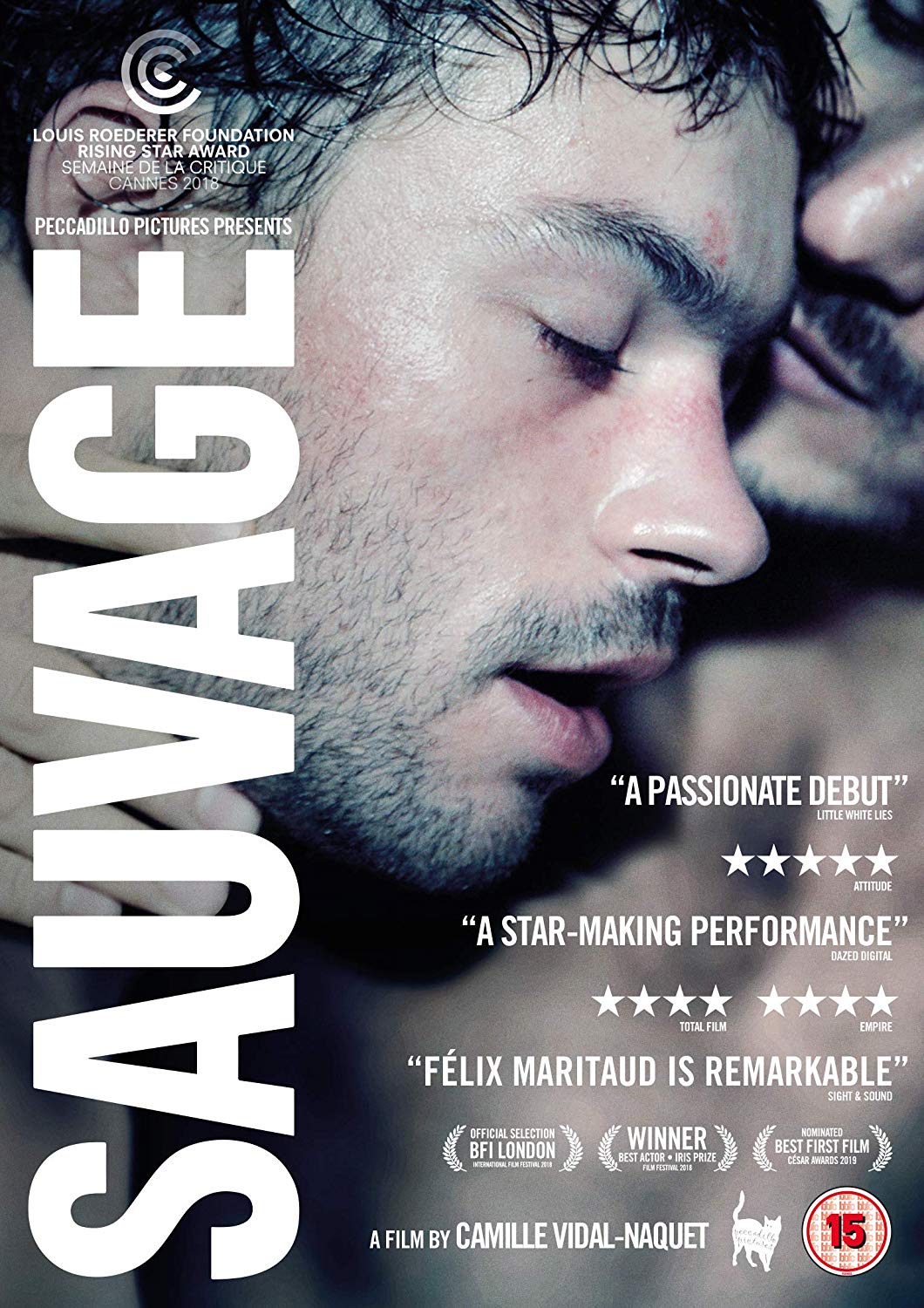
Anyone who saw Félix Maritaud playing the angry activist Max in Robin Campillo’s Paris ACT UP drama 120 BPM will certainly remember him (main picture). He came to the film as a non-professional, from an arts student background, and builds on that performance to deliver a visceral central role in Sauvage, the feature debut of another French director, Camille Vidal-Naquet.
Such directorial restraint keeps our attention firmly on Léo himself: there are no supporting plot strands and he appears in every scene, but though he’s in company much of the time, Maritaud’s performance brings home his striking solitude. At one point he’s asked – by a woman doctor who is trying to help him: she’s the only female presence in the film, the sympathy with which she treats him similarly unusual – why he doesn’t have a mobile phone. “Who am I going to call?” he replies, declining to talk about anything from his past, family especially. To her offer of medication to help him get off drugs, he answers with equally nonchalant incomprehension, indifferent to his physical well-being even though his lifestyle has clearly already taken its toll.
 But there are moments when the animal vigour at which the film's title hints bursts through: when things are going well, there’s an almost rockstar swagger to his step, and his face opens up in a winningly lopsided smile. He scavenges, almost ferally, for food, laps at the streams of water that course the streets, and it's there that he often ends up sleeping, seemingly oblivious to his surroundings. But most of the time he’s getting on with the distinctly mundane business of selling himself, whether to passing trade at a roadside cruising area or with pick-ups, older men, at the clubs where he manages to lose himself, hungrily, in strobed electro dance beats. Such experiences vary, ranging from unusual cruelty to moments of rare tenderness, both offered and given.
For Léo’s emotional needs are raw, though he seeks attachment in hopeless directions. He pursues a fellow hustler, Ahd (Éric Bernard), with whom he has established an element of genuine friendship – it’s captured in a long interior scene, all brown hues, that takes us into the Arabic community in which the latter lives – but his demands for real affection are rejected with increasing brutality (like a dog, Léo keeps going back for more). Vidal-Naquet follows the arc of his subject’s self-destruction with considerable narrative accomplishment, before new circumstances, and a different kind of contact, appear to offer him a way out – only for Léo’s character, all his rebellious assertion of independence that's surely linked to childhood damage, to assert itself again. The final scenes take Sauvage to a different plane, albeit offering little clue as to its protagonist’s future: they evince a rare beauty – all the more powerful for what has preceded it – that suggests a retreat to some more primal world, though what this strange presentiment may be suggesting is something the director leaves disconcertingly open.
The extras here give revealing context to the film, including an interview (“Writing Sauvage”) with Vidal-Naquet, in which he talks of how he approached the milieu that he depicts in the film, via a Paris charity, while stressing that Sauvage isn’t a film concerned with social issues as such. Interesting to learn from Maritaud (in “Playing Leo”) that the three films the director asked him to watch as preparation were studies of isolation – the Paul Newman-starrer Cool Hand Luke, Amos Kollek’s Sue Lost in Manhattan and, of course, Agnès Varda’s Vagabond, to which Sauvage, sharing its sense of a lonely, precarious existence on the edge of society, is a natural successor.
Interesting, too, that Vidal-Naquet stresses that there was very little improvisation in the film, despite its fluid handheld style. Other supplementary material has the director remembering screen tests – experiments with light, film format, even technical details such as zooms – with his cinematographer Jacques Girault, as well as discussing deleted scenes with editor Elif Uluengin. It offers perspective on the process of bringing a film together, but also drives home just how central Maritaud’s performance is to the result. It will be fascinating to see what actor and director alike move on to after a film as striking as this one.
Watch the trailer for Sauvage


