Sir Ernest Shackleton's Imperial Trans-Antarctic Expedition, which set out in 1914 only to be marooned until August 1916, was a failure but a “glorious failure”, in the words of one crew member, the meteorologist Leonard Hussey. It is also perhaps the greatest survival story ever told.
In a legendary feat of perseverance, Shackleton kept a crew of 30 men alive for almost two years in brutal conditions – and on a diet of penguins, seals, and their own sledge dogs – after his ship, Endurance, became trapped in pack ice and sank in the Weddell Sea.
“I have marvelled often at the thin line that divides success from failure,” pipes up Shackleton’s AI-generated voice, reading from his journal South, at one point in this National Geographic documentary film bearing the ship’s name, directed and produced by wife-and-husband team Elizabeth Chai Vasarhelyi and Jimmy Chin (whose Free Solo won the 2011 Oscar for Best Documentary Feature), along with Natalie Hewit.
It was a line that Shackleton himself, an Anglo-Irish carpetbagger and former merchant seaman whom Robert Falcon Scott invalided off his 1901 polar voyage, was always stepping over. Yet Endurance is a story of failure that ends, upliftingly, rather like Shackleton’s itself, with a kind of success. (Pictured below: Ernest Shackleton)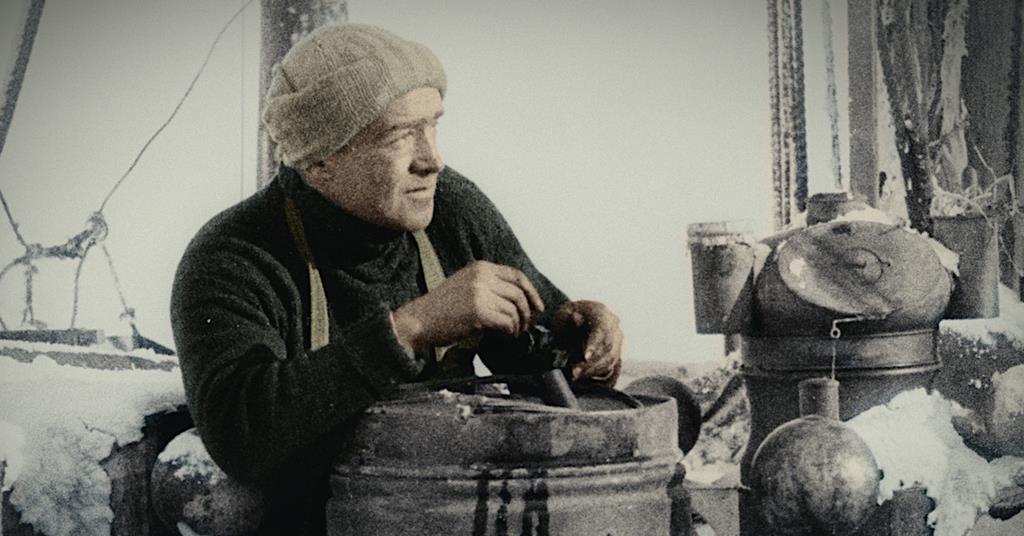 The film juxtaposes his doomed expedition with another Antarctic mission that happened a century later: the hi-tech logistics hunt in 2022 for the wreck of the sunken vessel, which is eventually discovered intact 10,000 feet under the sea.
Just as the Endurance22 team of modern-day explorers deploy the latest cutting-edge undersea search technology to locate one of the most famous shipwrecks of all time, so the film’s trio of directors use a lot of newfangled cinematic tools to prevent this oft-told story from getting trapped in narrative pack ice.
Remarkable celluloid footage of the expedition, taken by the Australian photographer Frank Hurley, has been restored by the British Film Institute, colourised by the filmmakers, and then augmented by sometimes off-putting AI recreation of Hurley’s voice, along with Shackleton’s and Hussey’s, taken from actual recordings and passages in the adventurers’ journals. There are also dramatic reconstructions of various nail-biting moments that Hussey failed to document, some of them original, though some “courtesy of other storytellers”, as the film’s end title rather oddly notes.
The film’s trick of intercutting between the stories of two different Antarctic expeditions occasionally pays off, revealing something deep and buried about the wreckage of human character – its tenacity, for example: John Shears, the 2022 expedition leader, confesses that his motivation in becoming one of the greatest British Antarctic explorers was the fact that his Devonian grandmother never got to see the world beyond Exeter.
The final discovery of Shackleton’s three-masted ship lolling on the seabed, three thousand metres down, yields some compelling images and 3D laser scans, even if the moment of discovery itself – cue hi-vis hugging and backslapping and cries of “brilliant, absolutely brilliant!” among the boffins – can’t avoid a certain sinking feeling of bathos (appropriately the Greek word for “deep”).
Interestingly, even after Endurance, Shackleton had one more failure in him: he died of a heart attack in 1922 on the island of South Georgia after returning to the Antarctic for a last hurrah. Vasarhelyi, Chin and Hewit end their film with an uncanny coda, Shears addressing the Endurance22 crew by the remote graveside where Shackleton was buried on 5th March 1922, exactly 100 years to the day before his lost ship was found again. Shears’s voice breaks slightly, in a way that AI-generated ones never do, as he signals this achievement