Sharing a mentor in Guillermo del Toro and even a basic plot with Bayona’s film, Hierro ticks all the boxes, but lacks the dramatic lightness of touch that made its predecessor so chillingly successful. Named after El Hierro – the smallest of the Canary Islands, and Europe’s southernmost point – the film maps the collapse of marine biologist Maria (Elena Anaya) from sanity to all-consuming madness. Travelling by ferry to El Hierro with her small son Diego (Kaiet Rodriguez), Maria falls asleep and wakes to find him gone. Refusing to accept her loss and possessed by the need to find both Diego and the truth, Maria returns to the island where the drama plays out to its violent and inevitable conclusion.
In sacrificing complexity of plot for psychological depth, Ibanez has created a film that lands in the long grass between schlock horror and art house. Its restrained 89-minute run time feels long indeed, and cruelly exposes the approach of the final twist – or what would be a twist if it weren’t quite so, well, untwisty. Padding the places where plot ought to be with a series of atmospheric episodes, we explore in turn the obligatory morgue, dodgy motel and even dodgier caravan park. Heavy-handed homages are evident here; Lynch, Cronenberg, Kubrick and del Toro all get a nod, and it is Lynch in particular whose signature is all over the opening car crash sequence.
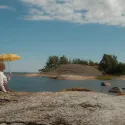
There are redeeming features. When not tied to the apron strings of genre convention, Ibanez makes some interesting and unsettling choices. Mirroring his heroine’s love of swimming and the water, he deliberately refuses to give either the story or viewer any sense of geographical or emotional home. We move from the underwater tunnels of an aquarium to the transitional space of the ferry, and thence to the barren volcanic island, where people live in greenhouses, caravans, hospitals or motels, but no one – least of all Maria – is truly rooted. We are left suspended in his narrative like the floating bodies of the opening credit sequence, denied the security of solid ground to anchor ourselves to once the descent into madness begins.
Elena Anaya’s Maria is well-judged – easily a match for El Orfanato’s Belén Rueda. As the only fully developed character, she faces the difficult task of summoning emotion not from dialogue (functional at best) but vision episodes that place her in alternative and increasingly surreal fantasy scenarios. Jungian symbolism is brandished here with the relish most horror directors save for carving knives – an odd element in an otherwise ruthlessly literal film, and one that jars not a little.
And then you have the reveal, the moment of Great and Powerful Oz exposure. It is shocking (if not unexpected) and distressingly potent in its sheer banality. Hierro spends so much of its time glancing towards, or hinting at, the other-worldly, yet its true blood and guts horror is only to be found in the closing moments of everyday, mundane brutality.
Redeemed by the elegance of Alejandro Martinez’ cinematography and Elena Anaya’s emotional conviction, this first feature is a watchable addition to the ever-growing canon of Spanish horror, but one whose chills are too slowly gained and too quickly forgotten.
- Find UK Hierro screenings here
- Watch short film Maquina by Ibanez on YouTube
Watch the Hierro trailer