Alfred Hitchcock isn't the only director who appeared in his own movies - François Truffaut, Orson Welles, Martin Scorsese and M Night Shyamalan are among many others who have done the same - but he is by far the one who has done it most frequently. He appeared, to the best of film historians' knowledge, in 39 of his 53 films.
It's not definitively recorded why he did it - ego, necessity, habit, superstition, a private joke, perhaps all of those - and biographers differ in their views. What we do know is that he appeared in full shot, profile, blink-and-you-miss-it walk-by, or even, in Lifeboat (1944), in a newspaper advertisement. Whatever the reason, Hitchcock fans have had huge pleasure over the years trying to spot his distinctive presence, which is why, when the joke was established, he started making his appearances early in the first reel - to make sure that once viewers spotted him, they could get down to the business of watching the actual film.
He had a few cameos in his British films but from Rebecca (1940) onwards appeared in all his Hollywood movies. The earliest recorded ones were in the same film, The Lodger (1927), where he appeared in two scenes, in a newsroom and in a crowd watching an arrest. He also appeared twice in Suspicion (1941), Rope (1948), Under Capricorn (1949) and Frenzy (1972), but the rest of his cameos were one-offs.
 Most of the cameos were, for obvious reasons of ease and disguise, in crowd scenes. But he made an effort to mix it up - the newspaper ad, for example – and other devices he used included having his back to camera sitting in a hotel lobby in Torn Curtain (1966) and The Man Who Knew Too Much (1966); posting a letter in Suspicion; and leaving a pet shop with his (real-life) two terriers in The Birds (1963). And in three films he had musical instruments: he was seen coming out of a lift with a violin case in Spellbound (1945), carried a cello off a train in The Paradine Case (1947) and boarded another with a double bass in Strangers on a Train (1951).
Occasionally he did more than waft through the background, and almost took part in the narrative. In Notorious (1946) he drank Champagne at Claude Rains' party, and in doing so helped to reveal the film's maguffin (some wine bottles are filled with uranium); in Stage Fright (1950) he turned to look at Jane Wyman, whose character is in disguise, after he has walked past her; and in Rear Window (1954) his character turned to camera, as if to say something.
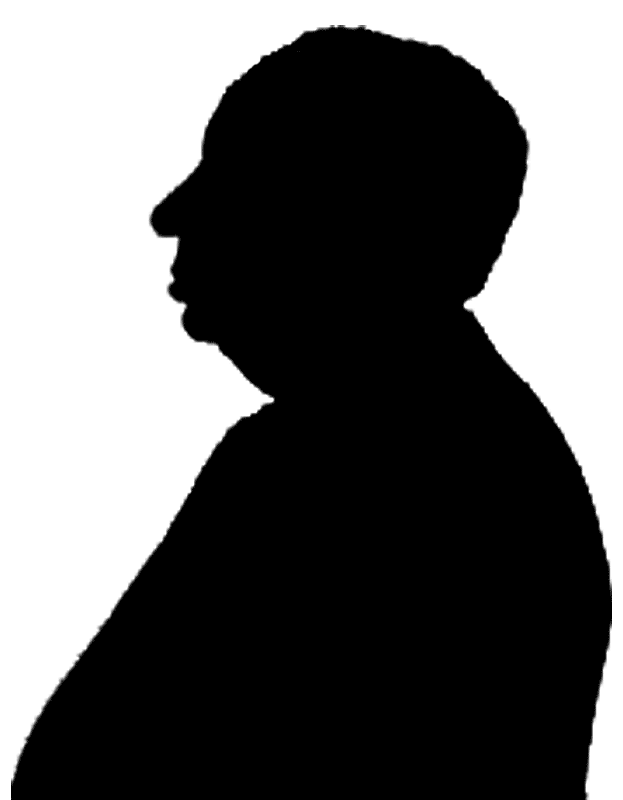
Perhaps his most iconic appearance was merely as a silhouette in Rope, later reprised in a slightly different way in Family Plot (1976). It became his trademark, and formed part of the title sequence of Alfred Hitchcock Presents, the television show of mysteries and melodrama he fronted for seven series between 1955 and 1962.