“The ocean is our home… Even in my next life I will dive again,” says Geum Ok, one of a band of female divers from Jeju, a volcanic island 60 miles south of the Korean peninsular.
Sue Kim’s documentary follows these brave Haenyeos as they plunge into the chilly waters to harvest sea urchins, conch, abalone and octopus. Wearing only a wet suit, mask and flippers, they descend into the depths, holding their breath for minutes on end before surfacing to store their catch in floating nets.
It’s hard work and extremely dangerous, points out Soon E Kim, a member of the committee tasked with preserving this traditional way of life. “At five meters the water pressure is like a giant blue glass pushing you down,” she says, “and, emerging, you must break through the glass with all your strength. Repeat this process 300 times a day and your head pounds.”
Strong currents are another hazard. “When they find Haenyeos dead at sea”, she observes, “their nets are always full. It’s as if death lured them with the bait of luck and the day they died, they’d found the jackpot.”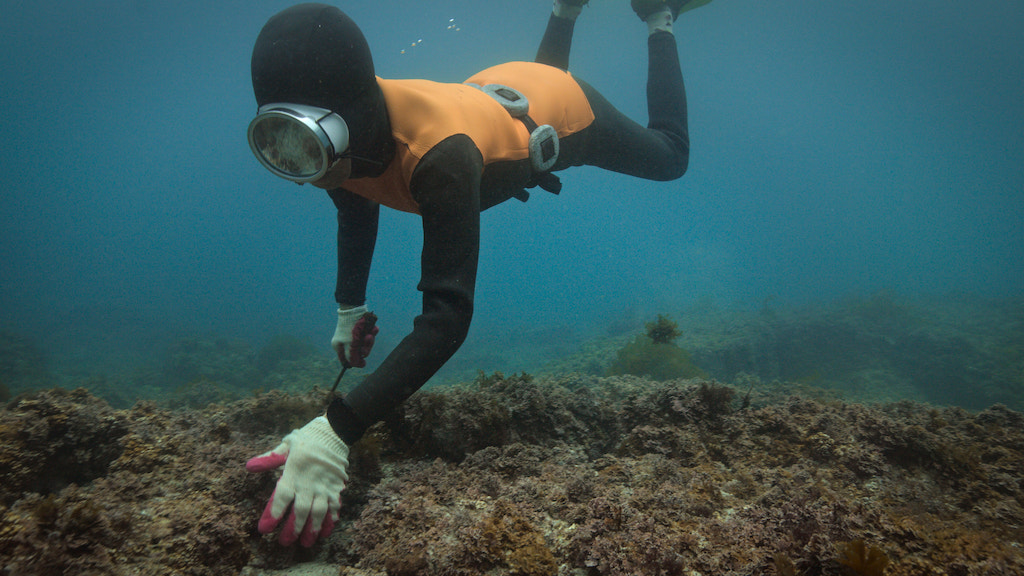 Yet the women, most of whom are in their 60s, 70s and 80s, are determined to continue. “Being a Haenyeo is a calling”, explains one of this intrepid gang. “As Haenyeos, the ocean feeds us and feels like our mother’s arms. It's more than that, though. Haenyeos are guardians of the sea; we have protected the oceans for hundreds of years.” They also help and protect each other and, from their high spirits and good humoured banter, it’s clear that a strong bond unites them.
On Jeju Island they’ve opened a school to encourage youngsters to join the profession, yet numbers are rapidly falling. In the 1960s there were 30,000 Haenyeos working, now about 4,000 are left many of whom have been at it for 50 years or more.
All is not lost, though. 157 miles away on Geoje Island, two young women have become Haenyeos and are posting videos on Youtube to spread the news. Until she was 25, Sohee Jin worked in an office, but always felt tired and burned out. “Since becoming a Haenyeo,” she says, “I feel comforted and soothed working in nature.” The glamorous Jeongmin Woo started diving when her husband’s business went belly up. These young divers may have become celebrities, but year on year their catches are down because of climate change and they are keen to alert the public to this worrying trend.
And another threat looms on the horizon. News arrives that the Japanese government is planning to release radioactive water into the sea from the decommissioned Fukushima nuclear power plant. The film follows the Haenyeos, young and old, as they join forces to organise protests. And it’s heartwarming to see the love and respect growing between the different generations as they join forces. Haenyeo, Soon Deok Jang is invited to Geneva to address the Human Rights Council of the UN. Kim accompanies this brave woman, who has rarely left her village on Jeju Island as, on arrival after a 13-hour flight, she struggles to learn enough English to make her speech.
Her contribution generates a lot of attention, but the protest fails and in August 2023 the pumping of radioactive water begins. The determination of these strong women to protect their traditional way of life is, nevertheless, inspiring. And Soon Deok Jang has the last word: “Just an old woman and the sea forever,” she affirms defiantly.
- The Last of the Sea Women now available on Apple TV+
- More film reviews on theartsdesk