Anyone who has seen Lee Miller’s photographs – those taken of her in the 1920s when she was a dazzling American beauty, those she took as a World War Two photojournalist – and read about her extraordinary life will have thought: this will make a great biopic.
Unfortunately, it’s precisely because those photographs have become so familiar that Lee was destined to be a frustrating film. We know what Miller looked like from the pictures taken of her by the likes of Edward Steichen, Man Ray, and David Scherman. It’s hard not to have those images in mind when watching the also familiar Kate Winslet portray Miller on screen. It's hard, as well, to be convinced by the movie, especially the 1977 scenes in which Winslet plays the 70-year-old Miller with none-too-subtle ageing make-up.
The main narrative recreates in detail how Miller came to photograph the war: ruined cities, the concentratrion camps, an abandoned train full of corpses, French women humiliated for sleeping with Germans. Anyone who knows Miller’s iconic and widely reproduced photographs has them in their mind’s eye as each dramatic scene unfolds before the decisive moment when the shutter clicks. We watch Miller setting up the shot (she poses in Hitler’s bathtub with the mud of Dachau on her boots), only to be disappointed by the re-creation. It’s not quite the uncanny valley effect, but it’s close.
 Lee is the star-producer's long-nurtured passion project. When Winslet was making Eternal Sunshine of the Spotless Mind in 2004, its cinematographer, Ellen Kuras, gave her a book about Miller, whom she thought resembled the actress, and whose extraordinary journey she thought would appeal to her.
Miller had been a fashion model in New York before moving to Europe, where she joined the haute bohemian circles of Man Ray, Picasso, and Paul Éluard and became a gifted photographer. By 2018, Winslet had a script to show Kuras and asked her to direct it as her first full-length fiction film.
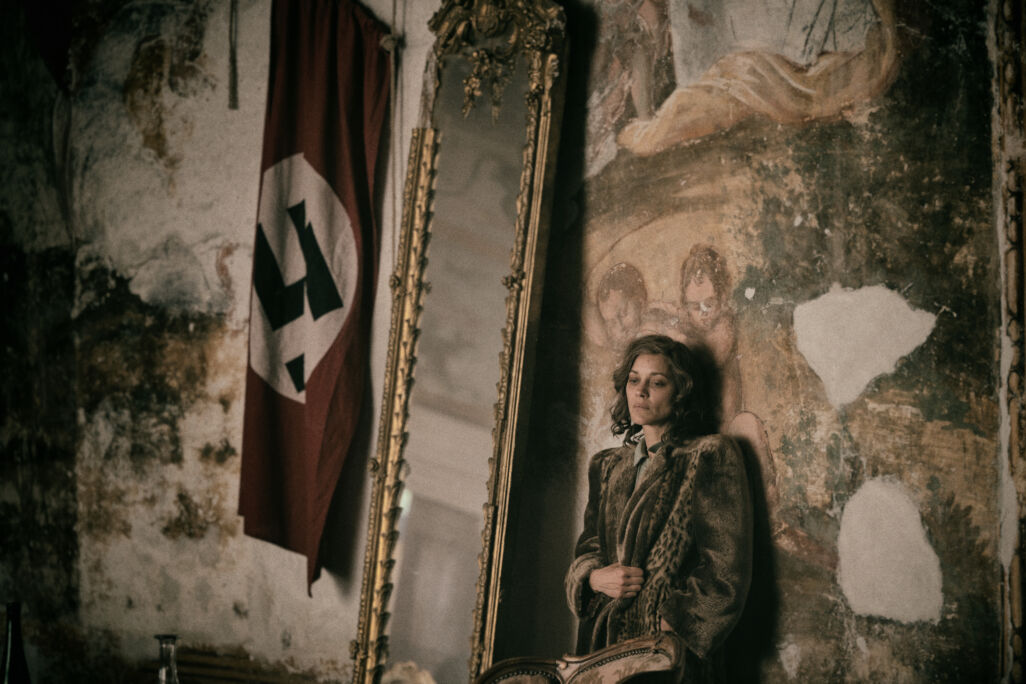
Funding was hard to raise, even with stars from film and television attached. Andy Samberg plays Miller's fellow photographer and sometime lover, David Scherman; Alexander Skarsgård takes the role of her artist husband, Roland Penrose. Marion Cotillard (pictured above) cameos as Solange d'Ayen, the aristocratic fashion editor of French Vogue, who was imprisoned for being in the Resistance. Andrea Riseborough plays Audrey Withers, British Vogue's 1940s editor, who encouraged Miller to become a war photographer. It’s a stellar cast, obviously drawn by Winslet's conviction.
Despite her own star power, Lee didn’t get the budget needed for a film that roams from the enclaves of high glamour to war-torn cities and the death camps, and that stretches over decades. Clearly, a lot of effort has gone into art direction, costumes and make-up, but it's not quite good enough to tell a convincing story.
It’s not the fault of the images – Kuras is a wonderful cinematographer (who’s worked with Spike Lee, Martin Scorsese, and Mary Harron), and she hired the exceptional Pawel Edelman (The Pianist) to shoot Lee. The filmic look is fine, but there’s something off about the locations, coupled with an overly didactic script, that breaks the viewer’s attention.
The film’s biggest problem is the weary framing device that has a young man interviewing the ageing Miller about her life. Even the twist at the end, which reveals that the interviewer (played by Josh O’Connor with his trademark pout) isn’t some opportunistic journalist, doesn’t make these scenes work. It's best to stick to the excellent documentaries that have been made about Miller, her photographs, and the fascinatiing books about her written by Anthony Penrose, her son.