Accustomed as we now are to superheroes who can change size and shape, fly at nuclear speeds, levitate ships and vibrate themselves through walls, a bloke wearing pedal-pushers and jumping out of trees might be considered a bit of an under-achiever. Nonetheless Tarzan is back yet again (more than 200 Tarzan movies have been made since 1918), and Warner Bros are doubtless hoping to kick off a new big-budget franchise.
If so, it's not a promising start. One of several damaging mistakes was casting Alexander Skarsgård (son of Stellan) as the simian-friendly protagonist. It must have been hard going doing most of his acting in front of a green screen – in a lot of the stunts you're seeing Skarsgård's face digitally pasted onto a CGI body – but he lacks any depth or definition as a character, and isn't so much strong and silent as bland and amorphous. He does have some dialogue rather then just grunting "Me Tarzan, you Jane", but it's hardly Aaron Sorkin.
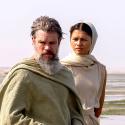
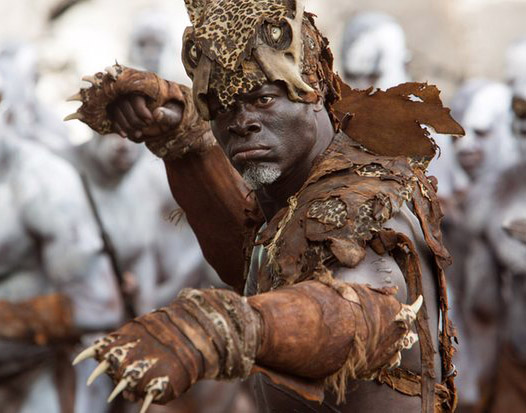 Margot Robbie, It-babe of the hour, fares slightly better as his wife Jane, since they've given her a bit of wit and a splash of feisty independence. That being the case, it's a shame they didn't build up her part a bit more, because she could certainly have handled it. There are also quite enjoyable turns from Christoph Waltz as the unspeakable Belgian empire-builder Leon Rom and Samuel L Jackson as an American adventurer called George Washington Williams, while Djimon Hounsou simmers with menace as Chief Mbonga (pictured above right). But by and large, the players are secondary to the scenery and the effects, and these are sometimes startlingly unconvincing, like the patently ersatz shots of the Belgian fleet lying off the Congolese port of Boma.
All that aside, The Legend of Tarzan feels as if it's caught between the old colonial era in which it's set and the modern consciousness which it has tried to splice onto it. The plot turns on an attempt by Belgium's King Leopold (via the unscrupulous Rom) to convert the Congo into a giant slave-labour camp and strip it of its mineral wealth, though this is being kept secret from the outside world. Tarzan, currently living in England under his civilian identity of John Clayton III, Lord Greystoke, turns down an invitation from King Leopold to visit the Congo to see the allegedly benign works he's carrying out there. However, Williams, a veteran of the American Civil War and the murderous Indian wars, has got wind of what the Belgians are really up to. Wracked by premature pangs of post-colonial guilt, he persuades His Lordship to help him investigate. Little does he realise that part of Rom's fiendish intent is to capture Tarzan, at the behest of Chief Mbonga (below, Margot Robbie with Jackson and Skarsgård). 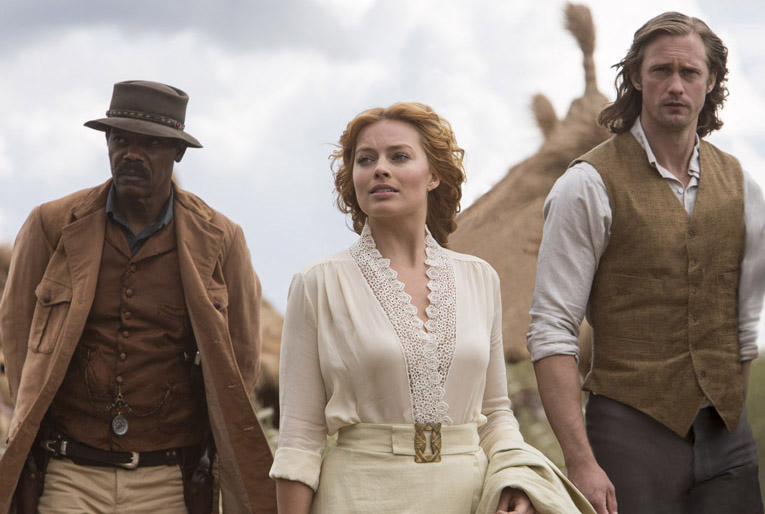 Try as one might, it's a struggle to keep a straight face as Tarzan, returning to the land where he was raised by a family of gorillas, indulges in hugs and nuzzles with a pride of computer-generated lions (they're old pals from his past, Jane confides), and treks back into the jungle to re-bond with the understandably sceptical great ape community. As for the scenes where Tarzan and Jane revisit the neighbourhood where they first met, and are hailed like returning gods by the delighted local tribesmen, these radiate an excruciating air of patronising, paternalistic smugness. Given the current international climate, with its cultural and racial sensitivities and identity politics, you have to wonder if the studio had all their ducks in a row when they greenlit this project.
Director David "Harry Potter" Yates has made the implausible claim that Williams – who was a real historical character, but wasn't in Edgar Rice Burroughs's Tarzan books – is "the real hero of the movie", as if parachuting in a black character advertising his anti-colonialist sentiments was enough to wreak a virtuous transformation of the entire project. But not even the great Sam Jackson can single-handedly pump all the water out of this sinking ship.